

The biggest property data platform isn’t automatically the best fit for your business. The best property data aggregator for realtors brings the records you need into a workable process and makes it clear where those records come from.
If you’re piecing together parcel, ownership, listing, HOA, or risk information across different sites, research can quickly become time-consuming. A polished dashboard also doesn’t guarantee complete or current coverage. A missing record or unclear source can matter when you’re preparing a property review or explaining findings to a client.
This guide compares property data platforms by coverage, source information, workflow fit, and reporting tools. It looks at how enterprise databases, agent-focused tools, consumer platforms, and specialized research options differ, and what to check before relying on a record. You’ll also see where a focused platform such as WithEasement may fit, depending on whether its coverage and data layers meet your needs. The goal is to find useful property information efficiently, then understand its limits before sharing it.
Key Takeaways
- Choose the best property data aggregator for realtors by matching its coverage and tools to the properties and questions in your workflow.
- Check source attribution, update practices, parcel matching, and record completeness before relying on a platform’s results.
- Compare public-record portals, title-research tools, data APIs, and aggregator platforms by their intended users and the outputs you need.
- Test candidate platforms with representative properties. Track missing records, conflicting fields, search time, and report usability.
- WithEasement offers specialized property research tools for supported properties. Confirm coverage before relying on the platform.
What Is a Property Data Aggregator for Realtors, and What Should It Do?
A property data aggregator gathers information from multiple sources and organizes it in one searchable platform. Depending on the provider, it may include parcel details, public records, listing data, ownership fields, or map-based risk layers. The aim is to make research easier to navigate, not to guarantee that every field is complete, current, or legally conclusive.
Sources may include assessor and recorder records, MLS feeds, and a provider’s own data or analytics. The Multiple Listing Service (MLS) is one possible source for listing information, but it isn’t a substitute for public property records. A useful aggregator makes its coverage and sources understandable, so you can judge whether a result is relevant to the question you’re researching.
Which property information matters in a realtor's workflow?
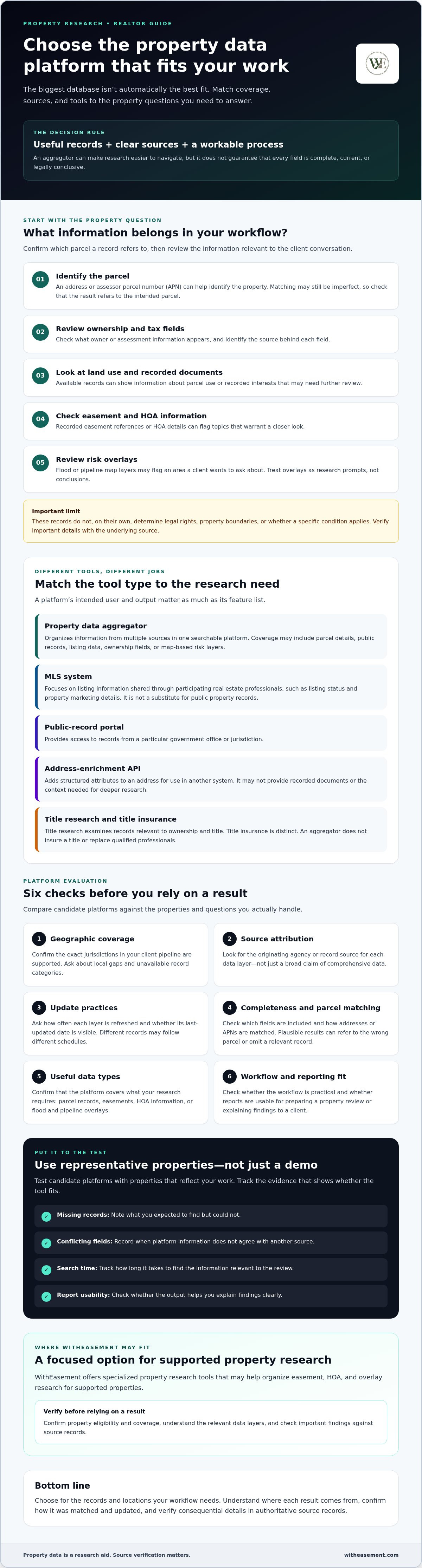
Start by confirming the parcel. An address or assessor parcel number (APN) can help identify which property a record refers to, but matching may still be imperfect. Then consider which information will help you prepare for a client conversation:
- Ownership and tax fields: What owner or assessment information appears in the available records, and which source provides it?
- Land use and recorded documents: What do available records show about the parcel’s use or recorded interests?
- Easements and HOA details: Are there recorded easement references or HOA information that warrant further review?
- Risk overlays: Do flood or pipeline map layers flag an area the client may want to ask about?
These records can help identify follow-up questions. On their own, they don’t determine legal rights, property boundaries, or whether a specific condition applies. Check the underlying source when a detail matters.
Aggregator, MLS, title search, or public record portal?
Each tool serves a different purpose. An MLS system focuses on listing information shared through participating real estate professionals, such as listing status and property marketing details. A public-record portal provides access to records from a particular government office or jurisdiction. An address-enrichment API typically adds structured attributes to an address for use in another system. It may not provide recorded documents or the context needed for deeper property research.
Title research is a separate process focused on examining records relevant to ownership and title. Title insurance is distinct as well. An aggregator may bring selected records together, but it doesn’t insure a title or replace the work of qualified professionals. Treat summaries and overlays as research aids, then verify important findings in authoritative source records.
Coverage depends on the platform’s supported locations, the identifiers it can match, the sources it uses, and how often those sources are updated. Ask which jurisdictions and data layers are included, how records are matched to parcels, and whether you can see when each layer was last refreshed. A specialized platform such as WithEasement may help organize easement, HOA, and overlay research for supported properties. Confirm property eligibility and check source records before relying on a result.
How to Evaluate the Best Property Data Aggregator for Realtors: Six Checks
Compare platforms against the properties and questions you actually handle, not just their feature lists. These six checks can show whether a tool suits your workflow and explains its limitations.
- Geographic coverage: Check that the exact jurisdictions in your client pipeline are supported. Ask about local gaps and which record categories are unavailable.
- Source attribution: Look for the originating agency or record source for each data layer. A general claim about “comprehensive data” isn’t enough to assess a specific result.
- Update practices: Ask how often each layer is refreshed and whether you can see its last-updated date. Different records may follow different schedules.
- Record completeness and matching: Check which fields are included and how addresses or APNs are matched to parcels. A result can look plausible yet refer to the wrong parcel or omit a relevant record.
- Useful data types: Confirm that the platform covers what your research requires, such as parcel records, easements, HOA information, or flood and pipeline overlays. U.S. Census Bureau housing data can add housing and demographic context, but it doesn’t replace parcel-specific records.
- Workflow and terms: Test address and APN search, map navigation, exports, and report readability. Check whether reports show sources, dates, and caveats, then review support options and membership terms.
Treat feature counts and uptime claims as questions to investigate, not proof that a platform’s property records are complete or reliable. Evaluate the results for the properties and records you need.
How can realtors verify data quality and coverage?
Choose properties you know and compare platform results with the relevant authoritative records. Note missing fields, conflicting details, and records that don’t appear. Ask which jurisdictions and record categories are included or excluded, and how the platform identifies each layer’s update date. Repeat the check across different property types or locations in your pipeline.
Which workflow features save time without obscuring limitations?
Search for the same property by address and APN, then confirm that both routes lead to the intended parcel. Review maps, summaries, and PDFs as if you were sharing them with a client: are sources, dates, and limitations easy to understand? For a focused option, explore WithEasement property research tools and confirm that the property is supported before relying on results.
Property Data Aggregators Compared: Match the Tool Type to the Job
These tools can all return property-related information, but they don’t answer the same questions. Start with the research task, then compare the tool categories and their typical outputs.
| Tool type | Best suited to | Typical records and scope | Typical output |
|---|---|---|---|
| Public-record portal | People checking a record at its source | Records held by a specific assessor, recorder, or other public office; scope is usually tied to that jurisdiction | Search results, record images, or downloadable documents |
| Title-research tool or service | Title professionals and transaction workflows requiring specialized title research | Records and findings relevant to title work; scope depends on the provider and assignment | Title-focused search results or work product, according to the service |
| Property data API | Developers, brokerages, and companies connecting data to their own systems | Address-linked attributes or property fields; coverage and depth vary by provider and dataset | Structured data delivered for integration, rather than a ready-to-share research report |
| Aggregator platform | Agents who want to search and review multiple property-data layers in one interface | A selected mix of parcel, public-record, listing, or map-layer data; coverage depends on the platform | Search results, maps, summaries, or reports, depending on the tool |
When is a public-record portal or title tool the better fit?
Go to the relevant public portal when you need to inspect an original document or confirm an entry with the responsible office. You may need to search several offices to assemble a fuller picture. Title research serves a distinct professional purpose and shouldn’t be replaced by an aggregator summary. For questions about market conditions, NAR research and statistics can provide broader context, but it isn’t a substitute for parcel-level records.
When does a property aggregator make more sense?
An aggregator can suit early-stage research when you want to search a property, view available data layers on a map, and organize findings into a report without moving between as many interfaces. That breadth can help with orientation, but a layer summary may offer less detail or source context than the underlying record. Check whether each result links to its source and shows relevant dates or limitations.
Choose an API when your team needs data to flow into a custom system. Choose an agent-facing platform when direct property searches and readable outputs matter more. For supported properties, WithEasement combines address or APN search with recorded easement information, HOA data, flood and pipeline overlays, AI summaries, and PDF reports. It’s a research aid, not title insurance or a substitute for reviewing source records. The best property data aggregator for realtors is the one that fits the task, coverage, and level of verification your workflow requires.
A Realtor's Practical Checklist for Choosing and Testing a Platform
Use the same test for every platform. Select representative properties from your client pipeline, then run the same searches and questions through each tool. This makes gaps and workflow friction easier to compare than feature lists alone.
What should a short platform trial test?
Include properties with known public-record details and, where possible, different addresses or parcel types. Search each by street address and APN. Compare the results with relevant authoritative records, and note mismatches instead of assuming the platform’s result is correct.
- Coverage: Did the platform return results for each property and jurisdiction? Record unsupported locations and missing record categories.
- Sources and dates: Are source references and update dates visible for each relevant layer? Check whether the information answers a real client question.
- Search and maps: Did address and APN searches identify the intended parcel? Could you interpret the map without losing important context?
- Reports: Generate an example report if available. Check whether it’s clear, shareable, and explicit about sources, dates, and limitations.
- Time and conflicts: Record how long common tasks take and flag fields that conflict with source records or other results.
Keep your notes in a simple comparison sheet. A platform that saves clicks may still create extra work if its reports omit caveats or its parcel matches need frequent correction.
What questions should you ask before paying for membership?
Get clear answers before choosing. Ask which jurisdictions and data layers are included, where each layer comes from, how often it’s updated, and how limitations appear in search results or reports. Confirm what membership access includes, whether multiple users can use it, what reports are available, and what cancellation terms apply. If an answer is vague, ask for a specific example or written clarification.
For WithEasement, verify that the properties you research fall within its supported coverage and confirm the current membership features and report details. Its address or APN search, property research tools, and PDF reports may suit a workflow that needs those records, but source records still matter.
Make the decision based on what you observed: proceed if coverage, sources, and outputs meet your needs; request clarification if a gap or limitation is unclear; or reject the platform if essential properties or records aren’t supported. This is a practical way to identify the best property data aggregator for realtors in your workflow, rather than choosing the tool with the longest feature list. Explore WithEasement Membership and research tools to assess whether they fit your property coverage needs.
Is WithEasement the Right Property Data Aggregator for Your Workflow?
WithEasement may suit real estate professionals who regularly research recorded easements, HOA information, or property risk overlays and want those tools in one property-research workflow. Search by street address or assessor parcel number, then review available map layers, AI-powered summaries, and downloadable PDF property reports.
Coverage is limited, so confirm that each property you need to research is supported before joining. Fit depends on both property eligibility and the specific records your work requires. If your client pipeline includes properties in different jurisdictions, check coverage for each location instead of assuming the platform will return data for every address.
What WithEasement Membership brings into one research workflow
Membership provides access to the platform’s research tools. For a supported property, you can review recorded easement information and HOA data alongside available flood and pipeline overlays. AI summaries can help you scan information, while PDF reports provide a downloadable format for organizing findings and discussing them with clients.
Use summaries and reports as research aids, not legal determinations. Check displayed sources and relevant underlying records before treating a finding as confirmed or sharing it as definitive.
Who should consider another tool or verify coverage first?
Start by checking property eligibility. If you need research for properties outside WithEasement’s supported coverage, confirm availability before considering membership. If broad national coverage is your primary requirement, compare tools that explicitly support the jurisdictions and records you need. If you need title insurance or a survey, look to providers of those separate services. WithEasement is a property research platform, not title insurance or surveying, and it doesn’t replace source-record review.
The best property data aggregator for realtors is the one that matches the records, coverage, and reporting needs of their actual workflow. If WithEasement’s focus aligns with yours, explore WithEasement Membership and confirm platform fit before signing up.
Choose a Platform That Fits Your Property Research
The best property data aggregator for realtors isn’t simply the one with the most features. Choose a platform that covers the properties you handle, shows where its information comes from, and makes important limitations clear. Test it against known records before relying on results or sharing them with clients.
For professionals whose properties fall within its supported coverage, WithEasement Membership brings address or APN searches together with recorded easement and HOA information, available map overlays, AI-powered summaries, and downloadable PDF property reports. Coverage is limited, so confirm that your properties are eligible before signing up. Use the platform as a research aid and verify important details against source records.
Explore WithEasement Membership and check whether your properties are covered. A practical comparison can help you choose tools that support your workflow and make findings easier to explain.
Frequently Asked Questions
What is the best property data aggregator for realtors?
The best property data aggregator for realtors is the one that supports the locations, records, and reports your workflow needs. Compare coverage, source attribution, update practices, parcel matching, and how clearly the platform flags gaps. A specialized tool may suit a focused research task better than a broad platform. WithEasement offers address or APN searches, easement and HOA information, available overlays, AI summaries, and PDF reports for supported properties. Verify coverage first.
How do realtors compare property data platforms?
Test each platform with the same properties and client questions. Search by address and APN, then compare results with relevant authoritative records. Record missing fields, conflicting information, source details, visible update dates, and the time required for common tasks. Review a sample report for readability and clear caveats. Before choosing, confirm that the tool supports the jurisdictions and record types you need, and check membership access, user permissions, support, and cancellation terms.
Can a property data aggregator replace a title search?
No. An aggregator organizes selected property information, but it doesn’t replace specialized title research or title insurance. It may help surface records or questions for further review, but a summary isn’t a legal determination. If a transaction requires title work, use the appropriate title professional and process. For important findings, inspect authoritative source records and confirm that they refer to the correct property before relying on or sharing the information.
What information should a realtor property data platform include?
Choose records based on the questions you need to answer. Useful categories can include parcel identification, ownership or assessment fields, recorded documents, easement references, HOA information, and relevant map overlays such as flood or pipeline layers. Check whether the platform identifies its sources, shows update dates, and explains coverage limits. Search and reporting features matter too: address or APN lookup, clear maps, and readable reports can help organize research.
Are property data aggregators nationwide?
No. Coverage varies by platform, data layer, and jurisdiction. A provider may offer broad address attributes while lacking specific recorded documents or overlays in some areas. Check coverage for the exact properties and record categories in your workflow rather than relying on general claims. WithEasement has limited geographic coverage and isn’t a nationwide data service. Confirm that each property is supported before considering membership.
How accurate are AI-generated property summaries?
Accuracy depends on the records and data layers available to the platform and how the summary interprets them. Treat an AI summary as a way to review information efficiently, not as verification or a legal conclusion. Check cited sources, dates, and underlying records, especially when details conflict or could affect a client conversation. WithEasement offers AI-powered summaries, but users should verify displayed records and understand the summaries’ limitations.
What is the difference between property data aggregation and address enrichment?
Address enrichment typically adds structured attributes to an address, often for use in another system. Property data aggregation organizes information from multiple sources into a searchable research platform, which may include parcel details, recorded records, or map overlays. The two can overlap, but they serve different tasks. If you need to review easement references or property-specific layers, confirm those records are included rather than assuming an enriched address provides full research context.


