

Falling in love with a spacious Poway property often comes with a costly blind spot: hidden association restrictions that surface only after escrow opens. Conducting an accurate Poway HOA lookup before writing an offer changes that dynamic completely. It replaces guesswork with immediate, parcel-level clarity.
You already know the frustration of waiting weeks for unresponsive management companies to issue expensive resale disclosure packets. Digging through dense county land records or wondering if a home belongs to an active master association drains momentum during critical contract timelines. Whether you want to build an accessory dwelling unit, park an RV, or budget for monthly dues, surprise rules and sudden assessment hikes shouldn't catch you off guard.
In this guide, you'll discover how to instantly identify Poway HOA governance, access recorded CC&Rs, and verify dues before submitting an offer. Here is your practical roadmap to running complete parcel due diligence without costly administrative delays.
Key Takeaways
- Run an accurate Poway HOA lookup by address or APN to instantly uncover whether a parcel carries active single-family, condo, or master-association governance.
- Understand the binding legal hierarchy of recorded CC&Rs and bylaws to identify restrictions on ADUs, vehicle parking, and architectural changes early.
- Verify recurring monthly dues and statutory assessment limits before making an offer to avoid unexpected closing costs.
- Skip weeks of manual county recorder archives and unresponsive management callbacks by adopting modern digital search methods.
- Consolidate HOA records alongside utility easements and hazard overlays into clear, client-ready property intelligence reports.
Understanding the Poway HOA Landscape: Why Property Association Lookups Matter
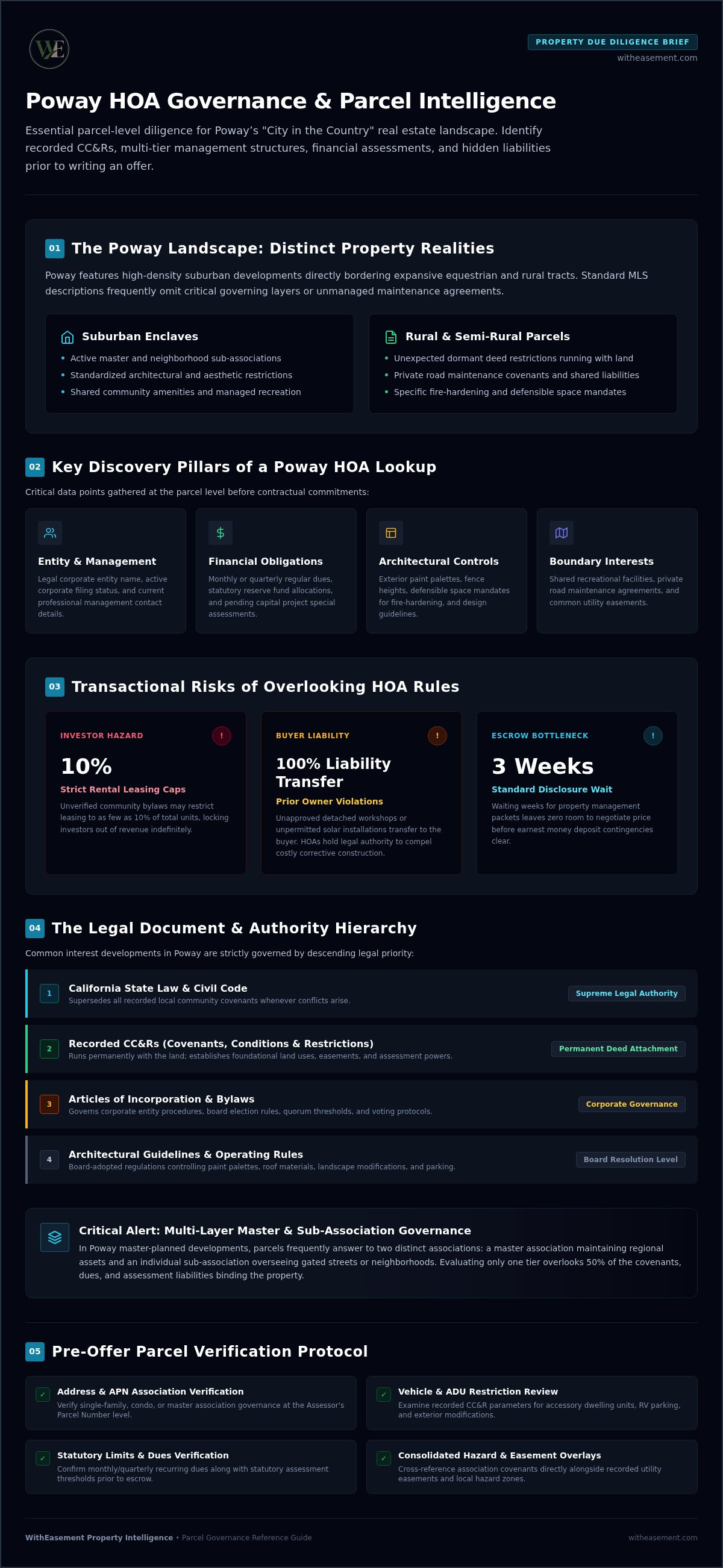
Poway presents a unique real estate environment known as "The City in the Country." Suburban subdivisions sit directly beside sprawling rural parcels and equestrian properties. While a modern master-planned enclave obviously features association management, semi-rural properties often carry unexpected covenants. A thorough Poway HOA lookup reveals whether a specific parcel answers to an active Homeowner Association (HOA), carries dormant deed restrictions, or belongs to multiple management layers.
Most real estate portals list properties with basic MLS data, but agent descriptions frequently miss sub-associations or unmanaged maintenance agreements. Pinpointing the exact governing entity early protects your purchase timeline, preserves financing terms, and eliminates last-minute escrow surprises.
What an HOA Lookup Covers in Poway Communities
A comprehensive association search delivers operational clarity across several key operational areas before you make an offer:
- Entity and Management Details: Identifies the recorded legal entity name, corporate filing status, and current professional property management contacts.
- Financial Obligations: Outlines monthly or quarterly regular dues, reserve fund allocations, and pending special assessments tied to capital projects.
- Architectural Controls: Details specific design guidelines, defensible space mandates for fire-hardening, fence heights, and exterior paint palettes.
- Common Interest Boundaries: Maps out shared recreational areas, private road maintenance obligations, and common utility infrastructure.
The Transactional Risks of Overlooking Association Governance
Skipping association verification exposes real estate deals to serious transactional friction. Investor buyers frequently face immediate setbacks when unverified properties turn out to enforce stringent rental caps or leasing prohibitions. If an association permits only 10% of units to be leased, an investor can find themselves locked out of generating rental revenue indefinitely.
Physical modifications create another major liability. Architectural violations committed by a previous owner, such as an unapproved detached workshop or unpermitted solar installation, transfer directly to the buyer upon deed recording. The association retains the legal authority to force corrective construction at the new owner's expense.
Relying on standard escrow disclosures to discover these rules creates dangerous bottlenecks. Waiting three weeks for a property management firm to release a costly disclosure packet leaves buyers zero room to negotiate. Completing a targeted Poway HOA lookup during your initial parcel review gives you immediate leverage before earnest money is committed.
What Governs Poway HOAs: CC&Rs, Bylaws, and California Civil Code
Every common interest development operates under a strict legal hierarchy. In Poway, master-planned developments often feature multiple layers of governance, where a master association manages broad community assets while an individual sub-association oversees local neighborhoods or gated enclaves. If you examine only one layer during a Poway HOA lookup, you miss half the governing rules and fee obligations that legally bind the land.
State law anchors this structure. Whenever recorded community covenants clash with California legislation, state statutes automatically supersede local HOA rules. For a detailed roadmap on interpreting recorded files, explore our San Diego HOA documents guide.
The Governing Document Hierarchy: From CC&Rs to House Rules
Understanding which document controls a specific issue keeps property assessments clear and disputes manageable:
- Recorded CC&Rs: Covenants, Conditions, and Restrictions run with the land permanently. They establish foundational property uses, maintenance easements, architectural parameters, and legal collection powers.
- Articles of Incorporation and Bylaws: These corporate filings dictate board election procedures, quorum thresholds, voting rights, and internal financial controls.
- Architectural Guidelines and Operating Rules: Board-adopted rules define paint color palettes, landscape modifications, roof materials, and vehicle parking. These operating rules can change through board resolution without a full community vote.
Key Statutory Mandates: The Davis-Stirling Act Framework
The Davis-Stirling Common Interest Development Act (California Civil Code §§4000-6150) establishes clear boundaries for HOA authority across California. Even the most powerful association board cannot bypass these statutory protections.
Boards cannot raise regular monthly assessments by more than 20% per year without approval from a majority of homeowners. Davis-Stirling also requires associations to distribute annual budget reports and reserve study disclosures between 30 and 90 days before the start of each fiscal year. These reserve disclosures reveal whether a community holds adequate cash reserves or faces imminent special assessments for deferred capital repairs.
Recent legislative updates expand homeowner rights even further. Under AB 130, most fines for non-safety covenant violations are capped at $100. Meanwhile, SB 770 streamlines electric vehicle charging installations by barring associations from demanding that homeowners name the HOA as an additional insured on personal policies. Reviewing these protections through WithEasement property intelligence helps you verify how state codes intersect with local covenants before closing.
Traditional HOA Search Methods vs. Modern Digital Property Platforms
Uncovering association records has historically meant wading through fragmented county archives or waiting on unresponsive property managers. Today, running a Poway HOA lookup no longer requires slow paper trails. Modern parcel intelligence lets real estate professionals verify governing entities instantly from a single digital map view.
Comparing conventional research channels with digital platforms highlights why older approaches slow deals down.
County Recorder Archives and Physical Document Retrieval
County grantor-grantee indexes depend heavily on exact historical titles. If you don't know the original developer's corporate entity or the formal legal title of an association, locating recorded covenants becomes an exercise in trial and error. Legacy documents frequently contain amendments, annexations, and supplemental declarations recorded years apart across disparate ledger volumes. Piecing these public records together manually burns billable hours and delays offer preparation when timing matters most.
Management Directory Gaps and Escrow Resale Chokepoints
Reaching out to private management firms introduces another layer of friction:
- Missing self-managed records: Small, self-managed communities rarely register in commercial management databases, leaving outside researchers with zero contact leads.
- Costly fulfillment fees: Resale disclosure platforms charge substantial fees just to generate basic demand statements and governing packets during escrow.
- Inaccurate seller disclosures: Homeowners often misremember their association's precise legal name, sending buyers and agents down dead ends during title verification.
- Protracted callback delays: Routine inquiries left on management voicemails can stall due diligence for weeks while contingencies tick down.
Centralized Digital Parcel Intelligence and Overlays
Modern platforms eliminate administrative bottlenecks by linking spatial property data directly to recorded title documents. Entering an address or Assessor's Parcel Number (APN) instantly surfaces association governance alongside property boundaries. You can easily visualize community limits and intersecting easements using a San Diego interactive property map.
This automated approach pairs deed restrictions with physical constraints like pipeline paths and flood hazards. Instead of coordinating with multiple county offices and private property management desks, agents and buyers receive immediate, parcel-level certainty from a single workflow.
Step-by-Step: How to Perform a Comprehensive Poway HOA Lookup
Management firms usually lock community details behind resident portals and private login screens. You don't have to wait for escrow to crack those doors open. Executing a systematic Poway HOA lookup before writing an offer gives you clear visibility into binding obligations and legal boundaries.
Identifying the Parcel and Assessor Parcel Number (APN)
Begin by converting the physical street address into its eight-digit Assessor Parcel Number (APN). San Diego County tax rolls and deed registries organize recorded documents around this numerical identifier rather than postal addresses. Verifying the APN guarantees you inspect the exact legal lot boundaries. It also prevents confusion between similarly titled subdivisions and catches separate deeded interests, such as assigned carports or detached storage units.
Distinguishing Master and Sub-Association Obligations
After verifying the APN, cross-reference the recorded subdivision tract map against recorded covenants and annexations. In many master-planned Poway tracts, properties answer to two separate governing bodies:
- Master Associations: Regulate regional open space corridors, community recreational centers, and common landscape easements.
- Sub-Associations: Oversee neighborhood security gates, private access streets, and exterior building envelopes.
Track down the recorded CC&Rs for both tiers. Calculate their combined monthly dues to verify that the buyer's debt-to-income ratio comfortably accommodates the aggregate fee structure.
Auditing Financial Disclosures and Special Assessments
Once you identify the operating entities, examine the annual financial disclosure package. Focus your audit on three critical data points:
- Reserve Study Health: Check the "percent funded" metric. Levels below 70% often signal deferred maintenance and an elevated risk of upcoming cash calls.
- Board Meeting Minutes: Read through the prior six to twelve months of board minutes to uncover discussions regarding unannounced roof replacements, repaving projects, or active vendor litigation.
- Insurance Coverage: Confirm structural master policy limits, especially regional master fire deductibles, to ensure prospective lenders will clear the property for final loan approval.
Skip the manual paper trail and start your parcel investigation immediately: Run an instant HOA search with WithEasement to access recorded association intelligence, utility easements, and parcel boundaries in seconds.
Streamlining HOA Due Diligence with WithEasement Property Intelligence
Carrying out due diligence on complex parcels shouldn't require juggling multiple logins, fragmented county records, and slow administrative desks. WithEasement removes this friction by unifying association governance, recorded easements, and environmental hazard overlays within a single, centralized interface. Running a targeted Poway HOA lookup through the platform turns days of manual searching into seconds of actionable clarity.
Instant Address and APN-Based Data Extraction
Type in a street address or Assessor's Parcel Number to instantly retrieve active association records. The system matches boundary lines directly against recorded tract maps, immediately identifying whether a home answers to a single association or overlapping management tiers. Along with HOA data, you see verified utility easements, access rights, and drainage corridors plotted directly on the parcel map. Listing agents and buyers gain reliable property intelligence during pre-offer reviews without waiting on phone callbacks.
AI-Powered Summaries of Complex Governing Documents
Deciphering recorded declarations running dozens of pages consumes valuable time during fast escrow windows. WithEasement applies specialized AI for real estate due diligence to translate dense CC&R language into structured, digestible summaries. The platform highlights key operational rules in seconds:
- Strict leasing caps, rental waiting lists, and short-term occupancy bans
- Restrictions on RV, trailer, boat, and commercial vehicle parking
- Architectural modification guidelines, pet limits, and ADU policies
- Clear division of maintenance duties between the owner and common elements
Comprehensive PDF Property Reports for Escrow Files
Property intelligence is only as valuable as your ability to share it clearly with clients, lenders, and escrow officers. WithEasement generates exportable, professional PDF property reports that package association facts, flood zone boundaries, and pipeline overlays into an organized document. Delivering these client-ready reports early elevates your transaction standard, protects earnest money deposits, and confirms thorough due diligence before contingency deadlines pass.
Take Control of Your Poway Property Due Diligence
Navigating Poway's unique mix of planned developments and semi-rural parcels requires complete clarity before contingencies expire. Uncovering whether a home carries master or sub-association covenants protects your buyers from surprise assessment hikes, rental limits, and inherited architectural violations. Conducting an accurate Poway HOA lookup eliminates weeks of administrative delays and puts verified property facts directly into your hands.
Modern parcel intelligence changes how real estate professionals verify land records. With centralized access to recorded easements, HOA records, and hazard overlays, you don't have to depend on county clerk lines or unreturned management phone calls. Proprietary AI summaries interpret complex CC&R declarations in seconds, while exportable, client-ready PDF property reports keep buyers, lenders, and transaction coordinators completely aligned throughout escrow.
Unlock instant HOA and parcel intelligence with WithEasement today, and move forward with total confidence on your next offer.
Frequently Asked Questions
How do I find out if a specific Poway home is in an HOA?
Run an address or APN search through a dedicated property intelligence platform to confirm active governance instantly. A comprehensive Poway HOA lookup matches parcel boundaries directly against recorded subdivision maps and common interest development filings. You can also review the parcel's grant deed or preliminary title report for recorded covenants, though digital platforms reveal active management contacts without waiting for escrow.
Can I look up Poway HOA CC&Rs and rules for free online?
Basic public tract records can be searched through San Diego County Recorder indexes, but downloading full recorded declarations usually requires document copy fees. While the City of Poway hosts general planning records online, specific HOA governing documents and unrecorded operating rules are held by private management companies or centralized property platforms. Performing a digital Poway HOA lookup remains the fastest way to preview recorded covenants.
What is the difference between a master HOA and a sub-HOA?
A master HOA manages shared community-wide infrastructure across large developments, such as main entryways, greenbelts, clubhouses, and private roads. A sub-HOA operates within a specific enclave or building cluster inside that master community, handling localized needs like exterior maintenance, roofs, or neighborhood security gates. Owners in these communities belong to both entities and pay separate assessments to each organization every month.
How long does an HOA management company have to provide resale documents?
Under California Civil Code Section 4530, an association or its management company must deliver mandatory resale disclosure documents within 10 days of receiving a written request. Even with this statutory deadline, processing delays frequently occur during busy transaction cycles. Requesting disclosures early in escrow or using modern property intelligence tools to review recorded declarations upfront prevents administrative logjams from threatening your closing schedule.
What happens if a property has unrecorded HOA architectural violations?
Unrecorded architectural violations pass directly to the new property owner once the grant deed records. If a seller installed an unapproved patio cover, shed, or perimeter fence, the association can legally require the buyer to modify or remove the structure at their own expense. Requesting an official HOA statement of violations or architectural clearance certificate before removing contingencies prevents inheriting costly compliance disputes.
Can an HOA restrict solar panel installation or electric vehicle chargers in California?
California state law prohibits HOAs from banning solar energy systems or electric vehicle chargers. Under the California Solar Rights Act and Davis-Stirling provisions, associations can only impose reasonable architectural restrictions that do not significantly increase system costs or reduce efficiency. Additionally, SB 770 prevents HOAs from forcing owners to list the association as an additional insured on their personal policies when installing a dedicated EV charging station.
How do I verify if an HOA has sufficient reserve funds before buying?
Review the association's annual reserve study disclosures provided in the financial package. A healthy association generally maintains a funded level of 70% or higher, whereas levels below 30% indicate serious underfunding and a heightened risk of large special assessments. Cross-reference this metric against board meeting minutes from the past twelve months to see if members are actively discussing emergency repairs or unfunded capital projects.


