

What if the most confident guidance you can offer starts with saying what the records don’t prove? Building realtor confidence with better data isn’t about having an answer for everything. It’s about knowing where information came from, what it shows, and where a gap remains.
Property details are often spread across records, maps, and other sources. An unverified fact can weaken a client’s trust, while dense documents can make a useful finding hard to explain. You don’t need to turn every conversation into a records review. You do need a repeatable way to check information and communicate it clearly.
This guide shows you how to evaluate property data, distinguish documented findings from assumptions, and explain the limits of what you’ve found. You’ll learn a practical review process, ways to present complex details in plain language, and how to flag missing information and identify sensible next steps. The goal is clearer client conversations grounded in evidence, without overstating what a record, map, summary, or report can establish.
Key Takeaways
- Build a repeatable review process: define the client’s question, check relevant records and context, then note gaps before sharing findings.
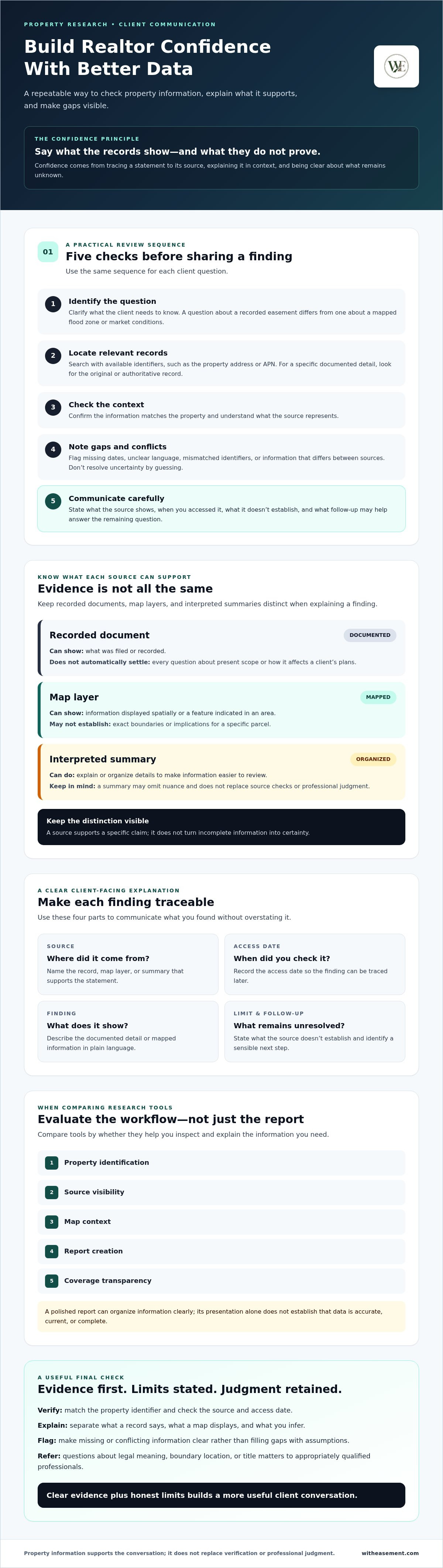
- Separate recorded documents, map layers, and interpreted summaries so clients can see what each source does and doesn’t establish.
- Compare research tools by property identification, source visibility, map context, report creation, and coverage transparency.
- Present findings with their source, access date, limitations, and appropriate follow-up steps.
- Building realtor confidence with better data means organizing useful property information while keeping source verification and professional judgment in the process.
Why Better Property Data Builds Realtor Confidence
Client confidence doesn’t come from sounding certain. It comes from explaining what a finding is based on, what it means in context, and what remains unknown. That distinction matters when property information is spread across public records, maps, listing systems, and personal notes. Each source may answer a different question, so a confident explanation starts with knowing which source supports which claim.
Property intelligence is organized information that helps professionals research a property, understand its context, and identify what still needs checking. It supports the conversation; it doesn’t turn incomplete information into certainty.
What does data-backed realtor confidence mean?
Data-backed confidence means being able to trace a statement to its source and describe its limits in plain language. For listing details, the Multiple Listing Service (MLS) is one important information-sharing system used by real estate brokers. But no single source should be assumed to answer every property question. A polished report may organize information clearly, yet its presentation alone doesn’t establish that the data is accurate, current, or complete.
For example, a recorded document may show that an easement was recorded. That finding doesn’t, by itself, settle every question about its present scope or how it affects a client’s plans. State what the document shows, then identify what needs further review.
Where property research creates friction
Research can involve moving between records, map layers, saved notes, and client-facing documents. Details copied into several places can make it harder to track the source or keep descriptions consistent. Terminology can add another layer of confusion: a record, a mapped feature, and a summary may describe related information without meaning the same thing.
Missing context can also lead to overstatement. A map overlay may indicate a feature in an area, but the map alone may not establish its exact boundaries or implications for a specific parcel. Describe what the source displays, note what it doesn’t confirm, and identify a suitable next step rather than filling the gap with an assumption.
This is the practical value of building realtor confidence with better data: clients hear a clear account of both the evidence and its limits. Consistent explanations make follow-up easier, help prevent uncertain details from being repeated as fact, and give clients a more useful basis for their next question.
How to Evaluate Property Data Before Sharing Findings
Use the same review sequence for each client question. It helps you catch mismatches, separate evidence from interpretation, and explain uncertainty before it becomes a misunderstanding. Check property data for its source, date, scope, and context before sharing a finding.
- Identify the question. Clarify what the client needs to know. A question about a recorded easement differs from one about a mapped flood zone or market conditions.
- Locate relevant records. Search using available identifiers, such as the property address or APN. When confirming a specific documented detail, look for the original or authoritative record.
- Check the context. Confirm that the information matches the property and understand what it represents. A recorded document is evidence of what was filed. A mapped layer displays information spatially, but may not establish exact boundaries or effects. An interpreted summary explains or organizes details, but may omit nuance.
- Note gaps and conflicts. Record missing dates, unclear language, mismatched identifiers, or information that differs between sources. Don’t resolve uncertainty by guessing.
- Communicate carefully. State what the source shows, when you accessed it, what it doesn’t establish, and what follow-up may help answer the remaining question.
Check source, date, and property match
Confirm the property identifier shown in the record and compare it with the address or APN you’re researching. Note the source and access date so you can trace the finding later. If a record is unclear, appears outdated, or conflicts with another source, flag the issue rather than treating one version as settled.
Separate documented facts from interpretation
Label what comes directly from a record, what a map layer indicates, and what is your interpretation. Summaries can make information easier to review, but they don’t replace source checks or professional judgment. Refer questions about legal meaning, boundary location, or title matters to appropriately qualified professionals. For broader housing-market context, NAR Research and Statistics offers reports and data; distinguish market-level information from evidence about an individual property.
For example, you might tell a client, “The document I reviewed records an easement affecting this parcel. I haven’t confirmed its precise on-the-ground location or what it means for your plans. That needs further review.” Clear limits don’t weaken your guidance. They show exactly where the evidence ends and the next step begins, a practical part of building realtor confidence with better data.
A centralized property search can help organize details for review. Explore property information tools as one way to bring relevant information together, while continuing to check source records and confirm coverage for the property.
Comparing Property Data Tools: What Helps Realtors Most?
The right tool depends on the research question, not the longest feature list. Compare how each approach helps you identify a property, inspect sources, understand map context, prepare a report, and check coverage. Use the table as a starting point, then confirm what a platform actually includes before relying on it.
| Approach | Property identification | Source visibility | Map context | Report creation | Coverage transparency |
|---|---|---|---|---|---|
| Fragmented manual research | May require separate searches by address or parcel identifier. | Can be strong when each original record is tracked, but details may be spread across notes and tabs. | Often requires switching between map sources. | Findings may need manual assembly and formatting. | Depends on checking each source’s geographic and record scope. |
| Single-purpose tools | Usually focused on a particular data need or search type. | Check whether the tool links to or identifies supporting records. | May provide context for its specific data category. | Output may be limited to that tool’s function. | Confirm which properties and locations are covered. |
| Centralized property platforms | May bring address or APN search into one workflow. | Look for clear source details and a way to review records. | Can combine relevant overlays, subject to their stated scope. | Summaries or downloadable reports may reduce repeated formatting. | Verify available geography, records, and fields before use. |
Which platform capabilities improve the research workflow?
Prioritize capabilities that address your recurring questions: address or APN search, access to recorded easement information, and relevant property details. Map overlays can add useful context, but check what area and information each layer represents. Summaries and PDF reports can help organize findings for review; they don’t independently confirm the underlying data. When reviewing an overlay, check its source, scope, and date so you understand what it can show.
Questions to ask before relying on a data platform
Ask which geography, record types, and property fields are included. Find out how you can inspect source records, identify missing information, and distinguish documented facts from interpreted summaries. Data standards also affect how property information is labeled and shared; the RESO Data Dictionary explains the role of consistent real estate data terms.
Feature breadth matters only when scope and limits are clear. A platform can help organize research, but building realtor confidence with better data still depends on checking relevant sources and explaining what the available information can and cannot establish.
A Practical Workflow for Sharing Property Findings With Clients
A consistent handoff turns research into useful guidance. Keep the steps simple: start with the client’s question, gather relevant information, review it, summarize what it shows, and make follow-up visible. This gives clients a clear answer without implying that a data point guarantees a particular outcome.
- Clarify the question. Confirm what the client is trying to understand and which property is involved.
- Gather relevant information. Search appropriate records and map layers. Note each source and when you accessed it.
- Review before interpreting. Check that the information matches the property, and look for gaps, conflicting details, or limits in coverage.
- Prepare a plain-language summary. Lead with the finding that relates directly to the client’s question, then explain what the source does and doesn’t establish.
- Set out follow-up. Identify any additional document or qualified professional review that may help resolve an open question.
Turn research into a clear client explanation
Put the client’s question first, then give the relevant finding. Keep the record’s wording distinct from your explanation of its possible significance. For instance: “The map layer shows a flood-zone designation near this property. This layer alone doesn’t establish site-specific conditions. Confirm the relevant details through appropriate records or professional review.” This phrasing gives context without presenting a map display as a guarantee.
A short written summary can follow a reliable format: Question, finding, source, date accessed, limitations, next step. That structure helps preserve the evidence behind a statement and makes the summary easier to revisit or hand off. AI-assisted property due diligence can also help organize complex information, provided summaries are checked against relevant source records.
Make uncertainty and follow-up visible
Say plainly when a record wasn’t available, its language is ambiguous, its date may matter, or the property falls outside a platform’s confirmed coverage. Don’t fill the gap with confident-sounding language. Instead, name what could help: a specific document, a source check, or review by a professional qualified for the question. Use the same format across client updates so colleagues can see what was checked and what remains open.
Clear notes on sources, dates, and limits make it easier to give consistent updates. To organize property information for client discussions, explore property reports and map overlays. Building realtor confidence with better data means using tools to support research while keeping the explanation grounded in what the available evidence shows.
How WithEasement Can Support a More Confident Data Workflow
Once you’ve established how to check sources and explain limits, a centralized platform can help organize research. WithEasement lets users search property information by address or APN and review available easement information, HOA data, and map overlays. Its interactive map includes assessed values, flood risk, HOA information, and pipeline overlays. These tools can bring related details together for review, but the source and scope of each item still matter.
Use centralized property information as decision support
Use a property search to gather relevant information, then apply the same review steps described earlier: confirm the property match, inspect the supporting information, note what’s missing, and explain findings with care. Map overlays can add spatial context. They don’t independently verify a condition or establish its effect on a specific property.
AI-powered summaries and downloadable PDF property reports can help organize complex details and prepare a clearer client discussion. Treat a summary as a starting point for review, not a substitute for checking underlying records or applying professional judgment. WithEasement provides property intelligence. It isn’t title insurance or a land surveying service.
Choose a sensible next step
Before using platform information to guide a client conversation, check whether the relevant property and records are covered. Confirm current geographic availability, the data sources and fields relevant to your question, and any limits on what the results can establish. Coverage and available details can vary, so don’t assume a search includes every record or answers every property question.
Then compare what’s available with the task at hand. If you’re researching HOA information, easements, or map context, identify which results help and which questions still need another source or qualified professional. This keeps the platform in its proper role: a way to organize research, not a guarantee of accuracy or completeness.
That’s the practical value of building realtor confidence with better data. A useful workflow combines organized information with source checks, clear explanations, and honest next steps. If you’d like to see whether the available tools fit your research needs, explore WithEasement membership and review current coverage before relying on platform results.
Make Your Property Research Workflow More Confident
Building realtor confidence with better data starts with a repeatable habit: identify the client’s question, trace findings to their sources, and explain both what the information shows and what remains uncertain. Clear notes on sources, dates, and limitations help keep conversations grounded and follow-up focused.
The right tools can make research easier to organize, but they don’t replace verification or professional judgment. WithEasement lets you search property information by address or APN and review available recorded easement information, HOA data, and property map overlays. AI-powered summaries and downloadable PDF property reports can help organize findings for review and client discussions. Check current coverage and relevant records before relying on platform information for a specific property.
Ready to see whether these tools fit your workflow? Explore WithEasement’s property research tools. Keep asking clear questions, checking the evidence, and sharing what you know with care. That’s a practical way to strengthen client trust, one conversation at a time.
Frequently Asked Questions
How does better property data build realtor confidence?
Better property data helps realtors trace findings to sources, organize relevant details, and explain what remains unknown. Confidence comes from showing how information was found and interpreted, not simply presenting a polished report. Check the property match, record dates, source scope, and conflicting details. Then explain limitations clearly. Data can support informed client conversations, but it can’t guarantee a particular legal or property outcome. That’s the basis of building realtor confidence with better data.
What property data should realtors check before advising a client?
Start with the client’s question and the property identifier, then review relevant records and context. Depending on the question, this may include recorded easements, HOA information, assessed values, or environmental overlays. Note each source and the date you accessed it. Confirm important details against authoritative records when possible. For specialized legal, title, or surveying questions, seek appropriately qualified professional guidance rather than treating a data summary as a final determination.
Can property data platforms guarantee that property information is complete and accurate?
No. Don’t assume any platform provides complete or error-free information for every property. Geographic coverage, available sources, update timing, and interpretation can vary. Review the platform’s stated scope and inspect underlying records when possible. If information is missing or conflicting, identify the gap instead of treating one result as definitive. Seek additional documentation or qualified review when needed, and use platform findings as research support, not a guarantee of completeness or accuracy.
How can realtors explain property records to clients in plain language?
Start with the client’s question, then state what the record says, where it came from, and when you accessed it. Separate documented details from your interpretation. Explain technical terms briefly, but keep important caveats. For example, clarify that a map layer displays a feature without necessarily establishing its exact effect on the property. If a finding is unclear, say so and identify the next step. A concise written summary makes the conversation easier to revisit.
What should realtors compare when choosing a property data platform?
Compare search methods, record types, source visibility, geographic coverage, map context, and reporting tools. Ask whether you can inspect the underlying records and check summaries against them. Find out how the platform identifies missing information and defines its coverage. Consider how well its features fit your clients’ questions, not just how many appear in a list. Verify current coverage and available records for the specific property before relying on platform results.
Can AI summaries replace reviewing property records?
No. AI summaries can help you navigate complex information, but they shouldn’t replace reviewing relevant source records. Check important claims against the underlying material, confirm that it matches the property, and note missing or ambiguous details. Treat the summary as an aid to research and communication, not as legal, title, surveying, or other professional advice. Explain unresolved issues to the client and arrange appropriate follow-up when further documentation or expert review is needed.


