

What if reassuring a client doesn’t mean having every answer? Property records can be complex, spread across sources, or unclear about what they establish. Effective client reassurance through property data means showing what the available evidence indicates, explaining what it can’t confirm, and making the next steps clear.
Clients need useful context, not a pile of unfamiliar records. Acknowledge their concern, connect relevant findings to the property, and be transparent about gaps or limitations. Clear explanations help clients understand the information and make more informed decisions.
This guide explains how to turn property findings into plain-language answers, distinguish documented facts from uncertainty, and organize follow-up. It also covers how easement records, HOA details, and map overlays can support a conversation when relevant and available. The goal isn’t to promise more than the records prove. It’s to help clients see what’s known, what needs checking, and how to proceed with greater confidence.
Key Takeaways
- Use a repeatable research sequence to connect a client’s concern to relevant property records and a clear explanation.
- Confirm the property’s address or APN before interpreting parcel-level information, and check each record’s source and timing.
- Compare manual searches, centralized data tools, and qualified professional review to decide what to verify and when to escalate.
- Build client reassurance through property data by separating documented findings from indicators that need further investigation.
- WithEasement Membership features, including HOA information, map overlays, AI summaries, and PDF reports, can support research and client communication where coverage is available.
How property data can reassure real estate clients without overpromising
Property data reassures clients when it makes relevant evidence easier to understand, not when it promises a risk-free property. A record or map can point to a useful answer, a possible concern, or a question that needs further review. It can’t guarantee what a client will encounter or settle every question about a property.
Evidence-based reassurance means explaining what available records show, what they don’t establish, and what to check next. That’s the foundation of client reassurance through property data: share useful context, be clear about uncertainty, and give the client a practical next step.
What clients need when property information raises questions
Questions may involve access across an easement, property restrictions, HOA membership, mapped flood exposure, or nearby pipelines and other infrastructure. A document or overlay without context can make these concerns harder to assess. Explain what the information relates to, where it came from, and whether it describes the parcel itself or nearby land. Then identify what, if anything, needs follow-up.
A calm, specific explanation acknowledges the concern without treating an indicator as a final answer. For example: “This map shows a flood-related indicator for the area. Let’s confirm what it means for this parcel and whether another review is needed.”
What property data can, and cannot, confirm
Separate four things: an observed feature, information in a recorded document, your interpretation of that information, and an item that still needs confirmation. A map may show a pipeline overlay, but that alone doesn’t establish its exact location on the ground or its effect on property use. A record may describe an easement, but understanding its scope may require reviewing the source document and getting qualified advice.
Property records are created through systems for recording instruments such as deeds and mortgages. For background, see this overview of the system of recording legal instruments. A record search or data platform can help locate and organize information, but records may be incomplete, unclear, or not current. No result doesn’t prove that an issue is absent.
When a finding could affect access, boundaries, obligations, or a client’s decision, explain the limitation and recommend appropriate follow-up. That may mean checking the original source document or seeking review from a qualified title, legal, surveying, environmental, or other relevant professional. Keep the explanation simple: state what the data indicates, what remains uncertain, and who can help verify it.
How to turn property records into clear, credible client explanations
Start with the client’s question, not the search results. Follow a consistent workflow to keep each finding tied to the concern and the property being discussed:
- Clarify the concern. Ask what the client wants to understand, such as a possible access route or an HOA reference.
- Identify the property. Confirm the address or APN, then check that the parcel shown matches the property.
- Review relevant records. Focus on records or map layers related to the concern. Check the source and any available date or update context.
- Explain what you found. Use plain language and distinguish the record itself from your interpretation.
- Flag follow-up. State what remains unclear and what source or qualified professional could help verify it.
Start with the client question and confirm the property
Before searching, ask what decision the client is trying to make. Then verify the address or APN and compare the displayed parcel with the property. Nearby parcels can look similar, and a mismatch can lead to an irrelevant finding. Be clear about the scope: a search may help locate a recorded document or display a mapped indicator, but it may not establish the complete legal or on-the-ground situation.
Summarize findings with their source and limits
Keep the source and context close to each finding. For example: “The map layer shows a pipeline indicator near the parcel. The display doesn’t confirm its exact location or effect on the property, so we should check the underlying information before drawing conclusions.” If a source date or update time isn’t available, say so rather than implying the information is current.
A concise report can make information easier to review and share, but it remains a starting point for discussion. A property report helps organize relevant findings for a client; it doesn’t replace source-document review or confirm what the records don’t show. This measured approach supports client reassurance through property data while keeping conclusions within the evidence.
Use the same workflow whether you gather records manually or organize them in a research platform. To explore a structured way to review property information, explore property research with WithEasement. Check current coverage and review relevant source information before sharing a finding with a client.
Property data tools compared: scattered searches, reports, and expert review
Choose a research method based on the question you need to answer. Manual searches can help locate specific public records. A centralized property-data platform can bring selected information into one workflow. Qualified professionals can review questions that require specialized interpretation. Each method has limits, so treat organized results as a starting point for verification, not a final conclusion.
| Typical use | Information presented | Verification needed | When to escalate |
|---|---|---|---|
| Manual searches across public sources | Individual records or map information from separate sources | Check the property identifier, source, date, and whether the document applies to the parcel | When records conflict, are difficult to interpret, or appear incomplete |
| Centralized property-data tools | Selected property information, map overlays, summaries, or reports in one workflow | Confirm coverage for the specific property and review source details and update context | When a finding affects a consequential decision or needs deeper confirmation |
| Qualified professional review | Analysis within the professional’s relevant area of expertise | Share the question and relevant source records; confirm the scope of the review | When the issue requires legal, title, boundary, or other specialized judgment |
When a centralized property-data platform can help
A platform can reduce the effort of switching between sources by organizing selected information around an address or APN. Depending on the platform and verified coverage, map overlays may surface relevant indicators, while AI summaries and downloadable reports can support review and client communication. Check that the property is within the platform’s available coverage, then verify the underlying source and limitations before relying on a result.
These tools support research and reporting. They don’t insure title or survey land, and they don’t replace source-record review or advice from a qualified professional. Responsible handling matters too. The National Association of REALTORS® guidance on data privacy is a useful reminder to handle client and property information carefully.
When the client should seek source records or expert review
Escalate when records disagree, a boundary is unclear, or the answer could carry legal consequences. Obtain the source document when possible, then frame a precise question for the appropriate specialist. For example, “Is an easement document recorded?” and “Where does the easement lie on the ground?” are different questions and may call for different kinds of review. Property research is not title insurance, land surveying, or legal advice.
Comparison takeaway: Use manual searches to locate specific evidence, a centralized tool to organize discovery, and qualified review when interpretation or consequences exceed the research task. The right workflow depends on the client’s question and the limits of the available records.
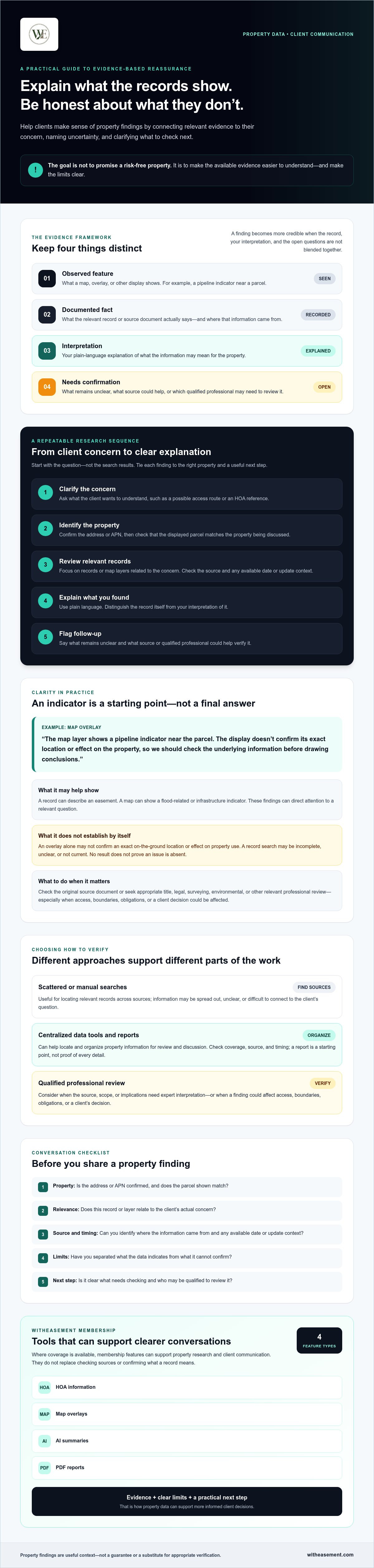
A practical checklist for discussing property findings with clients
A client-ready explanation doesn’t need to include every record you found. It should show how the information connects to the client’s question, what the evidence supports, and what remains unresolved. Use this checklist before sharing findings:
- Property identity: Note the address or APN used, and confirm the displayed parcel matches the property.
- Client question: State what concern or decision the research was intended to address.
- Source: Identify where the record or map information came from.
- Timing: Include the record date or data update context when available. If it’s unknown, say so.
- Interpretation: Describe what the information indicates in plain language, separating the source material from your explanation.
- Uncertainty: Flag missing, unclear, or conflicting information. Don’t present an indicator as a confirmed condition.
- Next step: Identify what to verify, which source to check, or what qualified review may be appropriate.
Every reported finding needs context and a verification path. This keeps client reassurance through property data grounded in evidence rather than in certainty the records can’t provide.
Prepare a client-ready property summary
Lead with the question and the property identifier used for the search. Present only relevant findings, label them clearly, and add a short explanation. Pair positive results with open questions and follow-up actions. For example, don’t report only that a search returned no easement information. Clarify which source was searched, whether its timing is known, and whether the result should be checked against other records.
Use neutral language. “The map displays a flood-related indicator in this area; its relevance to this parcel needs confirmation” informs without minimizing a concern or creating unnecessary alarm. Avoid claims stronger than the source supports.
Respond when a client questions accuracy or completeness
Take the question seriously. Explain which source supplied the information and whether you can confirm its date or update timing. A map overlay can help identify an area for closer review, but it doesn’t prove exact conditions on the property. An automated summary can organize information, but it shouldn’t replace checking the underlying record. A missing result doesn’t establish that nothing exists.
Offer a clear path forward: review available source materials, explain what they do and don’t show, or refer the client to an appropriate professional when specialized interpretation is needed. This transparency makes the discussion more useful and keeps uncertainty visible.
For a structured way to organize property findings for review, explore property research with WithEasement. Check coverage and available source details for the specific property before sharing results.
How WithEasement supports clearer property-data conversations
WithEasement Membership brings several property-research features into one workflow. Where a property is within verified coverage, professionals can search by address or APN for available information, then review relevant findings before discussing them with a client. The platform can help organize research, but it doesn’t guarantee that records are complete, current, or conclusive.
From property search to a shareable client report
Start by confirming the address or APN and checking that the displayed parcel matches the property. Available membership features can then support specific research tasks:
- Property easement searches: Help locate recorded easement information to review against the client’s access or use question.
- HOA information: Provide a starting point for checking whether association information is available for the property.
- Map overlays: Flood-risk and pipeline overlays can help surface indicators for further review. Assessed values and other displayed map information may add context, but should be interpreted in light of their source and limitations.
- AI summaries: Help organize information for review. Check the underlying records before relying on a summary or sharing its interpretation.
- PDF property reports: Provide a format for presenting selected findings and open questions in a structured client discussion.
A report is most useful when it makes the research easier to follow. Include the client’s question, the property identifier, relevant findings, and any uncertainties or verification steps. This structure can support client reassurance through property data without suggesting that a summary or report resolves every issue.
Choose the platform when its coverage and tools fit the task
Before starting, confirm that the specific property falls within current platform coverage and check which features are available. Review source details and update context for the information you plan to discuss. If a result is important to a client’s decision, verify it against appropriate source records. A search result, overlay, or summary is a research aid, not a substitute for that review.
Some questions need more than organized property data. Legal or title concerns, unclear boundaries, and significant land-use questions may call for review by an appropriate qualified professional. Use the platform to help identify and communicate the question, then seek specialist input where needed.
If the available coverage and tools fit your research needs, explore WithEasement Membership. Check current coverage and features for the property before relying on the platform in your workflow.
Make your next property-data conversation clearer
Trust grows when clients can see how a finding relates to their question, where the information came from, and what still needs confirmation. Keep explanations focused, distinguish records from interpretations, and make the next step clear. That’s the practical value of client reassurance through property data: better-informed conversations without promising more than the evidence supports.
WithEasement Membership brings property searches by address or APN together with HOA information and map overlays for assessed values, flood-risk information, and pipelines. AI-powered summaries and downloadable PDF property reports can help organize findings for review and discussion. Confirm coverage for the specific property, check available source details, and verify important findings against appropriate records. For legal, title, boundary, or other specialized questions, seek qualified professional review.
Ready to see whether the platform fits your research workflow? Explore WithEasement Membership. With clear evidence, honest limits, and thoughtful follow-up, you can help clients move forward with greater confidence.
Frequently Asked Questions
How can property data reassure a real estate client?
Property data can reassure a client by making relevant evidence easier to understand and clarifying the next step. Connect the information to the client’s specific concern, identify the property searched, and explain what the source shows. For example, a map overlay may flag an area for closer review, but it doesn’t confirm exact conditions on the parcel. Client reassurance through property data comes from clear context and honest limits, not guarantees.
Can property data prove that a property has no easements or restrictions?
No. A search that doesn’t return an easement or restriction doesn’t prove none exists. Available records may be incomplete, unclear, or outside the search’s scope. Check which sources were reviewed and obtain relevant original documents where possible. If a potential easement or restriction could affect access, use, or a client’s decision, recommend review by a qualified title or legal professional rather than treating a missing result as confirmation.
What property information should a realtor share with a client?
Share information relevant to the client’s question, such as recorded documents, HOA information, or applicable map indicators. Identify the address or APN used, name the source when known, and provide available date or update context. Explain what the information indicates and what it doesn’t establish. Include unresolved questions and practical follow-up steps. Keep the explanation focused, and don’t present an indicator or incomplete search result as a definitive conclusion.
How do you explain a property data report to a buyer?
Start with the buyer’s question and confirm which property the report covers. Point out relevant findings in plain language, then explain their source and any available timing information. Separate recorded facts from map indicators and your interpretation. For example, say an overlay flags an area for review rather than claiming it confirms a condition on the property. End with any records to check or professional input the buyer may need.
Are AI property summaries reliable enough to share with clients?
AI property summaries can help organize information, but review them against the underlying records before sharing or relying on their interpretation. Check that the summary refers to the correct property, preserves the source context, and doesn’t turn an indicator into a conclusion. If you share one, explain that it’s a review aid, not independent confirmation. Verify important findings and clarify any uncertainty or missing information for the client.
Does a property data platform replace title insurance or a land survey?
No. A property-data platform can organize available searches, records, and map information, but it doesn’t provide title insurance or land surveying. WithEasement offers property-data tools, not those services. A platform result also doesn’t replace review of appropriate source records or qualified professional advice. If a client needs title-related protection, boundary information, or another specialized assessment, direct them to the relevant qualified provider.
What should I do if property records conflict or seem incomplete?
Pause before drawing a conclusion. Recheck the address or APN, compare sources and available dates, and look for the underlying documents behind conflicting information. Explain to the client what differs and what remains unresolved. Don’t treat missing information as proof that an issue is absent. If the discrepancy affects a legal, title, boundary, or other significant question, refer it to an appropriate qualified professional for review.


