

What if the most useful property-history finding isn’t a single record, but a timeline built from several clues? Researching property history for clients often means piecing together deeds, maps, tax records, and other sources that may use different addresses or parcel boundaries.
That can make the process feel scattered, especially when older records aren’t online. Clients don’t need a pile of documents. They need clear findings they can follow, verify, and use to decide what questions to ask next.
This guide provides a repeatable process for building a chronological, source-backed property history. You’ll learn how to identify a property, trace ownership, compare records with maps, and flag gaps that need follow-up before you advise a client. It also explains how to turn your research into a concise summary. Tools such as WithEasement may help organize available property information, overlays, and reports, but confirm coverage and verify important details against primary sources.
Key Takeaways
- Define the client’s question and research scope before searching, so you focus on the records that matter.
- When researching property history for clients, follow a consistent process to identify the parcel, trace records, and organize evidence chronologically.
- Check what each source can actually confirm, then cross-reference important details instead of treating one document as the full story.
- Make findings easy to verify with a concise report that separates confirmed information, limitations, and follow-up questions.
- Choose public records, a data platform, or professional review based on the property’s complexity and the level of verification needed.
Researching Property History for Clients Starts with a Clear Question
Property-history research is a source-backed review of a property’s ownership, recorded documents, and documented changes over a defined period. It can help answer a client’s question, but it can’t guarantee that every historical record has been found or establish every fact about a property.
Start with the client’s purpose, not a broad search for everything available. A buyer reviewing recorded easements may need a different scope than an investor seeking ownership context or a client asking about prior improvements. The transaction stage and property characteristics matter, too. An older parcel with shifting boundaries may call for different records than a recently developed lot.
Be clear about the limits of the work. Historical research is not title insurance, a legal opinion, or a land survey. It organizes and interprets available information; it doesn’t insure ownership, determine legal rights, or establish a property’s precise boundaries. A basic understanding of real property can help frame what the research covers, but specific legal or boundary questions may require a qualified professional.
Which property-history questions should you ask first?
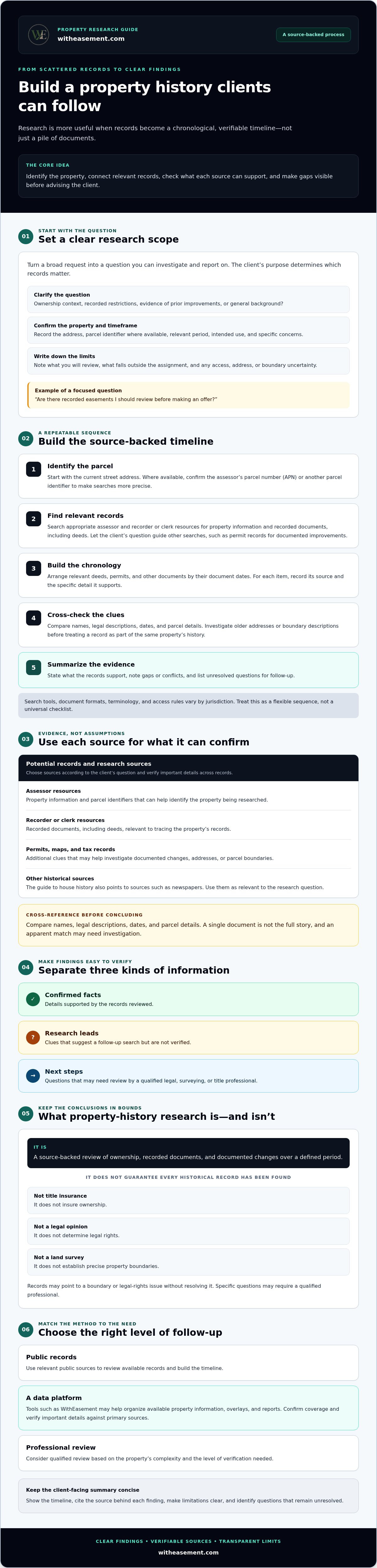
Turn a broad request like “Tell me about this property” into a question you can investigate and report on. Ask whether the client wants ownership context, recorded restrictions, evidence of prior improvements, or general background. Then confirm the property’s address and parcel identifier, how the findings will be used, the relevant time period, and any specific concerns.
For example, “Are there recorded easements I should review before making an offer?” gives the research a clearer direction than “Is there anything unusual about the lot?” If the client’s concern is a boundary or legal right, explain that records may point to an issue without resolving it.
What should a client-ready research scope include?
Write down what you’ll review, the time period you’ll cover, and what falls outside the assignment. Note any access limits, missing documents, or uncertainty about historical addresses and parcel boundaries. This gives the client a useful frame for understanding both your findings and their limitations.
- Confirmed facts: Details supported by the records reviewed.
- Research leads: Clues that suggest a follow-up search but aren’t verified.
- Next steps: Questions that may need review by a qualified legal, surveying, or title professional.
This scope keeps researching property history for clients focused and transparent. It also helps prevent a collection of documents from being mistaken for a complete record or a professional determination.
How to Research a Property History: Build a Source-Backed Timeline
A consistent workflow helps turn scattered records into a timeline your client can follow and verify. Search tools, document formats, terminology, and access rules vary by jurisdiction, so treat this as a flexible sequence rather than a universal checklist. The Library of Congress’s guide to house history also points to useful historical sources, including property records, permits, maps, and newspapers.
- 1. Identify the parcel. Start with the current street address. Where available, confirm the corresponding assessor’s parcel number (APN) or other parcel identifier. A parcel identifier can make searches more precise by helping distinguish a property from others with similar addresses.
- 2. Find relevant records. Search the appropriate assessor and recorder or clerk resources for property information and recorded documents, including deeds. Let the client’s question guide which additional sources to check, such as permit records for documented improvements.
- 3. Build the chronology. Arrange relevant deeds, permits, and other documents by their document dates. Record the source and the specific detail each item supports.
- 4. Cross-check clues. Compare names, legal descriptions, dates, and parcel details across records. If an older document uses a different address or boundary description, investigate whether it refers to the same property before adding it to the timeline.
- 5. Summarize the evidence. State what the records support, note gaps or conflicting details, and list questions that remain unresolved.
How do you identify the right parcel and ownership records?
Use the current address as a starting point, not your only search term. Confirm the parcel identifier through an assessor resource, then look for deeds and other relevant documents in the local recorder’s or clerk’s system. If a search comes up empty, check the jurisdiction’s guidance for older archives or alternate indexes. Records may be filed under a former address, owner name, or description that predates a boundary change.
How do you turn records into a property timeline?
Use a simple research log with columns for document date, source, relevant detail, and unresolved question. For example, a deed may support a transfer date, while a permit may document an application or other permit activity. Don’t treat a missing year or unexplained gap as proof of a problem. Mark it as a gap to investigate, then compare independent records before drawing a conclusion.
For properties within its coverage, WithEasement can help organize property information and provide AI summaries and PDF property reports for a research workflow. Confirm coverage and verify important details against primary sources. Explore property research resources as one possible aid alongside your own record checks.
Compare Property-History Sources and Verify What Each One Can Prove
Each source answers a different question. A deed can document a transfer, but it won’t establish every fact about a property, such as whether a structure was permitted or where a boundary lies today. Online information is a useful starting point, not proof that a record is complete. Availability and indexing vary, so check the source agency and look for independent support before presenting a conclusion.
A research lead is a clue to investigate; a verified finding is a detail supported by an identifiable source and an appropriate cross-check. Keep that distinction clear as you compare official records, secondary databases, physical observations, and personal recollections.
| Source | Likely insight | Limitations | Recommended cross-check |
|---|---|---|---|
| Recorded deeds | Transfers and recorded property descriptions | May not answer questions about current boundaries, permitted work, or every property condition | Compare dates and legal descriptions with assessor and other recorded records |
| Assessor records | Parcel identification and available assessment information | May reflect an administrative or assessment view, not every recorded right or historical change | Check parcel references against recorder or clerk documents |
| Building department or permit records | Documented work or permit activity | Availability and detail vary by location; absence of an online entry doesn’t establish that work never occurred | Check agency archives and compare with other dated records |
| Secondary databases | Searchable summaries or aggregated property details | Coverage, update timing, and underlying sources may vary | Locate and review the relevant primary record |
| Physical clues or personal recollections | Features or local stories that suggest where to investigate | May be difficult to date or independently confirm | Compare with dated photographs, permits, maps, or records |
What can deeds, assessor records, and permits tell you?
Read a deed for the transfer it records and the property description it contains. Use assessor resources to help identify the parcel and review available assessment information. Ask the local building department whether permit records are accessible for the relevant period. For older land history, the National Archives land records can help researchers explore federal land records, including material that may be relevant when tracing a property’s origins.
How should you handle conflicting or incomplete information?
Before drawing a conclusion, compare document dates, parcel references, document types, and issuing agencies. A mismatch may reflect a changed address, a different parcel description, or a record that addresses a different question. Note the conflict and identify what you checked. Don’t fill missing years with assumptions or treat an empty online search as proof that no record exists.
When researching property history for clients, label each item as confirmed, unverified, or unresolved. If a discrepancy could affect legal rights, boundaries, or a transaction decision, recommend review by a qualified professional rather than interpreting it beyond the evidence.
How to Present Property-History Findings Clearly to Clients
A useful report doesn’t make the client decode your research log. It answers the original question, shows the evidence behind each finding, and makes uncertainty visible. Keep the main summary brief, then provide source details so the client can check important records without wading through every note you collected.
What belongs in a concise property-history report?
Use the same structure for each assignment, adjusting the detail to fit the client’s question:
- Client question: State what the research was intended to clarify.
- Property identifier: Include the address and parcel identifier used to match records.
- Research date and scope: Note when you searched, the period covered, and the types of records reviewed.
- Timeline: List relevant events chronologically, with the source name and document date for each.
- Key findings: Summarize what the reviewed evidence supports in plain language.
- Limitations and next steps: Identify missing or conflicting information and any recommended follow-up.
Separate documented facts from interpretations and unresolved leads. For example, a dated permit record may document an application, while a visible change to a building may suggest work that needs more research. Don’t present the suggestion as a confirmed fact. Link to an online source or cite its office, document title, and date where available. Use short sections, clear labels, and only enough technical language to explain the evidence.
How can tools help organize research without replacing verification?
Maps and overlays can help you spot topics to investigate, such as a mapped flood-risk area or pipeline overlay. Treat these as prompts for follow-up, not as substitutes for reviewing relevant source material. Summaries can orient the reader, but verify important claims against the underlying records before including them as findings.
For properties within its coverage, WithEasement may help organize property information, overlays, AI-powered summaries, and downloadable PDF property reports. Confirm the property’s coverage and check the platform’s current data layers and report contents before recommending it. Use it as a research aid, not as a replacement for primary-source checks.
If a consolidated starting point would help you prepare client-facing findings, explore WithEasement property research and confirm coverage for the property first.
Choose the Right Next Step for Property-History Research
The best approach depends on what the client needs to know, how complex the records are, and how much verification the answer requires. Direct public-record research can work well when the question is specific and relevant documents are accessible. A data platform may help organize information for properties within its coverage. If the issue concerns legal rights or boundaries, research alone may not be enough.
When is a property data platform useful for client research?
Consider a platform when information is spread across sources and its available data matches the question. Mapped overlays can help identify topics to investigate, while summaries may help organize findings. Neither replaces checking underlying records. Before choosing a platform, compare its property coverage, data types, export options, and fit with your reporting process. Verify current features and coverage for the specific property before recommending membership.
WithEasement organizes property information within its coverage, including HOA information, recorded easements, and flood-risk and pipeline overlays. Confirm that the property is supported before relying on the platform as a research aid. Use any summary or report to guide your review, then confirm important details against primary sources.
When should you seek additional professional review?
Pause and refer the question when the client needs a conclusion about title, legal interpretation, property boundaries, or survey findings. Those questions call for qualified professionals, not an informal reading of historical records. If a database summary is incomplete or conflicts with a recorded document, obtain and compare the source documents where possible. Explain what your research does and doesn’t establish so clients don’t mistake research assistance for legal, title, or surveying services.
Use the client’s question, document access, time constraints, and required level of certainty to choose your next step. Then keep the process simple:
- Define the question: Clarify what the client needs to understand.
- Identify the parcel: Confirm the address and parcel identifier where available.
- Gather relevant records: Start with sources that can answer the question, then add a platform or professional review if needed.
- Document sources: Record what you checked, what it supports, and what remains unresolved.
That’s a practical foundation for researching property history for clients without overstating what the evidence can show. Match the method to the question, verify key details, and make the limits clear.
Turn Property Records into Clear Client Guidance
Strong property-history research starts with a clear client question and ends with findings they can understand and verify. Build a dated timeline from relevant records, check what each source can prove, and flag gaps instead of filling them with assumptions. A concise report should distinguish documented facts from interpretations and open questions.
That structure makes researching property history for clients more useful. It keeps the work focused, supports informed follow-up, and helps clients see when a question calls for qualified legal, title, or surveying review.
WithEasement may help organize information for properties within its coverage. Address- or APN-based searches, maps with available HOA, flood-risk, pipeline, and assessed-value information, AI-powered summaries, and downloadable PDF property reports can support a research workflow. Confirm property coverage and available data before relying on the platform, and verify important findings against primary sources.
Explore WithEasement property research tools and confirm coverage for your needs. With a clear question, careful source checks, and transparent reporting, you can give clients a practical foundation for their next decision.
Frequently Asked Questions
How do real estate agents research a property history for clients?
Agents start by defining the client’s question, then identify the property and search relevant public records. They may review deeds, assessor information, permits, maps, and other sources based on the assignment. A useful process records the source and date for each finding, arranges relevant events chronologically, and flags gaps or conflicts. Researching property history for clients should produce a clear, source-backed summary, not a document dump or a substitute for professional advice.
What records show the history of a property?
Deeds can document transfers and recorded property descriptions. Assessor records may help identify a parcel and show available assessment information. Building department records may document permits or work, depending on local availability. Historical maps, photographs, newspapers, and other archives can offer additional context. Each source has limits, so check what it can establish and compare significant details with another relevant record before presenting them as findings.
How do I find previous owners of a property?
Start with the current property identifier, then search the local recorder or clerk’s deed records for recorded transfers. Use the names and property descriptions in each deed to work backward through earlier documents. Compare dates, parcel references, and legal descriptions to confirm that records concern the same property, especially if its address or boundaries changed. An incomplete online index may require checking the office’s archive or asking how older records are searched.
Can online property records provide a complete history?
Not necessarily. Online records are a convenient starting point, but the available date range, document types, and indexing practices differ by jurisdiction. Older material may be held in archives or filed under a former address, owner, or property description. An empty search result doesn’t prove that no record exists. Note what you searched and where, then check relevant agency resources or primary documents before describing your findings as complete.
What happens if property records contain conflicting information?
Pause before drawing a conclusion. Compare each record’s date, document type, parcel reference, property description, and issuing office. A difference may reflect a changed address, a separate parcel, or records that describe different aspects of the property. Keep conflicting details visible in your notes and report rather than resolving them by assumption. If the issue could affect legal rights, boundaries, or a transaction decision, suggest review by a qualified professional.
How can I research a property by address or parcel number?
Use the address to locate the property in the relevant assessor resource, then confirm its parcel number or APN where available. Search the local recorder or clerk’s records using that identifier, and compare document descriptions to make sure they match the intended parcel. You can also check whether a platform covers the property: WithEasement supports address- or APN-based searches for properties within its coverage. Verify coverage and confirm important details against source records.
Should real estate agents use AI summaries for property research?
AI summaries can help organize information and make complex records easier to review, but treat them as a starting point. Check important statements against the underlying source documents before sharing them as confirmed findings. Note unresolved details rather than relying on a summary to settle conflicts or interpret legal rights. WithEasement offers AI-powered summaries for property research workflows, but confirm availability and property coverage before use.
What should a client property-history report include?
A concise report should identify the client’s question, the property address and parcel identifier, the research date, and the records reviewed. Present relevant events in date order, with source names and document dates. Separate confirmed facts from interpretations and unverified leads. Add a clear limitations section and list unresolved questions or recommended next steps. Link to source records where available so the client can check the evidence behind key findings.


