

Imagine you are days away from closing a high-value listing in North County, only to have the deal stall because of a buried utility easement no one saw coming. Ever since San Diego County discontinued online APN searches in late 2024, finding these critical details has become a major logistical hurdle. You shouldn't have to waste hours at a physical county kiosk or struggle with fragmented data just to protect your clients. It's frustrating when legal jargon and hidden encumbrances stand in the way of a smooth transaction. You need a way to see the full picture without the administrative headache.
We believe that high-level property intelligence should be accessible and immediate. This guide helps you master the complexities of local land records so you can generate a comprehensive property report San Diego buyers and sellers trust. You will learn how to unlock deep insights into easements, HOA data, and environmental risks without the traditional friction of government research. We'll walk through the process of transforming raw county data into professional PDF reports that provide instant clarity. By the end of this resource, you'll have the tools to conduct due diligence with total confidence and speed.
Key Takeaways
- Identify the San Diego County Assessor/Recorder/County Clerk as the primary custodian for all legal ownership and land use history.
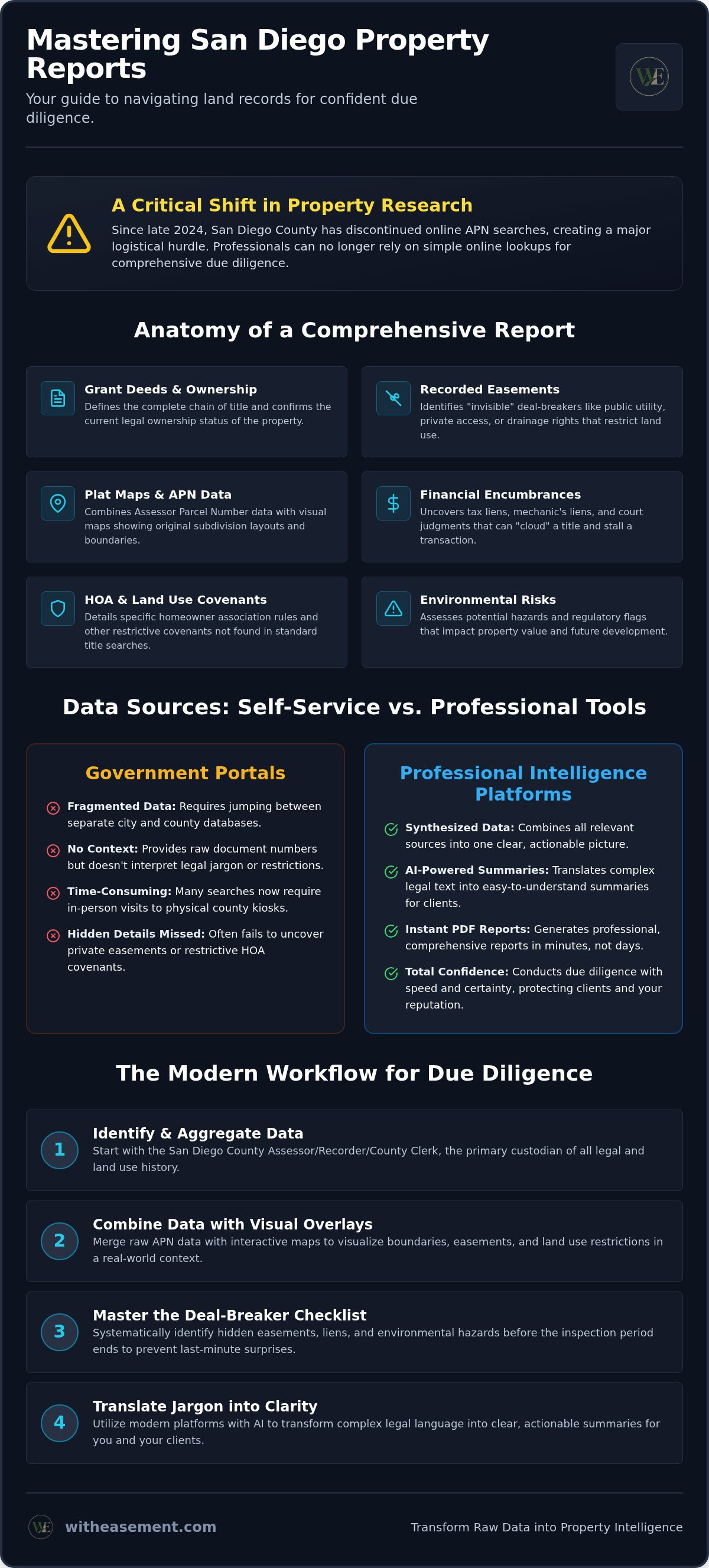
- Learn how to combine APN data with visual map overlays to generate a comprehensive property report San Diego professionals rely on for accurate due diligence.
- Understand the specific time and cost trade-offs between using free government self-service portals and specialized professional research tools.
- Master a step-by-step workflow to identify hidden easements and environmental deal-breakers before the inspection period ends.
- Discover how modern platforms use AI to translate complex legal jargon into clear, actionable summaries for your clients.
Understanding San Diego County Land Records: The Foundation of Property Research
San Diego County land records represent the complete legal biography of a piece of earth. They track every hand that has held the deed and every restriction placed on the soil. The San Diego Assessor/Recorder/County Clerk serves as the official custodian for these documents. While these records are public, accessing them isn't always a straight line. You're dealing with a massive library of history that requires precise navigation to find what matters for a modern transaction.
You'll find different rules depending on where the parcel sits. If it's in an unincorporated area like Ramona or Fallbrook, the county's Planning & Development Services (PDS) handles most data. However, for properties in incorporated cities like Oceanside or San Diego, you must often bridge the gap between city planning departments and county recording offices. Since late 2024, online APN searches are restricted due to state law. You can't just browse from your couch anymore; many searches now require in-person kiosk visits. This fragmentation is why a basic search often fails to provide a comprehensive property report San Diego professionals need for due diligence.
Key Records Maintained by the County Clerk
The office of the Recorder of Deeds, locally known as the County Recorder, manages a massive library of legal instruments. These aren't just names on a screen; they are the binding documents for every transaction. To build a solid foundation for your research, you must look for specific items that impact property value and use. Grab these documents first to see the property's true status:
- Grant Deeds: These define the chain of title and current ownership status.
- Recorded Plat Maps: These visual subdivision maps show how the land was originally carved out.
- Financial Encumbrances: This includes tax liens, mechanic's liens, and court judgments that "cloud" the title.
Why Public Portals Aren't Always Comprehensive
Government websites provide raw data, but they don't provide context. You might find a recorded document number without seeing the actual text of the easement. Public portals often separate building permits from land use restrictions. This forces you to jump between different databases just to see if a pool can be built over a specific area. Most county systems won't alert you to a private pipeline easement or a restrictive HOA covenant. These "hidden" details are often the biggest deal-breakers in a real estate transaction. A comprehensive property report San Diego must synthesize these disconnected data points into one clear picture. It saves you from the "missing data" trap that kills deals during the final hours of escrow.
Essential Components of a Comprehensive Property Report in San Diego
A professional report goes far beyond a simple title search. It acts as a synthesis of legal, physical, and administrative data, turning raw records into actionable intelligence. To provide a comprehensive property report San Diego clients can rely on, you must bridge the gap between static documents and visual reality. This means combining Assessor Parcel Number (APN) data with interactive map overlays. Instant results have moved from a luxury to the industry standard. Realtors who can provide immediate clarity on a parcel's status build faster trust and close deals with fewer surprises.
Modern property research is about "Property Intelligence." It isn't just about finding a deed; it's about understanding how that deed interacts with the physical world. Following a robust due diligence checklist is non-negotiable for protecting your client's interests and your professional reputation. You can access these PDF property reports instantly to stay ahead of the competition and keep negotiations moving.
Recorded Easements and Land Use Rights
Easements are often the "invisible" deal-breakers. A Public Utility Easement (PUE) might allow a city crew to dig up a backyard, while a private access easement could grant a neighbor the right to drive across the driveway. In San Diego County, identifying specific sewer and drainage easements is critical before any planned renovations. For a deeper look at locating these documents, consult this guide on San Diego property easement search techniques. Understanding these rights ensures your buyer knows exactly what they can and cannot do with their land.
HOA Data and CC&Rs
Finding HOA management contact information in public records is notoriously difficult. However, Covenants, Conditions, and Restrictions (CC&Rs) are vital for buyer due diligence. These documents dictate everything from paint colors to short-term rental possibilities. With the median San Diego HOA fee reaching $367 per month in 2026, buyers need total transparency on these costs and rules. Comprehensive HOA searches help prevent post-sale litigation by disclosing these administrative layers early in the process.
Environmental and Infrastructure Overlays
San Diego's diverse geography brings unique risks. A proper report must include flood zone risk assessments that compare FEMA data with local San Diego requirements. Pipeline overlays are equally important; they identify high-pressure gas lines that might run near or through a property. Given the projected 16% increase in California homeowners insurance rates for 2026, wildfire risk zones have a direct impact on land use and affordability. Visualizing these overlays allows you to spot environmental red flags before they become expensive liabilities.
Navigating San Diego Data Sources: Self-Service vs. Professional Tools
Accessing property data shouldn't feel like a full-time research project. You have two primary paths: the manual government route or modern property intelligence tools. Each has its place, but the right choice depends on your deadline and the depth of detail required. Every search starts with the Assessor Parcel Number (APN). It's the unique identifier that connects a physical address to its legal history. While title companies provide preliminary reports, these often arrive too late in the escrow process to catch early deal-breakers. A comprehensive property report San Diego realtors use for initial scouting needs to happen much faster. Waiting for a title officer can mean losing a competitive edge in a fast-moving market.
The trade-off between cost and time is the biggest factor here. Government portals are generally free or low-cost, but they require significant manual effort to navigate. You're often forced to piece together information from three or four different departments just to understand a single lot. Professional tools eliminate this friction by doing the heavy lifting of data aggregation for you. They turn hours of digital digging into a few clicks, providing a level of clarity that raw public records simply can't match.
Using San Diego County PDS Reports
For unincorporated parcels, the San Diego County Planning & Development Services (PDS) portal is a vital resource. You can access their tools at sandiegocounty.gov/pds. This site allows you to look up building permit history and basic property summaries. The "Self-Service" portal is useful for checking recent zoning changes or permit statuses. However, the interface is often clunky and difficult for non-technical users to navigate quickly. If you need historical records that haven't been digitized, you'll still have to submit manual requests to the County Clerk. This manual process can take days, which isn't ideal when you're trying to clear contingencies.
The Rise of Property Intelligence Platforms
Speed defines the modern real estate landscape. Centralized platforms now aggregate data from the County, various cities, and private sources into a single view. Instead of squinting at static PDF plat maps, you get interactive GIS layers that you can toggle on and off. You can see flood zones, pipeline locations, and easement boundaries instantly. Subscription-based access is becoming the standard for high-volume agents who value their time. It eliminates the need for repeated kiosk visits or digging through fragmented government sites. This tech-forward approach delivers the comprehensive property report San Diego buyers expect. It turns complex research into a simple, visual discovery process.
Due Diligence Checklist: Building Your San Diego Property Report
Physical inspections cover the roof and plumbing, but they often miss the invisible legal barriers that stall closings. You need a sequential workflow to build a comprehensive property report San Diego buyers can trust. An encumbrance is any claim or liability attached to the property. Identifying these early protects your commission and your client's investment. Cross-referencing multiple data sources ensures no detail slips through the cracks during the high-pressure contingency period. Speed is your greatest asset here.
Step 1: Parcel Identification and Basic Stats
Precision starts with the Assessor Parcel Number. Verify the APN and legal description against the current grant deed to ensure you're researching the correct boundaries. Check the tax status with the San Diego Treasurer-Tax Collector to catch any outstanding liabilities. In 2026, total property tax billed in the county reached a record $9.83 billion, so verifying the specific tax bill for your parcel is essential. Understanding the specific zoning code is equally vital. It dictates whether your client can build an ADU or if they're restricted by historic district regulations.
Step 2: Easement and Encumbrance Search
This is where most deals face friction. Search for recorded easements using the APN to find hidden utility lines like sewer, gas, or water mains that restrict building footprints. An unexpected right of way can kill a planned expansion before it starts. Use AI-generated summaries to quickly interpret dense legal language in recorded documents. This allows you to spot potential deal-breakers in seconds rather than hours. For immediate access to these insights, you can start your property easement search today and skip the manual digging.
Step 3: Risk and Administrative Review
Finalize your comprehensive property report San Diego by assessing external risks. Overlay flood maps to determine if mandatory insurance will impact the buyer's monthly budget. Given the median San Diego HOA fee of $367 in 2026, you must locate the management company early to request current fee structures and reserve studies. Once you've gathered all data, generate a professional PDF report. This documents your due diligence and provides a clear, visual summary for all parties involved. It moves the transaction forward with total transparency and professional clarity.
Traditional property research is a fragmented process that eats up your most valuable asset: time. WithEasement serves as the bridge between raw, intimidating public records and the professional clarity you need to close deals. It centralizes San Diego-specific data into a single, intuitive interface. You don't have to be a title expert or a land surveyor to understand a parcel's constraints. This platform empowers you to provide "big-firm" data to your clients with the click of a button. It's about removing the friction that usually accompanies complex due diligence.
Efficiency defines the modern realtor's success. By using a centralized platform, you eliminate the need to visit multiple government sites or wait for title officers to return your calls. You get instant access to the layers that matter most, from pipeline overlays to flood zones. This speed allows you to move from initial curiosity to deep insight in minutes. It turns a comprehensive property report San Diego into a standard part of your workflow rather than an occasional burden.
AI-Powered Summaries of Recorded Documents
Recorded documents are often written in dense, archaic legal language. Our AI summaries solve this by translating complex easement terms into plain English. You can process hundreds of pages of CC&Rs or Grant Deeds in seconds. This automation significantly reduces the risk of human error. You won't miss a critical "Right of Way" or a restrictive covenant hidden on page forty. It gives you the confidence to explain property encumbrances to your clients without needing a law degree. You save hours of reading and gain immediate, actionable facts.
Professional PDF Reports for Real Estate Professionals
Visualizing data is only half the battle; you also need to share it. WithEasement makes it easy to generate a professional comprehensive property report San Diego clients can actually understand. These reports are branded and ready for delivery with a single click. Every report includes clear map visuals, environmental risk assessments, and infrastructure overlays. You can use these documents to justify a listing price or to highlight potential issues during the negotiation phase. Having a downloadable PDF property report ensures that your due diligence is documented and easily accessible throughout the escrow process. It's a high-tech utility tool that makes you the most knowledgeable person in the room.
Take Command of Your Property Intelligence
Navigating the fragmented world of local land records doesn't have to be a manual chore. You now have a clear path to bypass the logistical hurdles of county kiosks and dense legal jargon. By prioritizing a comprehensive property report San Diego professionals trust, you protect your reputation and your client's interests. You've learned how to identify hidden encumbrances, understand complex zoning, and visualize environmental risks before they stall a transaction. These insights turn potential deal-breakers into manageable facts.
Success in the modern real estate market depends on speed and accuracy. You can now access an instant San Diego easement search and interactive flood or pipeline maps without leaving your desk. Our AI-powered property summaries do the heavy lifting by translating recorded documents into actionable insights you can share immediately. It's time to move beyond raw data and embrace professional clarity that empowers your decision-making. Start your comprehensive San Diego property report with WithEasement today and experience the efficiency of centralized property intelligence. You're ready to close your next deal with total confidence and speed.
Frequently Asked Questions
How do I find recorded easements on a property in San Diego County?
You can find recorded easements by searching the San Diego County Assessor/Recorder/County Clerk records using a parcel's APN. Since online searches are now restricted, you'll often need to use in-person kiosks or specialized digital tools. These professional tools aggregate the data and provide visual overlays, making it easier to see how a utility or access easement physically impacts the lot.
What is included in a comprehensive San Diego property report?
A comprehensive property report San Diego combines legal, physical, and administrative data into one view. It includes grant deeds, recorded easements, and interactive maps showing flood zones or pipelines. You'll also find HOA contact info and CC&R summaries. This synthesis helps you spot deal-breakers that a basic record search might miss during your initial due diligence.
Where can I look up San Diego County building permit records?
Look up building permit records via the San Diego County Planning & Development Services (PDS) portal for unincorporated parcels. If the property is within an incorporated city like Oceanside or Chula Vista, you'll need to check that specific city's building department database. These records are essential for verifying that all structural additions were legally permitted and inspected by the proper authorities.
How do I find the HOA for a specific address in San Diego?
Finding an HOA often involves searching through the CC&Rs recorded with the County Clerk or using a professional HOA search tool. Public records rarely provide current management contact info directly. With median San Diego HOA fees hitting $367 per month in 2026, getting these details early is critical. It ensures your buyer understands their total monthly commitment before they sign the final papers.
Can I search for San Diego property records by APN online?
You cannot search for records by APN on the official county website as of December 9, 2024. California Assembly Bill 1785 requires these searches to be done at physical kiosks in county offices. Professional property intelligence platforms bypass this friction by providing digital access to these records. This allows you to conduct your research from your office without the need for a commute.
What are pipeline overlays and why do they matter for San Diego properties?
Pipeline overlays are digital map layers that show the location of high-pressure gas or water lines. They matter because they often carry "Right of Way" restrictions that limit where you can build or plant trees. Knowing a pipeline's location helps you advise clients on future development potential. It prevents them from buying land they can't actually use for their intended backyard projects.
Is a title report the same as a comprehensive property report?
A title report is designed for insurance purposes, while a comprehensive property report San Diego is designed for decision-making. Title reports focus on ownership and financial liens. A comprehensive report adds layers like environmental risks, building permits, and HOA rules. It's a scouting tool that gives you a competitive advantage during the early stages of a listing or purchase.
How can I get an AI summary of a property's land records?
You can get an AI summary by using property data platforms that specialize in document analysis. These tools scan recorded deeds and easements to extract the most important facts instantly. Instead of reading hundreds of pages of legal jargon, you get a concise summary in plain English. This speed allows you to clear contingencies faster and move toward a successful closing with total confidence.


