

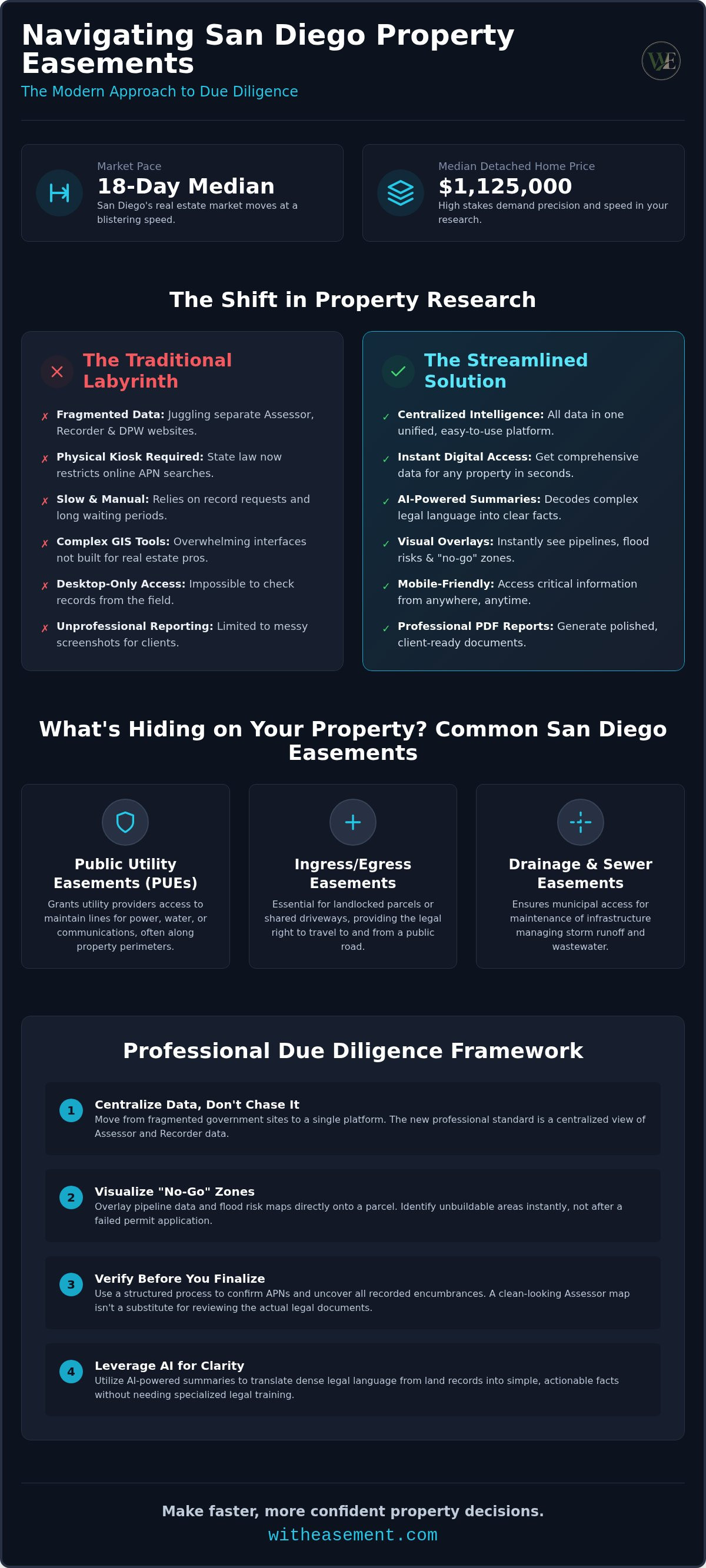
The San Diego real estate market moves at a blistering 18-day median pace, but the traditional San Diego property easement search often feels stuck in the past. You've likely spent hours wrestling with glitchy government portals or squinting at blurry plat maps, only to worry that a hidden utility line might derail your project. With recent state law changes now restricting online APN searches to physical county kiosks, the process has only become more fragmented. It's a high-stakes gamble when the median price for a detached home in the county has climbed to $1,125,000. You need a research process that matches the speed and precision of your professional investment.
You can now bypass these administrative hurdles and access comprehensive, interpreted easement data for any San Diego County property in seconds. This guide reveals how to leverage modern tools to generate professional PDF reports and AI-driven summaries that translate complex legal language into clear facts. We will look at how to visualize pipeline overlays, identify flood risks, and verify HOA data instantly. Stop waiting on manual record requests and start making faster, more confident property decisions with the right intelligence at your fingertips.
Key Takeaways
- Identify the friction caused by fragmented data across the Assessor and Recorder offices and why centralized records are the new professional standard.
- Streamline your San Diego property easement search by moving from complex GIS tools to a centralized, mobile-friendly platform for faster results.
- Learn to visualize building "no-go" zones by overlaying pipeline data and flood risk zones onto specific parcel maps.
- Follow a structured due diligence framework to verify APNs and uncover hidden encumbrances before finalizing any sale or build.
- Utilize AI-powered property summaries to decode dense legal language in land records without requiring specialized legal training.
Why traditional San Diego easement searches fail modern realtors
A professional San Diego property easement search is often a lesson in professional frustration. Most realtors start at official county websites, expecting a one-stop shop for land data. Instead, they find a fragmented system where data silos prevent a clear view of property rights. A San Diego property easement is a recorded legal right for a third party to use a specific portion of land. These encumbrances "run with the land," meaning they remain attached to the parcel regardless of who owns it. If you miss one, you risk a collapsed development deal or a costly legal dispute for your client.
The friction of fragmented data is the primary hurdle. Currently, the Assessor, Recorder, and Department of Public Works (DPW) don't talk to each other through a unified interface. As of December 9, 2024, California state law has made this even more difficult by restricting online APN searches to physical county office kiosks. You can't simply browse parcel records from your office anymore. While the county launched a new Public Records Request Center in March 2024, it still relies on manual submissions and waiting periods. This "free" government approach carries a high hidden cost: hours of lost productivity spent chasing paper trails across different departments.
Before diving into local specifics, it's helpful to understand the foundational concepts of What is a Property Easement? to see how these rights are established. In San Diego, missing a recorded document can mean the difference between a buildable lot and a permanent "no-go" zone.
The difference between Assessor maps and recorded documents
Assessor parcel maps are designed for tax purposes, not legal due diligence. They show boundaries and lot dimensions, but they often lack the specific text of an easement. A "clean" map doesn't always mean a clean title. The County Recorder is the only entity that archives the actual legal instruments. You must access the recorded deed or easement grant to see the specific language, limitations, and expiration dates. Relying solely on a visual map is a common mistake that leads to overlooked utility lines or shared access rights.
Common easement types found in San Diego County
San Diego's unique geography and infrastructure create specific types of encumbrances. You'll frequently encounter these during a San Diego property easement search:
- Public Utility Easements (PUEs): These grant utility providers or municipal water districts access to maintain lines, often found along property perimeters.
- Ingress/Egress Easements: Essential in hilly coastal areas or rural inland zones where shared driveways provide the only access to a public road.
- Drainage and Sewer Easements: Managed by municipal Public Works, these ensure that runoff and waste infrastructure remain accessible for maintenance.
Identifying these early prevents surprises during the building permit process or the final stages of a real estate transaction.
Comparing official San Diego County land records to digital platforms
Mastering professional GIS mapping systems often takes weeks of specialized training. These platforms are built for civil engineers and city planners, not for realtors who need answers in seconds. While these systems offer over 100 data layers, the interface is frequently overwhelming and lacks the intuitive flow required for daily due diligence. If you're conducting a San Diego property easement search, you don't want to dig through technical metadata just to find a single utility line or shared driveway agreement.
Accessibility remains a significant barrier for traditional government portals. Most official sites are desktop-only, making it difficult to check records while standing on a client's driveway. These sites also lack professional reporting features. When a client asks for proof of an encumbrance, you're often left taking screenshots of a browser window rather than providing a polished, professional PDF. Integrating multiple data types is where modern platforms outshine traditional methods. Seeing HOA data, flood risk, and pipeline overlays in a single view provides a level of clarity that fragmented sites can't match.
Under California Government Code § 65871, specific procedures exist for creating easements through recorded covenants. Missing these details in a manual search can lead to significant liability for a developer or homeowner. Using a WithEasement Membership allows you to bypass these administrative hurdles by providing instant access to recorded easements and pipeline overlays in a user-friendly format.
Government Portals: The manual route
Navigating official county databases requires patience and a specific set of search parameters. The secured assessment roll search is functional but limited in its scope. If you need to find specific document numbers or Book/Page records, you're often forced to use phone-based inquiries or visit a physical office in person. Because these systems were designed for administrative record-keeping rather than real estate sales, they lack the speed and visual clarity needed for modern property transactions.
WithEasement: The professional intelligence route
Centralized data speeds up the due diligence process for realtors and developers alike. You can generate professional PDF reports for listing presentations with a single click, ensuring your clients have the full picture before they sign. The platform's AI-powered summaries are particularly valuable. They translate complex legal descriptions into digestible insights, allowing you to verify land use permissions and identify potential building "no-go" zones without waiting days for a public records request to process. This modern approach turns a San Diego property easement search from a chore into a competitive advantage.
Decoding property encumbrances: What your search actually shows
A successful San Diego property easement search uncovers more than just lines on a map. It reveals the invisible boundaries that dictate how a property can actually be used. While a title report lists documents, a modern search, like those facilitated by WithEasement, visualizes these encumbrances in real time. For instance, a pipeline overlay can reveal high-pressure gas lines that restrict ADU placement. This level of detail is essential for developers looking to maximize lot utility without hitting underground obstacles.
Understanding how to find easement records directly from San Diego County sources is the first step in protecting your investment. The San Diego County Assessor/Recorder/County Clerk (ARCC) website and local city planning departments are crucial starting points for official documentation. In San Diego County, topography plays a massive role in where these records appear. Properties near canyons or coastal bluffs often carry specific drainage or environmental overlays that don't exist in flat inland parcels. An HOA search by address further clarifies these restrictions by uncovering CC&Rs that might be stricter than city zoning laws.
Identifying utility and sewer easements
Utility easements are the most common "surprise" in local real estate. Most residential lots contain a Public Utility Easement (PUE), typically five to ten feet wide, along the front or rear property lines. You'll need to read the plat map carefully to verify these specific widths. Sewer easements can be even more restrictive. Because these lines require heavy equipment for maintenance, building a pool or a permanent deck over a sewer main is usually prohibited. Uncovering these during a San Diego property easement search prevents major project delays.
Flood risk and environmental overlays
San Diego's varied terrain means FEMA flood zones can cut across a single parcel, affecting only a small portion of the land. Interpreting these zones within San Diego County limits is vital for determining insurance premiums and buildability. Drainage facilities on private property often come with maintenance obligations that the homeowner must fulfill. You can use these environmental overlays to justify a lower property value or negotiate better purchase prices during the due diligence period. Seeing these risks visually allows for a more transparent conversation between realtors and clients.
A professional due diligence framework for San Diego land use
Modern real estate professionals need a repeatable workflow to navigate the complexities of local land records. Relying on luck or fragmented data leads to missed deadlines and legal liability. A professional San Diego property easement search should follow a structured sequence to ensure no stone is left unturned. This framework moves you from a simple address to a deep, actionable understanding of a parcel's potential in minutes.
- Step 1: Perform an APN lookup. Verify the correct San Diego parcel number. Since the December 2024 restriction on online APN searches at the county level, using a digital platform that links addresses to parcel numbers is the most efficient starting point.
- Step 2: Overlay easements and pipelines. Check for building "no-go" zones visually. Identify where high-pressure gas lines or municipal water mains might conflict with proposed structures or landscaping.
- Step 3: Review HOA status. Uncover hidden CC&Rs and use restrictions that dictate everything from paint colors to short-term rental permissions.
- Step 4: Generate a PDF report. Create a professional document for stakeholders, including buyers, sellers, and lenders. This provides a clear paper trail for your due diligence.
- Step 5: Use AI summaries. Highlight potential deal-breakers instantly. Let technology scan dense legal descriptions to find keywords like "revocable," "perpetual," or "exclusive use."
Following this sequence reduces the risk of human error. It ensures that every team member, from junior agents to senior developers, maintains the same high standard of research. To implement this framework on your next project, start your property easement search here and get results in seconds.
Checking for easements before building or remodeling
Never rely on a general property map when applying for building permits. Hidden easements are a primary cause for the demolition of unpermitted structures in San Diego. If a homeowner builds a guest house over a utility line, the utility company has the legal right to remove that structure to access their infrastructure. As a realtor, you have a professional responsibility to disclose these encumbrances to potential buyers to prevent these catastrophic outcomes.
Fast-tracking research for real estate listings
Property intelligence allows you to create more accurate and compelling listing descriptions. When a buyer asks about a specific line on a map during an open house, you can answer with confidence. Identifying title issues early in the process significantly reduces escrow delays. Instead of waiting for a title officer to flag an issue three weeks into a deal, you can address access rights or utility restrictions before the property even hits the market.
How WithEasement centralizes San Diego property intelligence
WithEasement acts as the bridge between dense public records and your professional success. Instead of managing multiple accounts for the Assessor, Recorder, and various municipal departments, you get a single login for all San Diego County land records. This centralization eliminates the friction of traditional research methods. You no longer need to cross-reference multiple browser tabs to understand a parcel's true potential. By consolidating these disparate data streams, the platform transforms the way you conduct a San Diego property easement search.
Unlocking the value of AI-powered property summaries is a game-changer for non-lawyers. These summaries scan complex legal instruments and provide clear, digestible fragments of information. You'll immediately see if an easement is perpetual or if a pipeline overlay restricts your specific building plans. This isn't just about data; it's about clarity. It empowers you to provide high-level insights to your clients without requiring specialized legal training. You get the answers you need without the wait.
Professional PDF reports elevate your brand by delivering better data in a polished format. When you present a comprehensive report during a listing presentation or a buyer consultation, you build instant trust. It shows you've done the heavy lifting. You're not just guessing about property encumbrances; you're providing documented proof. Join the growing community of San Diego real estate professionals who use WithEasement to win more deals through superior intelligence and faster due diligence.
Key features of the WithEasement platform
The platform is designed for speed and utility. You don't need specialized training to navigate the interface. Every tool is built to provide immediate results. Key features include:
- Interactive Map: Visualize easement, HOA, and flood overlays in a single, cohesive view to spot conflicts early.
- Address and APN Search: Find any San Diego parcel instantly, bypassing the recent restrictions on government portals.
- Automated Summaries: Get instant AI-driven breakdowns of recorded property documents to identify potential deal-breakers.
Getting started with your San Diego property search
Starting your journey toward better property intelligence is simple. Sign up for a WithEasement Membership to unlock full access to the San Diego County database. Once you're in, the process is streamlined for maximum efficiency. Enter an address or APN to pull up the interactive map. Select the overlays you need, such as pipelines or flood zones, and review the AI-powered summary of the recorded documents. Finally, download your professional PDF report to share with stakeholders or include in your digital files.
Stop wasting time on glitchy portals and manual record requests. Start your San Diego property easement search with WithEasement today and experience the future of real estate due diligence.
Master your due diligence with instant property intelligence
San Diego's real estate market moves at a blistering pace, and your research process must keep up. You've seen how fragmented government records and new APN restrictions create unnecessary barriers for busy professionals. By switching to a centralized platform, you gain the clarity of AI-powered property summaries and the authority of professional PDF reporting tools. These resources allow you to visualize hidden pipeline overlays and identify flood risks before they become costly deal-breakers.
Performing a comprehensive San Diego property easement search no longer requires physical trips to county kiosks or hours of manual document decoding. You can now access precise, interpreted land records from any device, ensuring your clients receive the most accurate information available. Focused exclusively on San Diego County data, our platform helps you stay ahead of the competition and avoid the pitfalls of unrecorded encumbrances.
Ready to streamline your workflow? Access San Diego Easement Records Instantly with WithEasement and take control of your property research today. You'll have everything you need to close your next deal with total confidence.
Frequently Asked Questions
How do I find easements on my property in San Diego?
You can find easements by searching the San Diego County Recorder's Index or using a centralized property intelligence platform. Traditional methods require searching by document number or visiting a physical kiosk as of December 2024. Modern tools allow you to search by address to visualize recorded easements and utility lines instantly. This approach bypasses the need for manual record requests and provides immediate clarity on land use restrictions.
Are all easements recorded in San Diego County?
Most legal easements are recorded, but prescriptive or implied easements might not appear in official records. A San Diego property easement search focuses on recorded documents like deeds and plat maps found in the County Recorder's database. Under California law, prescriptive easements can be established after five years of continuous, unauthorized use. These specific legal claims often require a professional title search or legal consultation to verify beyond public records.
Can I build a fence over an easement in San Diego?
You can often build a fence over an easement, but you do so at your own risk. Most easement holders, such as SDG&E or municipal water districts, require unobstructed access to their infrastructure. If they need to maintain a line, they have the legal right to remove your fence without compensation. Always check the specific language in your recorded easement document to understand your rights and the holder's access requirements.
What is the difference between an easement and an encroachment?
An easement is a legal right to use someone else's land, while an encroachment is an unauthorized physical intrusion onto a neighbor's property. For example, a shared driveway is often a recorded easement. A neighbor's shed built two feet over your property line is an encroachment. Easements are usually documented in a San Diego property easement search, whereas encroachments are typically discovered during a physical land survey.
How do I find my San Diego Assessor Parcel Number (APN)?
You can find your APN on your property tax bill or by using a digital property search platform. While the County Assessor's website previously allowed online lookups, changes in state law effective December 9, 2024, now require these searches to be conducted in person at county kiosks. Using a professional intelligence tool that integrates parcel data is the fastest way to verify your APN remotely without visiting a physical office.
Where can I find HOA documents for a specific San Diego address?
HOA documents are typically found through a specialized HOA search or by requesting them from the association's management company. These records include CC&Rs and bylaws that dictate land use and architectural standards. Since these are private agreements, they don't always appear in a standard county easement search. Accessing them through a centralized platform ensures you see both public encumbrances and private association restrictions in one view.
How long does a property easement search take?
A manual search through county records can take several days or weeks depending on the complexity of the title chain. If you visit a physical kiosk or submit a public records request through the portal launched in March 2024, expect a significant wait time. Modern digital platforms have reduced this process to seconds. You can now access recorded easements, pipeline overlays, and AI-driven summaries instantly from your mobile device or desktop.
Do I need a surveyor to find my property easements?
You don't need a surveyor to find recorded easements, but you may need one to physically locate them on the ground. A property intelligence search identifies the legal existence and dimensions of an easement from official records. A licensed surveyor then uses that data to mark the exact boundaries on your land. This step is critical before starting any major construction project or installing permanent structures like pools or ADUs.


