

Your dream property in North Park or La Jolla might come with a silent partner you never invited to the closing table. Since the rollout of Assembly Bill 1785, understanding property easements in San Diego has become a logistical hurdle that often requires a physical trip to a county kiosk just to start your research. Most buyers and developers don't realize that a utility line or an old prescriptive right-of-way can legally dictate where they can build, plant, or park before they even break ground.
It's exhausting to decipher dense legal jargon in a title report while your project timeline hangs in the balance. You deserve total clarity on your land use rights without wasting hours at the County Recorder's office. This 2026 guide helps you master the complexities of local land use and shows you how to uncover hidden easements instantly. We'll break down current fee schedules, explain how transit density laws like SB 79 impact your lot, and provide a clear path to getting the professional reports you need to mitigate risk and build with confidence.
Key Takeaways
- Discover why San Diego's unique canyon and coastal geography makes easements more common and how they define your property's usable boundaries.
- Gain clarity on the difference between public rights-of-way and private utility easements, including how to identify SDG&E's specific access rights.
- Master the step-by-step process for understanding property easements in San Diego, from locating your APN to navigating the County Recorder’s index.
- Learn how to bypass manual record searches by using interactive maps to visualize pipeline overlays, flood zones, and HOA boundaries instantly.
- Understand how new 2026 density regulations like SB 79 could impact future development and easement requirements on your local land.
What Are San Diego Property Easements & Why They Matter
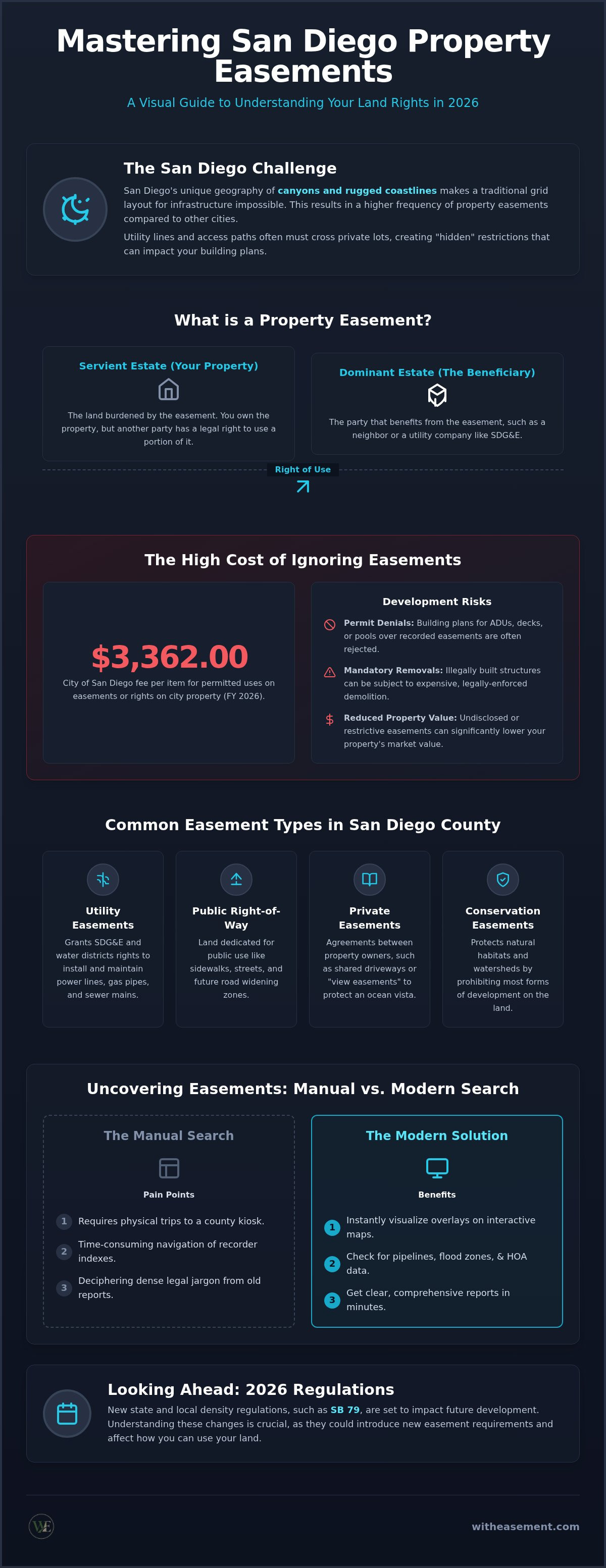
An easement is a non-possessory interest in land that stays with the title, granting someone else the legal right to use your property for a specific, limited purpose. While you still own the soil, you don't have the exclusive right to block certain types of access. When understanding property easements in San Diego, you must view your land as a collection of rights rather than a simple boundary. These rights often belong to utility companies, the City, or even your neighbors.
San Diego's unique geography makes easements more common here than in many other California cities. Our sprawling canyons and rugged coastal zones prevent a traditional grid layout for infrastructure. Because of this, utility lines and access paths often cut through private lots to reach homes tucked into hillsides or along the shore. If you own a home near a canyon edge in Scripps Ranch or a beach lot in La Jolla, your property likely hosts several recorded access points that you cannot legally obstruct.
California law categorizes these relationships through the dominant and servient estates. The "servient estate" is the land burdened by the easement; that's your property. The "dominant estate" is the party that benefits from the use, such as a neighbor who needs your driveway to reach their garage. These designations are permanent. They don't disappear when the property sells, which is why understanding property easements in San Diego is critical before you sign a purchase agreement or apply for building permits.
Easements directly impact your property value and your ability to develop the land. The City of San Diego is strict about building over recorded easements. In fact, according to the Fiscal Year 2026 User Fee Schedule, the City charges a fee of $3,362.00 per item for permitted uses related to easements or rights on city property. Attempting to build a deck, ADU, or pool over a utility line can lead to permit denials or expensive mandatory removals.
The 'Hidden' Nature of Recorded Easements
Easements don't always appear on a physical survey. A surveyor might mark your fences, but they won't necessarily see a "prescriptive easement" created by five years of continuous, unauthorized public use. These "hidden" restrictions are often buried in decades-old title reports. If a neighbor has openly used a corner of your lot to reach a trail for over five years without your permission, they may have established a permanent legal right to continue doing so.
Common San Diego Easement Scenarios
- Beach Access: Properties in Del Mar or Point Loma often feature public access paths that allow surfers and hikers to reach the water.
- Shared Driveways: In older neighborhoods like North Park or Hillcrest, narrow lots often share a single paved entrance recorded as a private easement.
- Canyon Maintenance: The City of San Diego Open Space Division frequently holds easements to access brush management zones behind homes for wildfire mitigation.
Common Types of Easements Found Across San Diego County
Every property in San Diego County exists within a web of shared rights. Identifying these early protects your investment and prevents costly construction delays. While utility access is the most frequent type, several other categories dictate how you can use your land. The process of understanding property easements in San Diego begins with recognizing which specific entity holds a claim to your parcel.
- Utility Easements: These grant SDG&E or municipal water districts the right to install and maintain infrastructure. This includes overhead power lines, underground gas pipes, and sewer mains. These rights are usually permanent and stay with the title.
- Public Right-of-Way: This covers land dedicated for public use, such as sidewalks, streets, and future road widening zones. These are common in developing areas like Otay Mesa or Chula Vista where the City plans for future traffic flow.
- Private Easements: These are custom agreements between property owners. One neighbor might grant another a "view easement" to prevent tall trees from blocking an ocean vista. According to California Government Code § 65871, these are established through recorded covenants that bind all future owners of the land.
- Conservation Easements: These protect San Diego’s natural watersheds and sensitive habitats. They often prohibit any development to preserve the local ecosystem, particularly in canyon-heavy regions.
Utility and Pipeline Overlays
High-pressure gas lines require specific buffer zones for safety. You cannot build permanent structures within these designated strips. This makes understanding property easements in San Diego vital if you plan to build an Accessory Dwelling Unit (ADU). A sewer easement running through your backyard could instantly disqualify your site for a secondary suite or a pool. The City of San Diego charges $3,362.00 per item for permitted uses related to these rights. You can view pipeline overlays to see exactly what lies beneath the surface before you pay for architectural plans or permit filings.
HOA and CC&R Restrictions
If your property is in a managed community like Carmel Valley or Eastlake, your Homeowners Association (HOA) likely holds easements over your lot. These allow the HOA to maintain common slopes, landscaping, or shared drainage systems. These rights are usually detailed in the Covenants, Conditions, and Restrictions (CC&Rs). Since California Assembly Bill 1785 removed the ability to search by APN online in San Diego County, searching by address for HOA data is the most efficient way to conduct due diligence. Our platform streamlines this process by centralizing HOA and easement data in a single, interactive view. This ensures you aren't surprised by community restrictions after you close escrow.
Public vs. Private Easements: Navigating the Legal Landscape
Public easements are typically granted to government entities or utility providers for the common good. Private easements, however, are agreements between two specific parties. Understanding property easements in San Diego requires a clear look at how these rights are created and, more importantly, how they end. Public rights are established through dedication on a parcel map or a formal city ordinance. Terminating them is difficult. It requires a formal "abandonment" process where the City Council or County Board of Supervisors must vote to relinquish the right.
Private easements are more flexible but equally binding. These are often created through a deed or a written contract. To remove one, the party benefiting from the easement must sign a "quitclaim deed" to release their interest. If you discover an old utility easement on your lot that hasn't been used in decades, you may be able to petition the utility company for a quitclaim. This process cleans up your title and can significantly increase your property’s marketability. It's a proactive step that protects your equity.
Flood risk overlays are another critical tool for homeowners. In San Diego’s canyon-heavy terrain, areas designated as high-risk flood zones often overlap with municipal drainage easements. If your property sits in a natural path for runoff, the City likely holds a right to keep that path clear. Using interactive maps to visualize these layers can reveal potential restrictions that a standard paper deed might miss. This data is essential for managing environmental risk before you commit to a purchase.
Encroachments and Disputes
Disputes often arise when a fence, retaining wall, or shed crosses an easement line. If your structure blocks a utility company's access, they have the legal right to remove it, often at your expense. The San Diego County Assessor documents these land uses, but resolving a boundary disagreement should always start with a professional record review. Before hiring a lawyer, check the recorded survey map. Effective July 15, 2026, the fee for a Record of Survey Map Review is $711 for the first sheet. This document provides the definitive word on where your rights end and the easement begins.
Impact on Development and Permits
San Diego Development Services requires a comprehensive easement check for every building permit application. "Floating easements" are particularly troublesome for new construction. These are recorded rights that don't specify a precise location on the lot. They simply state that a utility has a right to cross the property "somewhere." This ambiguity can halt an ADU project in its tracks. Utilizing AI summaries can help you quickly digest hundreds of pages of title records to spot these red flags. Instead of reading every line, you get a direct insight into whether a floating easement exists and how it might impact your site plan.
Step-by-Step: How to Perform a San Diego Property Easement Search
Traditional methods for understanding property easements in San Diego changed significantly on December 9, 2024. California Assembly Bill 1785 removed the ability to perform online APN searches through the official County portal. This means if you rely solely on government kiosks, you'll spend hours in line just to start your due diligence. A modern, tech-forward search requires a more efficient approach to bypass these administrative hurdles.
First, identify your target parcel. While street addresses are convenient for navigation, the Assessor Parcel Number (APN) is the only definitive way to track land records. Once you have this number, you can cross-reference the County Recorder’s index for every deed, map, or covenant recorded against that specific plot. If you're currently in a real estate transaction, your preliminary title report will list these easements as "exceptions" to your title insurance policy.
To move faster, utilize a property intelligence platform for instant visualization. Instead of guessing where a utility line sits based on a text description, you can see the easement layers overlaid directly on a satellite map. Once you've identified the relevant restrictions, generate a professional PDF report. This documents your findings for stakeholders, ensuring your architect, contractor, and lender are all working from the same data set. You can start your Property Easement Search now to skip the county kiosks and get instant results.
Searching by Address vs. APN
Precision is everything in land research. Street addresses often change as neighborhoods are re-subdivided or renamed, but the APN remains the constant identifier for land records. Finding your APN instantly using an interactive map tool ensures you are researching the correct boundaries. This prevents the common mistake of pulling records for a neighboring lot or an adjacent public right-of-way.
Interpreting the Results
Once you have the documents, look closely at the Plat Map. This visual diagram shows exactly where the easement sits in relation to your home's footprint. You'll likely see terms like "Easement in Gross," which typically belongs to a utility like SDG&E, or "Easement Appurtenant," which benefits a neighboring property. Use AI-powered summaries to translate this legalese into plain English. This helps you understand exactly where you can and cannot build without needing a law degree to decipher the fine print.
Simplifying Due Diligence with WithEasement’s Property Intelligence
Traditional land research is often slow and fragmented. With the 2024 restrictions on online APN searches at the county level, property owners and professionals need a faster path to clarity. Our platform centralizes San Diego County’s complex records into a single, interactive map. This makes understanding property easements in San Diego as simple as typing in an address. You can instantly visualize high-pressure gas lines, flood zones, and HOA boundaries without leaving your desk. It's about moving from guesswork to certainty in seconds.
Our technology does the heavy lifting of organizing public data. Instead of manually reading through hundreds of pages of title exceptions, you can use AI Summaries to extract critical details. These summaries translate dense legalese into plain English. If a floating easement or a specific utility restriction exists on your lot, you'll see it clearly highlighted. This level of visualization prevents the "hidden" surprises that typically stall real estate transactions or construction projects.
Documentation is just as important as discovery. You can generate professional PDF Property Reports to share with stakeholders, lenders, or clients. These reports provide a comprehensive snapshot of a parcel's land use rights and environmental risks. By having all this data in one place, you reduce the friction of property research and mitigate the risk of costly development errors.
The Realtor’s Competitive Advantage
In a competitive market, speed wins listings. Providing a transparent, data-backed report during the initial listing process builds immediate trust with potential buyers. It removes the uncertainty that often clouds properties with complex canyon access or shared driveways. Instead of waiting days for a title company to return a preliminary report, you can present a clear view of the property’s restrictions on day one. A WithEasement Membership offers a cost-effective alternative to paying for individual record requests, giving you the tools to close deals with total confidence.
Empowering Homeowners and Builders
Don't waste thousands of dollars on architectural plans for a site that has building constraints. Identify sewer lines or utility buffer zones before you commit to a contractor or a design. Mastering the process of understanding property easements in San Diego ensures your ADU or home expansion project stays on schedule. Monitoring neighborhood flood risks and pipeline locations also protects your long-term equity. It's a proactive approach to property management that puts high-level data in your hands. Unlock San Diego property insights with a WithEasement membership today.
Take Control of Your Property Intelligence
Your land is more than just a street address; it's a complex layer of recorded rights and restrictions. Mastering the art of understanding property easements in San Diego is the best way to safeguard your investment and avoid the logistical headaches of manual record searches. Whether you're navigating new density laws or planning a backyard ADU, having instant access to pipeline, flood, and HOA data ensures you never build on a "hidden" restriction. You can skip the long lines at the County Recorder's office and move straight to actionable insights.
WithEasement provides the modern tools you need to visualize these overlapping layers instantly. Leverage our AI-powered property summaries to translate technical documents into clear language and access comprehensive San Diego County data in seconds. When you're ready to share your findings with contractors or clients, you can generate downloadable PDF reports that keep everyone on the same page. Don't let a missing record stall your project or complicate your closing. Start your San Diego easement search now with WithEasement and build your future with total confidence.
Frequently Asked Questions
How do I find out if there is an easement on my San Diego property?
Review your preliminary title report or search the San Diego County Recorder’s official index using your Assessor Parcel Number (APN). Since Assembly Bill 1785 requires in-person kiosk visits for APN searches at county offices, using a digital platform that centralizes this data is the most efficient way of understanding property easements in San Diego without the commute. You can also view interactive maps to see recorded utility and pipeline overlays instantly.
Can I build a fence or ADU on a utility easement in San Diego?
Generally, you cannot build permanent structures that obstruct a utility provider's access to their infrastructure. The City of San Diego charges a fee of $3,362.00 per item for permitted uses related to easements, but most utility companies will require you to remove obstructions at your own expense if they need access. Always check your specific easement language before spending money on architectural plans for an ADU or fence.
Do easements in California ever expire or go away?
Most recorded easements "run with the land" and remain active indefinitely unless they are formally terminated. Termination usually requires a quitclaim deed from the dominant estate or a formal abandonment vote by the City Council for public rights-of-way. Conversely, a prescriptive easement can be created after five years of continuous, unauthorized use, meaning new easements can form even if they aren't currently on your title.
What is the difference between an easement and a right-of-way?
An easement is a broad legal right to use someone else's land for a specific purpose, whereas a right-of-way is a specific type of easement that allows for passage. In San Diego, rights-of-way are typically used for public streets, sidewalks, or shared driveways in older neighborhoods like Hillcrest. While all rights-of-way are easements, not all easements grant the right to travel across the land.
How much does it cost to search for easements in San Diego County?
Official document copy fees at the County Recorder are $2 for the first page and $0.05 for each additional page. If your research requires a professional map review, the San Diego County Record of Survey Map Review fee is $711 for the first sheet as of July 15, 2026. Utilizing a membership-based property intelligence platform is often more cost-effective for those performing multiple searches or requiring detailed overlays.
Can a neighbor grant themselves an easement on my land?
A neighbor cannot unilaterally grant themselves an easement, but they can earn one through "prescriptive" use under California law. If a neighbor uses a portion of your property openly, continuously, and without your permission for at least five years, they may gain a permanent legal right to that use. Monitoring your boundaries and understanding property easements in San Diego is essential to preventing these unauthorized claims from becoming permanent.
How do I remove an old SDG&E easement from my property title?
You must contact SDG&E’s real estate or land management department to request a formal abandonment or quitclaim. If the utility company determines the easement is no longer necessary for their infrastructure, they will record a document to release their interest. This process often involves an administrative application and may require you to provide a professional survey to prove the infrastructure has been relocated or removed.
What should I do if I find an undisclosed easement after buying a home?
Contact your title insurance provider immediately to determine if the easement is a covered "exception" or a title defect. Title insurance is designed to protect homeowners from financial loss caused by undisclosed encumbrances that were recorded but missed during the title search. Resolving these issues early is critical, as an undisclosed easement can impact your property value and your ability to obtain building permits for future improvements.


