

Your client just found a hidden utility line on their title report, and now they're ready to walk away from a perfect home. You know it's a standard access right, but to them, it feels like a total loss of control. Explaining property easements shouldn't feel like a high-stakes legal defense. Most agents lose hours digging through county records or squinting at blurry map overlays just to give a simple answer. It's a friction point that can stall a deal and drain your productivity.
It's frustrating when legal jargon gets in the way of a smooth closing. You want to be the authoritative expert who simplifies the complex, not the one stuck in a cycle of waiting for answers. This WithEasement guide provides a clear communication framework to help you manage expectations and build lasting trust. Learn how to use digital overlays and AI summaries to accelerate your due diligence process. We'll show you how to turn dense land use data into clear, visual insights that keep your clients calm and your deals on track.
Key Takeaways
- Simplify land rights using the "bundle of sticks" analogy to help clients visualize ownership without the legal jargon.
- Identify common utility and access easements early to set clear expectations about property usage and third-party rights.
- Master the process of explaining property easements in San Diego by verifying details through title reports and visual plat maps.
- Prevent deal-breaking surprises by clarifying buildability rules and identifying potential encroachments before they become legal hurdles.
- Use AI-powered summaries and professional PDF reports to translate complex records into actionable insights for your clients.
What is an Easement? Defining the Concept for Your Clients
Mastering the art of explaining property easements in San Diego starts with a clear, accessible definition. To understand what is a property easement?, think of it as a legal carve-out. It is a specific right to use land owned by someone else for a clearly defined purpose. It isn't a transfer of ownership. Instead, it's a permission slip recorded on the title that stays with the land, regardless of who buys or sells it.
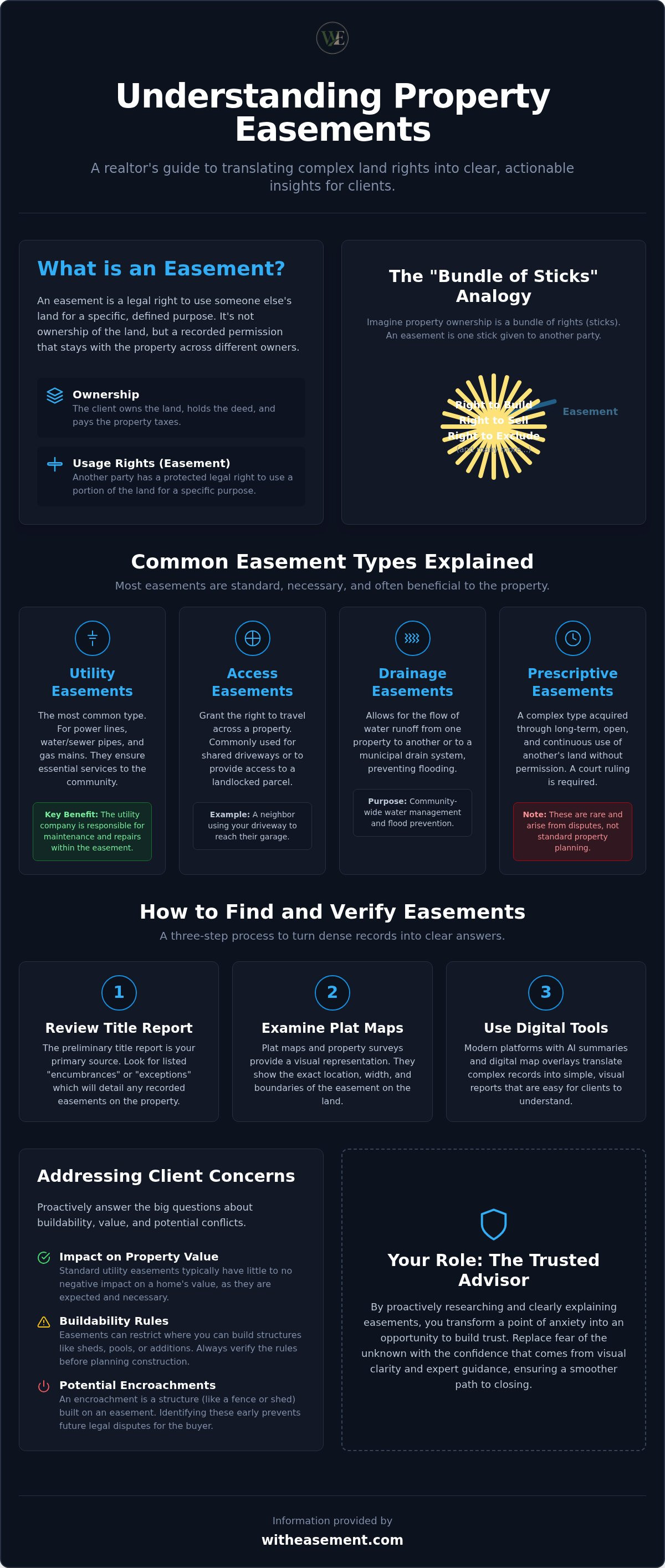
Most clients assume that "owning" a property means they have absolute control over every square inch from the clouds down to the center of the earth. In the professional world of land use, we use the "Bundle of Sticks" analogy to correct this. Imagine property ownership as a bundle of wooden sticks. Each stick represents a specific right, such as the right to build, the right to sell, or the right to exclude others. An easement is simply one stick pulled from that bundle and handed to another party, like a utility company or a neighbor. The homeowner keeps the rest of the bundle, but that one specific right belongs to someone else.
Ownership vs. Usage Rights
It's vital to clarify that your client still owns the "dirt" even when an easement exists. They pay the taxes on it and hold the deed. However, the easement holder has a protected right of usage. An easement is a right of use, not a transfer of title, allowing specific activities. This distinction is the core of explaining property easements in San Diego effectively. If a neighbor has an easement to use a driveway, they don't own the driveway; they just have the right to drive over it.
To keep things organized, we use two technical terms: the dominant estate and the servient estate. The dominant estate is the party that benefits from the easement, like the landlocked neighbor who needs a path to the road. The servient estate is the property that is "burdened" or provides the access. Most residential properties act as servient estates for utility companies, providing space for power lines or water pipes that serve the broader community.
Why Clients Get Anxious About Easements
Anxiety usually stems from a fear of the unknown. When a buyer sees an easement on a preliminary title report, they often imagine strangers wandering through their backyard at all hours. You can mitigate this fear by highlighting that most easements are passive. A utility easement for an underground sewer line might exist for decades without a single technician ever setting foot on the property. These rights are often dormant, serving as a "just in case" insurance policy for city infrastructure.
Your role as a realtor is to replace that anxiety with visual clarity. By using modern property research tools, you can show clients exactly where these lines sit on a map. When they see that an easement is tucked into a back corner or follows a side fence line, the "hidden" threat becomes a manageable reality. Providing this level of detail builds immediate trust and keeps the due diligence process moving toward a successful closing.
Translating Jargon: Common Easement Types Explained
Legal documents are rarely written for the average homeowner. When you're explaining property easements in San Diego, your first task is to strip away the complex terminology. Most buyers feel overwhelmed by the word "encumbrance" on a title report. You can ease their minds by categorizing these rights into simple, functional groups. Most easements fall into four categories: utility, access, drainage, or prescriptive. Each serves a specific purpose, and most are actually beneficial to the property's long-term viability.
The legal framework for these rights is established through specific state regulations. For example, California Government Code § 65871 outlines how local agencies can create easements for public purposes. Understanding the "why" behind the record helps you present the information as a standard part of land management rather than a red flag.
Utility and Public Service Easements
Utility easements are the most common type you'll encounter. They cover the infrastructure that makes modern living possible, including power lines, water pipes, and gas mains. These are often invisible to the naked eye. To help your client identify them, look for physical markers like utility poles, manhole covers, or green transformer boxes near the property line.
The biggest selling point here is the maintenance benefit. The utility company is responsible for all repairs and upkeep within that easement area. If a water main breaks under the sidewalk, the city pays for the fix, not the homeowner. These rights ensure that essential services remain functional and accessible without direct costs to the owner. You can quickly identify these recorded lines using a property easement search to give your clients immediate peace of mind.
Private Access and Shared Driveways
Access easements deal with the right of "ingress and egress," which is just a fancy way of saying "coming and going." These are critical for landlocked parcels that don't have direct street frontage. If your client is buying a home with a shared driveway, they need to know exactly where their rights end and the neighbor's rights begin.
Maintenance is the primary concern for most buyers in this scenario. You should always check the deed for a recorded maintenance agreement. This document specifies who is responsible for paving, gravel, or gate repairs. Without a clear agreement, shared paths can lead to neighbor disputes. Always encourage your buyers to review the specific usage limitations, such as weight limits for vehicles or hours of access, to ensure the property fits their lifestyle.
Finally, keep an eye out for drainage and prescriptive easements. Drainage easements allow stormwater to flow through designated channels to prevent local flooding. Prescriptive easements are rarer and occur when someone uses a portion of the land openly and continuously for five years without the owner’s permission. Identifying these early in the due diligence process prevents legal surprises after the close of escrow.
The Research Process: How to Find and Verify Easements
The traditional approach to property research involves hours of manual digging through dense paperwork. You usually start with the Preliminary Title Report. This document contains a section often called the "exceptions" list or Schedule B. It flags every recorded encumbrance that won't be covered by title insurance. This is where you'll find the specific recording numbers for each easement. However, a list of numbers doesn't help you with explaining property easements in San Diego when a client wants to know if they can build a deck or plant a privacy hedge.
To get the full picture, you must reference the plat map or parcel map. These documents provide the visual dimensions and locations of the rights of way. You'll also want to look for "subject to" clauses in the deed, which indicate existing rights granted to third parties. These records are built on the legal framework of the California Government Code on Easements, ensuring that every right of way is legally documented and searchable. Moving beyond these static records is the key to faster due diligence.
Navigating County Records and Plat Maps
Reading a traditional plat map often feels like deciphering a secret code. You'll see various symbols like dotted lines, hatch marks, or specific abbreviations. Dotted lines often represent underground utility paths, while hatch marks might indicate a shared access zone. The limitation here is clarity. Traditional maps are static and often low-resolution, making them difficult for clients to interpret without your help.
If you rely solely on these paper records, you risk missing the nuance of the land. Clients need to see the relationship between the easement and the actual structure of the home. This is where manual research often fails to provide the immediate insight needed to keep a deal moving forward.
Leveraging Digital Map Overlays
Modern real estate requires faster, more visual tools. Instead of squinting at a 50-year-old parcel map, you can use interactive platforms to layer data directly over a satellite view. Professional guide to property easement search tools allow realtors to visualize recorded easements instantly. You can toggle between pipeline overlays, flood risk zones, and recorded access paths with a single click.
This visual data builds significantly more trust than a simple verbal assurance. When you can show a client an AI-generated summary of a 20-page legal description, you remove the jargon barrier entirely. AI tools pull the most relevant facts from dense records, highlighting the usage rights and limitations in plain English. This speed and clarity allow you to master the process of explaining property easements in San Diego while keeping your due diligence timeline tight.
Addressing Buildability and Property Value Concerns
When explaining property easements in San Diego, the most common question you'll face is: "Can I build a pool here?" Your answer will determine whether a deal moves forward or falls apart. The Golden Rule of land use is simple. You generally cannot build permanent structures on top of a recorded easement. This includes anything with a foundation, such as Accessory Dwelling Units (ADUs), detached garages, or even certain types of heavy masonry walls. While the client owns the land, the easement holder maintains a superior right to keep that space clear for its intended purpose.
Clients often confuse easements with setbacks. A setback is a city zoning rule that dictates how far a building must be from the property line to maintain neighborhood consistency. An easement is a specific legal right granted to another party to use a portion of the land. One is a regulatory limit; the other is a shared right of way. Understanding this distinction helps you guide clients through the planning stages without the fear of future legal battles.
Can My Client Build Here?
Most buyers have big dreams for their backyards. They want to know if they can install fences, sheds, or decks over easement areas. While some utility companies allow "removable" structures like a wooden fence, the risk remains. If the utility provider needs immediate access to an underground line, they have the legal right to remove any obstruction. They aren't required to fix or replace your client's fence afterward.
If a structure already crosses a recorded line, it's called an encroachment. This can create a massive headache during a future resale or appraisal. You should advise clients to seek a formal encroachment agreement from the easement holder if they absolutely must build near these zones. To avoid these risks entirely, you can use a WithEasement Membership to identify clear buildable areas before your client ever signs a contract.
Impact on Resale and Appraisal
A common fear among buyers is that an easement will automatically lower the property's value. In reality, the answer is usually no. Appraisers distinguish between obtrusive and standard easements. A utility line that follows the front curb or a side fence is standard for almost every home in the neighborhood. These have zero impact on the final sale price because they're a known, expected factor in residential real estate.
In some cases, easements actually protect property value. A conservation easement might ensure that the beautiful wooded lot behind the home is never developed. A view easement can prevent a neighbor from building a second story that would block your client's sunset vista. By framing these rights as protective measures rather than restrictions, you build professional authority and help your clients see the full potential of their investment.
Streamlining Client Communication with Property Reports
Verbal explanations are often prone to misunderstanding. When you're discussing land rights, clients can easily forget the specific details of a phone call or a quick meeting at the property. Shifting your strategy to professional PDF property reports changes the dynamic of the relationship. It moves the conversation from "I think" to "here is the data." This transparency-first approach builds trust before the buyer even has to ask a difficult question. By providing documented evidence, you eliminate the ambiguity that often leads to deal-killing anxiety.
A tech-forward approach positions you as a modern property specialist rather than a traditional salesperson. In a market where speed and accuracy are paramount, your ability to deliver high-level data quickly is a significant differentiator. You become a transparent facilitator who has already done the heavy lifting of organizing complex records. This level of service ensures that your clients feel empowered and secure in their investment decisions.
AI-Powered Summaries for Fast Interpretation
Legal descriptions in title reports are notoriously dense. They often use archaic language that intimidates buyers and slows down the transaction. Using AI for real estate due diligence allows you to extract the most critical easement details instantly. You don't have to spend hours translating legal jargon into plain English. AI-driven property summaries empower realtors to interpret complex land use data in seconds.
This speed is vital when you're explaining property easements in San Diego to a buyer who needs to make a decision on a tight deadline. It reduces the time-to-insight for both you and your client. Instead of waiting for a callback from a specialist, you can provide immediate clarity. This proactive communication keeps the momentum of the transaction high and prevents small concerns from spiraling into major roadblocks.
Generating Professional Reports for Client Meetings
A modern property report should act as a comprehensive visual tool for your client meetings. It needs to include clear maps, HOA data, flood zones, and every recorded easement. This isn't just about sharing raw data. It's about providing a professional leave-behind document that reinforces your expertise. When a client reviews the information later, they see a structured, branded report that answers their questions before they even have to ask them.
Digital platforms provide a massive competitive edge in today's real estate environment. They allow you to visualize pipeline overlays and access rights directly on a satellite map. This visual clarity is far more persuasive than a simple verbal assurance. When you present a client with a clean, organized PDF, you demonstrate that you value their time and their need for reliable property intelligence. This commitment to professional clarity is what turns a one-time buyer into a lifelong client.
Lead with Property Intelligence
Explaining property easements in San Diego becomes a seamless part of your service when you lead with clarity and visual data. You've learned how to move from legal jargon to actionable insights, helping your clients understand their rights without the typical panic. By mastering the research process and addressing buildability rules early, you maintain deal momentum and build lasting professional trust. Efficiency isn't just about saving time; it's about providing a superior experience that sets you apart from the competition.
Stop losing hours to manual county record searches and start delivering results instantly. Upgrade your due diligence with a WithEasement Membership to unlock AI-powered property summaries and interactive map overlays for comprehensive risk analysis. You can generate professional PDF reports for your next client presentation with just a few clicks. These tools give you the power to visualize recorded data and simplify complex land use records in seconds. Take control of your due diligence process and give your clients the high-tech, high-value service they expect.
Frequently Asked Questions
What is an easement in simple terms for a homebuyer?
An easement is a legal right that allows a third party to use a specific portion of your land for a defined purpose. It's not ownership. Instead, it functions like a permanent permission slip recorded on the property title. Common examples include a utility company's right to maintain power lines or a neighbor's right to use a shared driveway. The homeowner retains the deed and pays the taxes, but the easement holder has a protected right of access.
Can a property owner block a recorded easement?
No, you cannot legally block or interfere with a recorded easement. Doing so can lead to legal action or the forced removal of any obstructions at the owner's expense. If you install a locked gate or build a shed over a utility line, the easement holder has the right to remove those items to gain access. This is why explaining property easements in San Diego to buyers is vital; they must understand that these access rights are superior to their right to exclude others.
Do easements show up on a standard title search?
Yes, recorded easements appear on a preliminary title report, typically listed under the exceptions in Schedule B. These are items the title insurance policy won't cover because they're already known encumbrances on the land. While the report lists the existence of the easement, it often lacks visual context. Realtors should supplement this search with interactive map overlays to show clients exactly where these rights of way sit in relation to the home's footprint.
How do I find out if there is an easement on my property?
You can identify easements by reviewing your preliminary title report or searching records at the county recorder’s office. However, manual searches are often time-consuming and difficult to interpret. A more efficient method involves using professional property intelligence platforms. These tools aggregate recorded data, providing AI-powered summaries and visual map overlays. This approach simplifies the process of explaining property easements in San Diego by turning dense legal descriptions into clear, digestible insights for your clients.
Can you build a fence on a utility easement?
Building a fence on a utility easement is often permitted, but it comes with a significant caveat. If the utility company needs to access underground lines for repairs, they have the legal authority to remove the fence. They aren't required to pay for damages or rebuild the structure. You should always advise clients to check the specific language of the easement or seek a formal encroachment agreement before installing any removable structures in these zones.
Does an easement expire when the property is sold to a new owner?
Most easements are appurtenant, meaning they're tied to the land itself rather than the individual owner. These rights automatically transfer to the new buyer during a sale and remain in effect indefinitely unless a formal termination is recorded. While some easements in gross may be tied to a specific person or entity, the vast majority of residential access and utility rights stay with the property title regardless of how many times the home changes hands.
What is the difference between an easement and an encroachment?
An easement is a legally recorded right for a third party to use a portion of the land. It is a known, authorized part of the property title. An encroachment, however, is an unauthorized physical intrusion over a property line, such as a neighbor's fence or a shed built across the boundary. While an easement is a shared right, an encroachment is a potential legal dispute that can complicate a sale or impact the property's overall marketability.
Who is responsible for maintaining an easement area?
Maintenance responsibilities usually depend on the type of easement and any recorded agreements. For utility easements, the service provider typically handles all repairs and upkeep of their infrastructure. For private access easements, like shared driveways, the responsibility often falls on the parties who benefit from the path. You should always look for a recorded maintenance agreement to clarify who pays for paving, gravel, or repairs to ensure there are no surprises for your buyer.


