

What if your $1,085,000 San Diego investment was derailed by a single line of text buried in a 1950s plat map? It's a valid fear for developers, especially when a San Diego easement search for new construction feels like navigating a digital maze of slow government portals and confusing legal jargon. You shouldn't have to be a title expert just to know where it's safe to break ground on your property.
We understand that your time is better spent building than decoding ancient land records. This guide provides the definitive 2026 checklist to help you identify every hidden utility line and public right-of-way before the first shovel hits the dirt. You'll gain total confidence in your site's buildability while generating the professional reports your investors and lenders demand.
We'll explore the latest 2026 regulatory updates, including how new laws like AB 1820 streamline your fee estimates within 30 business days. You'll also learn how to bypass manual County kiosks to unlock a clear, actionable list of every encumbrance on your land.
Key Takeaways
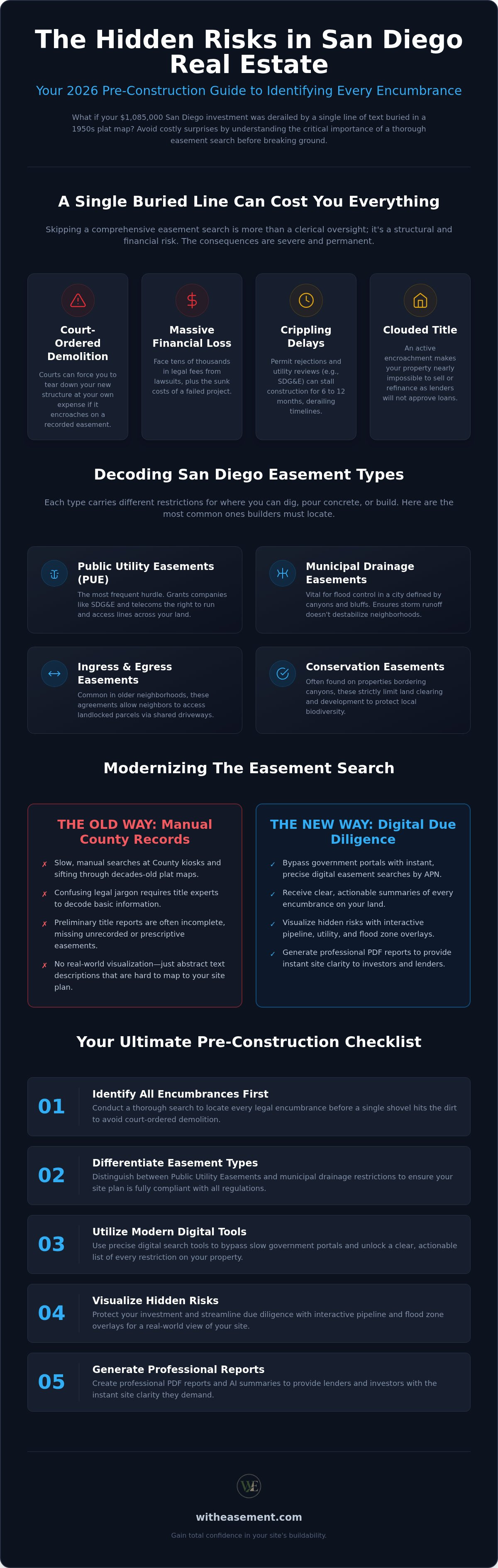
- Avoid costly court-ordered demolition by identifying legal encumbrances before you break ground on any new project.
- Differentiate between Public Utility Easements and municipal drainage restrictions to ensure your site plan is fully compliant.
- Conduct a precise San Diego easement search for new construction using digital tools that bypass slow manual government portals.
- Visualize hidden risks with interactive pipeline and flood zone overlays to protect your investment and streamline due diligence.
- Generate professional PDF reports and AI summaries to provide lenders and investors with instant site clarity.
The Risks of Skipping a San Diego Easement Search for New Construction
Building in San Diego requires precision. An easement is a legal right for a third party to use a specific portion of your land for a defined purpose. In our region, these often involve utility lines, municipal drainage, or public access rights. Skipping a San Diego easement search for new construction is more than a clerical oversight; it's a structural risk. If you build over a recorded easement, the consequences are permanent. Courts can order the immediate demolition of your new structure at your own expense. It doesn't matter if you've already spent hundreds of thousands on the foundation; the legal right of the easement holder takes priority.
San Diego's unique topography creates a high density of these restrictions. Properties near canyons or hillsides often feature municipal drainage easements that are critical for local flood control. Understanding different easement types is essential for any site plan. You can't assume a backyard is clear just because it looks empty. Utility companies and the city maintain these rights to ensure they can repair infrastructure without notice. If your new deck or ADU blocks that access, you're the one who will pay the price.
Financial and Legal Consequences of Encroachment
Encroaching on an easement triggers a chain reaction of expensive headaches. The San Diego Development Services Department (DSD) will likely flag your project during the plan check phase. This leads to costly delays that stall construction for months. Beyond permitting, you face direct legal threats. Utility companies like SDG&E protect their access rights aggressively. Any proposed work within an SDG&E easement requires a detailed review. This process often involves the California Public Utilities Commission (CPUC) and can take 6 to 12 months to resolve. A lawsuit to reclaim access can cost tens of thousands in legal fees. Finally, a clouded title impacts your resale value. Lenders won't approve loans on properties with active encroachments, making it nearly impossible to sell in the future.
Why Preliminary Title Reports Are Often Not Enough
Standard preliminary title reports don't always tell the full story. These documents frequently miss unrecorded easements or prescriptive rights that have developed over decades of use. Title insurance also has limits. Most policies include exceptions for visible easements that a physical inspection would reveal. If a utility line is present but wasn't in the paperwork, you might not be covered. A comprehensive San Diego easement search for new construction requires looking beyond the basic deed. You need digital tools that provide pipeline and flood overlays to see the real-world impact on your build site. Don't let a hidden line ruin your project.
Decoding San Diego Easement Types: What Builders Must Locate
Identifying the right San Diego easement search for new construction starts with knowing exactly what you're looking for. San Diego properties aren't just patches of dirt; they're complex layers of legal rights. You'll likely encounter several distinct categories of easements during your due diligence process. Each one carries different restrictions for where you can dig, pour concrete, or erect walls.
- Public Utility Easements (PUE): These are the most frequent hurdles. They grant companies like SDG&E or telecommunications providers the right to run lines across your land.
- Municipal Drainage Easements: These are vital in a city defined by canyons and coastal bluffs. They ensure runoff doesn't destabilize the neighborhood.
- Ingress and Egress Easements: Common in older neighborhoods like North Park, these shared driveways allow neighbors to access landlocked parcels.
- Conservation Easements: If your site borders a canyon, these strictly limit land clearing to protect local biodiversity.
Utility and Municipal Infrastructure Restrictions
Precise site planning requires mapping every sewer main and gas line. You won't find these by looking at a standard deed. You must search easements by APN to unlock the full picture of underground infrastructure. Gas pipeline overlays are particularly critical for safety. Building too close to a high-pressure line can trigger a complete project shutdown. Identifying these through San Diego County land records early prevents the DSD from rejecting your permit later.
Private Easements and View Blockage Issues
Don't forget about private agreements. A neighbor's access right can halt an ADU project before it starts. San Diego also has specific solar easement regulations. These protect a property owner's access to sunlight for solar panels. If your new construction casts a shadow on a neighbor's existing array, you could face legal challenges. Finally, always check the CC&Rs for parcels within an HOA. These often contain "hidden" easements that don't appear in the general county record but remain legally binding. Performing a thorough San Diego easement search for new construction involves cross-referencing these private records with public data. This ensures your site plan respects both municipal infrastructure and your neighbor's legal rights.
San Diego County Land Records vs. Modern Digital Tools
The San Diego County Assessor/Recorder/County Clerk (ARCC) serves as the official repository for every deed, map, and encumbrance in the region. If a legal right exists on your land, the ARCC has the record. However, the official nature of these files doesn't make them easy to access. Traditional methods often involve visiting physical kiosks or waiting for phone requests to process. For a builder on a tight schedule, these manual hurdles create unnecessary friction. Modern digital platforms now bridge the gap by aggregating this raw data into a user-friendly interface.
One major hurdle for developers is the jurisdiction overlap. While the San Diego County ARCC maintains the official recorded documents, the City of San Diego manages local infrastructure and zoning. A thorough San Diego easement search for new construction requires data from both entities. Relying on just one source often leaves builders blind to municipal drainage lines or city-specific setbacks. Professional digital tools solve this by layering County records with City-level pipeline and flood data on a single interactive map.
Navigating the San Diego County ARCC Process
Requesting an Assessor's parcel map through traditional channels is a slow, methodical process. You can order documents via phone or mail, but you're at the mercy of administrative timelines. The official "Signature Authentication" and recording process ensures legal validity, but it provides zero visual context for your site plan. A comprehensive property report San Diego search requires pulling data from multiple government branches. Without a centralized tool, you'll spend hours cross-referencing paper maps with digital permit statuses from the City's OpenDSD portal.
The Advantages of Using a Centralized Property Data Platform
Digital property intelligence platforms transform how builders conduct due diligence. Instead of driving to a County office, you get instant access to recorded easements by simply entering an address or APN. These tools provide immediate value through visualization and clarity. You can see exactly where a gas line or sewer main sits in relation to your proposed foundation. Key benefits include:
- Interactive Overlays: Visualize flood risks and pipeline locations directly on your parcel map.
- AI-Driven Summaries: Skip the dense legal jargon with automated summaries of recorded documents.
- Professional PDF Reports: Generate clean, authoritative reports for lenders and investors in seconds.
- Efficiency: Eliminate the need for multiple City Hall visits for basic site research.
Using these high-tech tools ensures your San Diego easement search for new construction is both accurate and fast. It empowers you to make data-driven decisions without needing specialized legal training or professional intermediaries. Efficiency in the research phase leads to fewer surprises during the build.
The Ultimate Pre-Construction Easement Checklist for San Diego
Moving from research to action requires a structured approach. Government portals often provide a fragmented list of records without a clear sequence for builders to follow. This checklist bridges that gap. It ensures your San Diego easement search for new construction covers every legal and physical constraint before you finalize your site plan. Follow these five steps to secure your build site.
- Step 1: Identify Parcel Boundaries. Verify the exact dimensions of your lot. Don't rely on visual fence lines; use recorded maps to establish the legal footprint.
- Step 2: Cross-Reference the APN. Use your Assessor Parcel Number to pull records from both the County Assessor and the Recorder's databases. This ensures you see both tax-related maps and recorded legal encumbrances.
- Step 3: Analyze the Plat Map. Look for "hidden" utility lines or municipal drainage paths. These often appear as dashed lines or specific abbreviations that dictate where you cannot pour concrete.
- Step 4: Verify HOA and CC&R Status. Community-specific restrictions can be more restrictive than city code. Confirm there are no private easements for views or shared access.
- Step 5: Generate a Professional PDF Report. Compile your findings into a single document. This provides your design and engineering team with the data they need to avoid costly revisions.
Phase 1: Initial Parcel Discovery and Mapping
Everything starts with the Assessor Parcel Number (APN). It's the unique identifier for your build site. Once you have this number, use parcel maps with easements San Diego tools to visualize restrictions in real time. This phase is about identifying "deal-breakers" early. For instance, locating a major flood zone or a high-pressure gas line during the discovery phase can save months of wasted design time. Mapping these layers early allows you to adjust the building footprint before submitting plans to the DSD.
Phase 2: Deep Dive and Professional Verification
Once you've mapped the basics, dive into the specific "right-of-way" language found in recorded documents. Some easements allow for surface use, while others strictly prohibit any structures. Pay close attention to pipeline overlays. These often require specific setbacks that are much larger than standard property lines. To speed up this process, you can use AI-powered summaries to translate dense legal jargon into actionable insights. This allows you to consult with your architect or engineer with clear, summarized data in hand. Ready to simplify your due diligence? Get started with a WithEasement Membership to access these professional mapping tools and overlays instantly.
Executing a San Diego easement search for new construction doesn't have to be a manual grind. By following this sequence, you transform a complex legal requirement into a streamlined part of your pre-construction workflow. You'll move forward with the confidence that your site is clear and your investment is protected.
Streamlining Your Build with WithEasement Professional Tools
WithEasement serves as your high-tech partner for property intelligence. It centralizes San Diego County's dense land records into a single, intuitive platform. For realtors and builders, this means no more navigating outdated government websites or waiting on physical kiosks. You get immediate access to critical data. A San Diego easement search for new construction becomes a matter of clicks rather than days. This efficiency allows you to move from site discovery to project approval with total confidence. You're empowered to unlock high-level data without requiring specialized training or expensive intermediaries.
The platform acts as a bridge between complex public records and your specific build goals. It prioritizes utility and speed. By focusing on APN-based search efficiency, you bypass the friction usually associated with municipal research. You can visualize every restriction on your lot instantly. This no-nonsense approach values your time and ensures your project stays on schedule. Executing a San Diego easement search for new construction through our platform ensures your project starts with a clean slate.
Using AI to Summarize Complex San Diego Records
Legal descriptions in recorded easements are notoriously difficult to read. They use archaic language that can hide significant restrictions. Our AI summaries translate this legal jargon into clear, actionable insights. You don't need a legal background to understand your property's limitations. The tool scans recorded documents and highlights the "fine print" you might otherwise miss. This reduces hours of manual research to a few minutes. It ensures your due diligence is exhaustive and accurate during the critical planning stages. You'll gain a professional-grade understanding of your land's legal status without the traditional headache of manual document review.
Generating Professional Property Reports for Stakeholders
Transparency is key when dealing with lenders, architects, and investors. A WithEasement Membership allows you to generate professional PDF property reports that serve as a definitive due diligence package. These reports link interactive map overlays directly to recorded data. You can show exactly where utility lines or flood zones sit in relation to your build site. It provides a professional standard of proof that the land is clear for development. These reports are ready for client presentations or lender reviews. Start your next project with a San Diego property easement search to ensure your site plan is built on facts. You'll have the confidence that your build site is clear and your investment is protected from hidden surprises.
Secure Your Project’s Future with Precise Site Intelligence
Proactive due diligence turns a risky investment into a secure project. By mastering the 2026 checklist, you ensure that hidden utility lines or ancient drainage rights won't stall your progress or lead to costly demolition. You've learned that a comprehensive San Diego easement search for new construction requires looking beyond basic title reports to uncover the true legal landscape of your parcel. High-level data is now within reach for every builder and realtor in the county.
Understanding the intersection of city infrastructure and county records is the key to a smooth permitting process. You now have the framework to identify Public Utility Easements and private access rights before they become expensive obstacles. Efficiency in the research phase leads to fewer surprises during the build. Stop wrestling with slow government portals and complex legal jargon. Our platform provides comprehensive San Diego County data coverage and AI-powered property summaries that translate dense records into actionable insights. You can generate instant PDF property reports to keep your lenders and architects informed at every stage.
Unlock Professional San Diego Property Data with WithEasement
Your next project deserves a clear path forward. Start today and build with the certainty that your site is ready for the first shovel.
Frequently Asked Questions
How do I find a utility easement on my property in San Diego?
Locate utility easements by reviewing the recorded plat map or a professional property report. You can use an APN based search to pull recorded documents from the County Recorder. Digital platforms make this easier by providing interactive overlays that show utility lines directly on your parcel map. This visualization helps you see exactly where infrastructure sits in relation to your proposed build site.
Can I build a fence on an easement in San Diego County?
You can usually build a fence on an easement, but you do so at your own risk. Utility companies and the city have the legal right to remove any obstruction to access their infrastructure for repairs or maintenance. If they need to reach a buried line, they can tear down your fence without compensating you for the damage. It is always better to design your site plan to keep permanent structures clear of these zones.
What is the difference between a City and County easement search?
The County Recorder holds the official legal documents and deeds for all land in the region. The City of San Diego manages local infrastructure like sewer mains and municipal drainage. A thorough San Diego easement search for new construction requires cross-referencing County legal records with City level pipeline overlays. Using a tool that aggregates both sources ensures you don't miss a city managed pipe while looking at a county deed.
How long does a San Diego easement search usually take?
Manual searches at County kiosks or through mail requests often take days or weeks to process. Digital property intelligence tools provide results almost instantly. You can pull a full report with AI summaries and map overlays in minutes. This speed allows your design team to move forward without waiting on traditional administrative timelines.
Are all easements recorded with the San Diego County Assessor?
No, the County Assessor primarily focuses on property tax data and valuations. You must look in the County Recorder's office to find most legal easements and encumbrances. Some prescriptive or unrecorded easements might not appear in official databases at all. This is why reviewing historic maps and physical site conditions is a critical step in your due diligence.
What happens if I build over a sewer easement in San Diego?
Building over a sewer easement can lead to court ordered demolition of your new structure. If your building interferes with municipal maintenance or emergency repairs, the city can force you to remove it at your own expense. This mistake also leads to permit denials from the Development Services Department during the initial plan check phase. Identifying these lines early prevents these catastrophic financial losses.
Can an easement be removed from my San Diego property title?
Easements can be removed through a legal process called a quitclaim or abandonment. For example, SDG&E requires a non refundable $250 application fee to start an easement quitclaim request. You must prove the easement is no longer necessary for public or utility use. This process often involves a detailed review and may require approval from the California Public Utilities Commission.
Does WithEasement cover all of California or just San Diego?
We provide a centralized platform specifically for San Diego County property data. This local focus allows us to offer high accuracy for builders and realtors working within the unique regulatory landscape of our region. Our platform includes recorded easements, HOA information, and interactive flood risk maps tailored specifically to San Diego parcels. We don't provide data for the rest of the state to ensure our local intelligence remains the most reliable available.


