

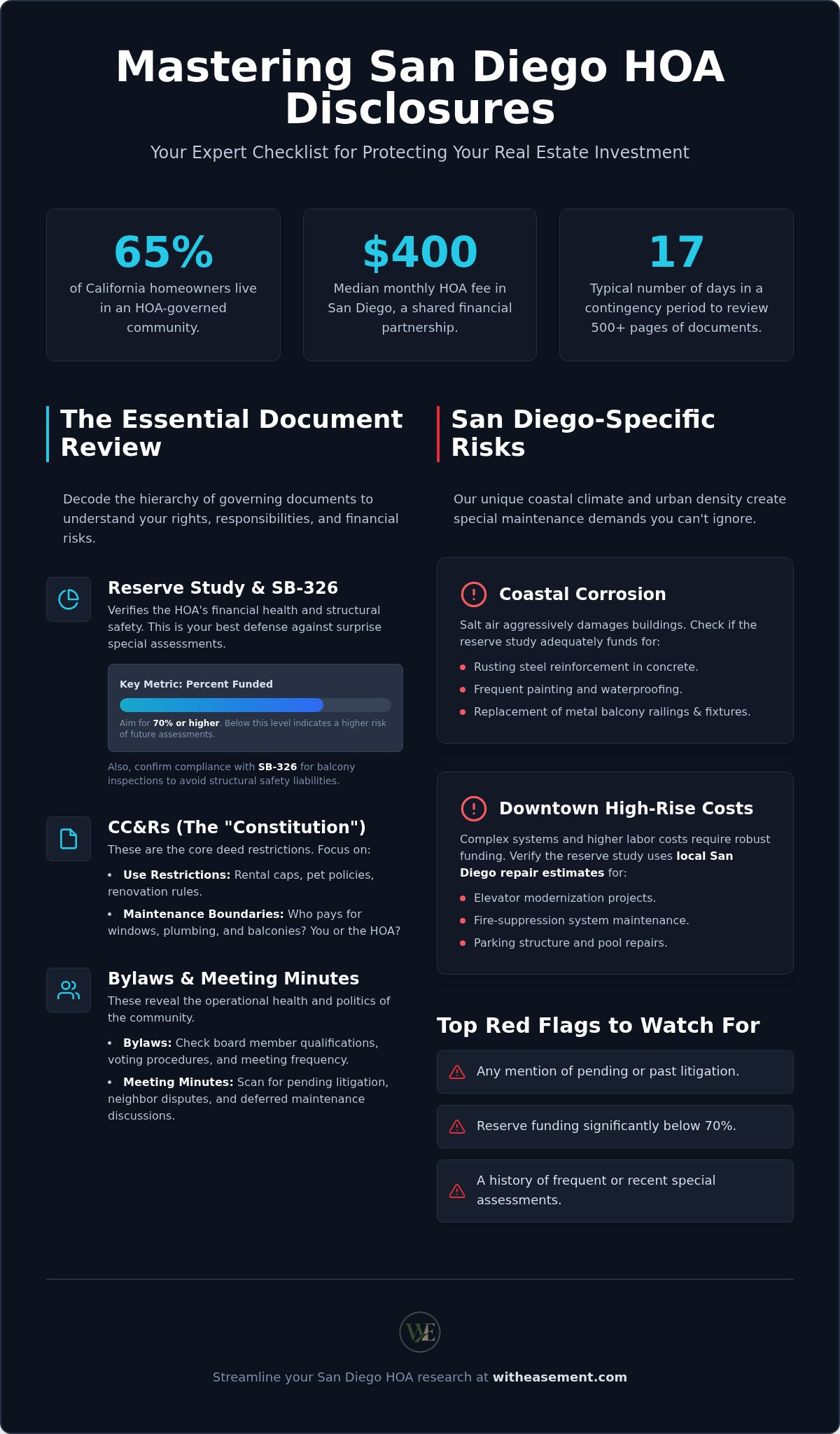
Did you know that roughly 65% of California homeowners live in an HOA-governed community? In San Diego, where monthly fees now median at $400, your home is more than just a place to live. It is a shared financial partnership. Knowing what to look for in HOA documents San Diego is the only way to avoid surprise assessments after you move in. It's completely normal to feel overwhelmed when a 500-page disclosure package lands in your inbox during a short contingency period. You want to focus on the sunset views, not the technical details of a reserve study.
This expert checklist helps you master the complexities of these disclosures. You will learn how to protect your investment and your lifestyle with professional clarity. We provide a clear list of deal-breakers, fast ways to verify financial health, and a guide to understanding San Diego-specific coastal maintenance risks. We also break down critical 2026 updates, including SB 326 compliance and new seller disclosure requirements, so you can close with total confidence. This guide gives you the tools to unlock the data hidden in public records and make an informed decision.
Key Takeaways
- Identify structural safety risks by verifying SB-326 compliance and review reserve studies to avoid surprise special assessments.
- Learn exactly what to look for in HOA documents San Diego to separate your personal unit responsibilities from high-cost common area liabilities.
- Decode the "community constitution" found in CC&Rs and Bylaws to understand how board decisions impact your lifestyle and property value.
- Uncover hidden red flags like pending litigation or neighbor disputes by scanning meeting minutes for unrecorded liabilities.
- Streamline your research process using AI-powered summaries and address-based searches to extract critical financial data instantly.
Why Reviewing San Diego HOA Documents is Non-Negotiable
Buying a condo or townhouse is different from buying a detached house. You are effectively joining a corporation. When you purchase a property within a Homeowner association, you're acquiring a fractional share of a business entity. This non-profit corporation manages shared assets like roofs, parking structures, and pools. Your unit is your "separate interest," but you share liability for the "common area" infrastructure. If the building's main plumbing stack fails, every owner shares the repair bill. Understanding what to look for in HOA documents San Diego is the only way to see these hidden costs before they become your problem.
California's fast-paced real estate market leaves little room for error. Standard purchase agreements usually provide a short 17-day window for all due diligence. You must review hundreds of pages of financial and legal data before this period ends. If you find a massive funding gap on day 18, it's often too late to back out without losing your deposit. You need a systematic way to scan these documents quickly and accurately to protect your investment.
The Legal Reality for California Buyers
California Civil Code section 4525 requires sellers to provide a comprehensive disclosure package. This bundle includes the current budget, the most recent reserve study, and any notices of violation. You have a legal responsibility to perform due diligence during the "investigation" period. Claiming "I didn't read it" provides no legal protection against future assessments or rules. Once you remove contingencies, you inherit the HOA's existing financial health and structural liabilities. There's no undo button once the deal is closed.
Local San Diego Risk Factors
San Diego’s coastal climate creates specific structural maintenance demands that inland cities don't face. Coastal corrosion is a major risk factor for properties near the water. Salt air penetrates concrete and rusts the steel reinforcement inside. It also destroys metal balcony railings and exterior light fixtures. If the HOA hasn't budgeted for frequent painting and waterproofing, you'll eventually see a special assessment to cover the damage. These costs are often much higher than buyers expect.
Downtown high-rises face different pressures. Elevator modernization and fire-suppression systems are incredibly expensive to maintain and replace. San Diego labor costs also trend higher than national averages due to the local cost of living and specialized trade requirements. You must ensure the HOA's reserve study uses local San Diego repair estimates rather than generic national figures. A well-funded association in 2026 must account for these specific regional price increases to remain solvent and avoid financial distress.
Decoding the Governing Documents: CC&Rs, Bylaws, and Rules
Every San Diego homeowner association operates under a strict hierarchy of authority. If a conflict arises between documents, the law takes precedence, followed by the recorded CC&Rs, then the Bylaws, and finally the Rules and Regulations. Understanding this order is vital when you find conflicting information about your rights. CC&Rs are the recorded deed restrictions that run with the land. They are difficult to change and require a vote from the entire membership. Bylaws function as the operational framework for how the board makes decisions. They dictate meeting frequencies, voting procedures, and board member qualifications. Rules and Regulations are the living documents that the board can update with a simple majority vote, making them the most frequent source of day to day changes.
Knowing exactly what to look for in HOA documents San Diego involves peeling back these layers of governance. You need to verify that the board's current actions align with the powers granted in the CC&Rs. While the CC&Rs set the broad duty to maintain the property, the Reserve Study Guidelines from the California Department of Real Estate provide the standard for how the board must calculate the cost of those duties. If the governing documents don't mandate regular updates to these studies, the association risks falling behind on critical repairs. You can use an HOA search by address to pull these specific records and compare them against state standards instantly.
CC&Rs: What to Search For
Focus your search on use restrictions and maintenance boundaries. Rental caps are a major deal-breaker for many buyers. Some CC&Rs prohibit short term rentals entirely or limit the total percentage of units that can be leased at any given time. You also need to check the maintenance responsibility sections. This text defines exactly where your unit ends and the common area begins. It clarifies if you are responsible for window seals, patio railings, or plumbing lines inside the walls. These definitions determine who pays the bill when a pipe bursts or a window leaks.
Rules That Impact Your Lifestyle
Rules and Regulations often contain the details that affect your daily routine. Pet policies go beyond simple "yes or no" answers. They frequently include breed restrictions, specific weight limits, and even "pet rent" nuances for certain common area uses. Parking rules are equally critical. You must verify assigned spots versus guest parking availability. With the rise of electric vehicles, check for specific EV charging rules. Some associations have strict requirements for installing chargers in shared garages. Finally, review the architectural review committee (ARC) requirements. Most San Diego HOAs require formal approval for any interior upgrades that might impact structural integrity or soundproofing between floors.
Assessing Financial Health: Reserve Studies and SB-326
Financial health is the pulse of any homeowner association. Your monthly dues split into two distinct buckets. The operating budget handles daily expenses like landscaping, water, and management fees. The reserve fund acts as a long term savings account for major projects. Under the Davis-Stirling Common Interest Development Act, boards must maintain these funds to meet future obligations. If the reserve fund is empty, the board will likely issue a special assessment. These one-time fees can cost tens of thousands of dollars per unit. You must verify the association's "Percent Funded" figure immediately.
When you analyze what to look for in HOA documents San Diego, the reserve study is your 30-year roadmap. This document lists every major component, from the roof to the pool pump, and estimates when each will fail. A healthy association is usually 70% funded or higher. Anything below 30% is considered high risk. Associations in this weak category are almost guaranteed to face special assessments or aggressive dues increases. You want to see a funding plan that accounts for San Diego's specific 2026 labor and material costs.
SB-326 and SB-721: The Balcony Mandate
Multi-unit buildings in San Diego face strict safety regulations known as the "Balcony Law." SB-326 required initial inspections of exterior elevated elements for condo HOAs with three or more units by January 1, 2025. In 2026, any association that missed this deadline is out of compliance and faces significant liability. Effective January 1, 2026, SB 410 requires sellers to provide the most recent SB-326 inspection report to prospective buyers. You must search the disclosure package for this report. If the inspection found structural decay, check the budget to see if the association has a funded plan for repairs. Unfunded balcony repairs are a common cause of massive 2026 special assessments.
Delinquency Rates and Litigation
Financial stability also depends on your future neighbors. Review the delinquency report to see the percentage of owners behind on their dues. If this number exceeds 5%, the association's cash flow is in danger. You should also search for construction defect litigation. Active lawsuits often prevent lenders from approving mortgages, which could trap you in the property later. Finally, check the insurance premium line item in the budget. San Diego properties in high fire risk zones have seen premiums double or triple recently. Ensure the 2026 budget reflects these current market rates so you aren't hit with a mid-year dues hike to cover an insurance shortfall.
Spotting Red Flags in Meeting Minutes and Easements
Meeting minutes provide a raw look at the community's internal health. While the budget shows you the numbers, the minutes show you the friction. Boards often discuss major repairs months or years before they appear as line items in a budget. These discussions represent unrecorded liabilities. If the board has spent three months debating a failing roof in the "old" section of the complex, that cost is coming for you. Knowing what to look for in HOA documents San Diego means looking for these pending financial storms before they break.
You should treat these documents like a gossip log for the building's infrastructure. Minutes reveal ongoing neighbor disputes, security breaches, and recurring system failures that a standard home inspection might miss. If the board is constantly discussing "plumbing patches" instead of "pipe replacement," you are looking at a community that defers maintenance. This approach eventually leads to higher costs and lower property values for every owner in the association.
The 'Reading Between the Lines' Checklist
Don't just scan the minutes; search them for specific triggers. Use the search function to find keywords like "leak," "mold," "security," "lawsuit," and "assessment." Look for recurring repairs on the same system. If the association is patching the same plumbing line every six months, the system is likely at the end of its life. High board member turnover is another major red flag. It often signals community instability or a toxic political environment. You want a board that is focused on property values, not neighbor feuds.
Beyond the HOA: Easements and Risk
Shared property risk extends beyond the buildings themselves. Utility or sewer easements under common areas can impact your use of the land. A San Diego property easement search reveals hidden encumbrances that the HOA package might miss. For example, a utility company may have the right to tear up the pool deck to access a main line. You should also identify if the HOA has granted easements to third parties that restrict resident access to amenities like parks or trails.
Pipeline overlays are equally critical in San Diego's dense neighborhoods. High-pressure gas lines often run through common areas or near building foundations. Identifying these risks early prevents future surprises during community renovations. Finally, always verify the flood zone status for the entire complex. Even if your unit is on the third floor, a flooded ground-level garage or electrical vault can still trigger massive shared repair costs. You can access interactive property maps to visualize these overlays and easements instantly before your contingency period expires.
Streamline Your San Diego HOA Search with WithEasement
Traditional due diligence is slow. It relies on manual document review and waiting for escrow packages that might arrive too late. WithEasement changes this process by centralizing San Diego County HOA data and property records into one accessible platform. You no longer need to spend days wondering what to look for in HOA documents San Diego because our technology does the heavy lifting for you. We provide the tools to unlock high-level data instantly, ensuring you don't miss critical financial or structural red flags.
Our AI Summaries perform the tedious work of scanning 500-page disclosure packages. They extract key financial benchmarks, rental restrictions, and maintenance liabilities in seconds. You get the facts without the friction. If you need to share these insights with others, our Professional PDF Property Reports offer a clean, shareable format for your lender or legal counsel. We also provide interactive mapping that overlays HOA boundaries with critical environmental data. You can visualize flood risks and high-pressure pipeline locations directly on the property map, providing a level of property intelligence that traditional reports lack.
Instant HOA Lookup by Address
Speed is your biggest advantage in the competitive San Diego market. You can enter a specific address or APN to identify the governing association immediately. This feature allows you to access recorded documents before you even submit an offer. Verifying the HOA's status early in the process prevents you from wasting time on properties with insolvent reserves or restrictive rules. It's about making informed decisions before you're legally committed. You can confirm the association's identity and basic standing while your competitors are still waiting for a callback from the listing agent.
The WithEasement Advantage for Realtors
Efficiency defines top-tier real estate professionals. You can cut hours of manual document review by using AI-powered keyword extraction to find red flags like "litigation" or "special assessment" across thousands of pages. Providing your clients with a professional Property Intelligence Report builds trust and demonstrates your local expertise. It's a high-tech utility tool that helps you close deals with confidence. Our WithEasement Membership allows you to fast-track the due diligence process for multiple properties at once. This approach ensures your buyers are protected while you maintain your momentum in a fast-paced market. Start your San Diego property search with WithEasement today.
Secure Your San Diego Investment with Data
Navigating a 500-page disclosure package doesn't have to be a source of stress. By focusing on the 70% reserve funding benchmark and verifying SB-326 structural compliance, you've already mitigated the biggest financial risks. Knowing what to look for in HOA documents San Diego is your best defense against unexpected assessments that could impact your lifestyle. You now have the checklist to separate a healthy community from a struggling one.
Efficiency is the key to a successful closing in 2026. You can now bypass manual document review and access high-level property intelligence instantly. Our platform provides AI-powered property summaries and San Diego County specific data to help you verify HOA health in seconds. You can also use interactive map overlays to visualize easements and flood risks before you remove contingencies. Unlock instant San Diego property and HOA data with a WithEasement membership. Take control of your due diligence and move forward with total confidence.
Frequently Asked Questions
How long does it take to get HOA documents in San Diego?
Management companies typically have 10 days to deliver the disclosure package after a formal request. However, delays are common during high-volume months. You should request these records as soon as you enter escrow to ensure you have enough time to review them during your 17-day investigation period.
What is the most important document in a San Diego HOA package?
The Reserve Study is the most critical document for your financial protection. It acts as a 30-year roadmap for major repairs like roofs and plumbing. While CC&Rs govern your behavior, the Reserve Study reveals if the association has enough cash to avoid massive special assessments in the future.
Can an HOA in San Diego prevent me from renting my condo on Airbnb?
Yes, most associations have the power to prohibit short-term rentals. You must check the "Use Restrictions" section of the CC&Rs for specific language regarding rental durations. Many San Diego HOAs require a minimum 30-day lease, which effectively bans Airbnb or VRBO operations within the community.
What is a 'healthy' reserve fund percentage for a San Diego condo?
A healthy association is 70% funded or higher. This percentage indicates the HOA is on track to cover its long-term maintenance obligations. When researching what to look for in HOA documents San Diego, treat any funding level below 30% as a major red flag for upcoming dues hikes.
What happens if I find a red flag in the HOA documents during escrow?
You can request a repair credit, ask the seller to pay off a pending assessment, or cancel the purchase entirely. As long as you are within your contingency period, you have the right to back out without losing your deposit. Discuss any financial or legal risks with your realtor to negotiate a better deal.
How does SB-326 impact my monthly HOA dues in San Diego?
Monthly dues often increase to cover the costs of mandatory balcony inspections and structural repairs. Associations must now include these nine-year inspection cycles in their long-term budgets. If an inspection reveals structural decay, the board may raise dues or issue a special assessment to bring the building back into safety compliance.
Is there a way to search for HOA information by address in San Diego County?
Yes, you can use WithEasement to search for HOA data by address or APN instantly. This tool identifies the governing association and allows you to access recorded documents before you even submit an offer. It is the most efficient way to verify a property's status and avoid wasting time on troubled associations.


