

What if a single overlooked easement could cost you a $1 million deal in a market where the median home price has soared past $954,000? With San Diego's total taxable real estate hitting a record $845 billion in 2026, the stakes for accurate due diligence have never been higher. Accessing a comprehensive property report San Diego is no longer just a convenience; it's a necessity for any serious buyer or listing agent. You can't afford to miss the hidden encumbrances that don't show up on a standard title search.
It's frustrating to spend hours clicking through fragmented county websites or interpreting dense legal jargon only to realize you still don't have the full picture. You want instant clarity on property encumbrances without the headache of visiting in-person kiosks for APN searches following recent regulation changes. This guide will help you master the complexities of San Diego land records and professional reporting.
You'll learn how to identify critical easements, understand the latest recording fees effective July 2025, and generate professional PDF reports that give your clients total confidence. We'll show you how to bypass the friction of traditional research and get the data you need immediately.
Key Takeaways
- Identify the San Diego County Assessor/Recorder/County Clerk as your primary source for tracking the legal history and ownership of any parcel.
- Build a comprehensive property report San Diego by combining administrative APN data with visual map overlays to reveal the full physical context of a property.
- Compare the time-saving benefits of professional research tools against the manual effort required by standard government self-service portals.
- Use a sequential due diligence checklist to spot hidden easements or environmental risks before they become costly deal-breakers.
- Modernize your workflow with AI-powered summaries and interactive overlays that turn complex land records into professional PDF reports instantly.
Understanding San Diego County Land Records: The Foundation of Property Research
San Diego County land records are the legal DNA of a property. They represent the complete history of a parcel's ownership, usage rights, and restrictions. The San Diego County Assessor/Recorder/County Clerk (ARCC) acts as the central hub for these documents. Every time a house sells or a boundary changes, a new entry is added to this public archive. Accessing these records is the only way to verify who truly owns a piece of land and what legal baggage might come with it.
Understanding these records is the first step in generating a comprehensive property report San Diego. You aren't just looking for a name on a deed. You're looking for the story of the land. This includes tracking how the property has been divided and what specific rights have been granted to others over decades. Tracing this history helps you spot potential red flags before you commit to a purchase or listing.
The search process varies based on whether a property sits in an incorporated city or an unincorporated area. For unincorporated land, the county's Planning & Development Services provides detailed land use data. For incorporated cities like Chula Vista or Oceanside, you must often juggle records between city hall and the county recorder. This fragmentation is where many researchers get stuck, as data isn't always synced across different jurisdictions.
Key Records Maintained by the County Clerk
The ARCC manages several document types that are vital for due diligence. Grant deeds are the primary records for ownership transfers. They often contain specific language regarding "exceptions" or "reservations" that affect your rights. Subdivision maps and plat maps show the physical boundaries and dedicated public spaces. These records rely on the standard system of Recording (real estate) to ensure every claim is documented for public view. Additionally, the clerk tracks financial encumbrances like tax liens and involuntary judgments that could prevent a clean title transfer.
Why Public Portals Aren't Always Comprehensive
Raw data is not the same as actionable insight. Government portals offer access to files, but they don't provide context. You might find a recorded document but fail to realize it was superseded by a later filing. Building permits are often stored in separate databases from recorded easements, making it easy to miss a conflict. A comprehensive property report San Diego must bridge these gaps by synthesizing data from multiple sources.
There is also the issue of "missing" data. Private utility agreements and HOA CC&Rs (Covenants, Conditions, and Restrictions) aren't always easy to find through a standard parcel lookup. These documents can dictate everything from your paint color to where you can build a fence. Relying solely on a basic search often leaves you blind to these private encumbrances that can kill a real estate deal. Professional reporting tools ensure you aren't just looking at a list of files, but actually understanding the property's risks.
Essential Components of a Comprehensive Property Report in San Diego
A professional report isn't just a collection of documents. It's a synthesis of legal, physical, and administrative data that tells the full story of a parcel. To get a comprehensive property report San Diego, you must bridge the gap between what's recorded at the county office and what actually exists on the ground. This requires combining Assessor Parcel Number (APN) data with visual map overlays. Seeing a boundary line on a high-resolution map is far more valuable than reading a technical metes-and-bounds description.
Real estate moves fast. Instant results have become the industry standard because they allow for immediate decision-making. Waiting days for a manual search can mean losing a competitive listing or missing a crucial contingency deadline. This shift toward "Property Intelligence" means moving beyond simple record lookups. It's about having the foresight to see how easements, HOA rules, and environmental risks interact before you ever step foot on the property.
Recorded Easements and Land Use Rights
Easements are often the most complex part of a property's legal history. You need to distinguish between a Public Utility Easement (PUE) and a private access easement that might grant a neighbor the right to cross your land. In San Diego, identifying sewer and drainage easements is particularly vital due to the region's unique topography. These encumbrances can severely limit where you can build or landscape. For professional methods on locating these documents quickly, consult our guide on San Diego property easement search deep-dive techniques.
HOA Data and CC&Rs
Public records are notoriously poor at providing management contact info for Homeowners Associations. This creates a massive blind spot for buyers and agents. Covenants, Conditions, and Restrictions (CC&Rs) are the private laws of a community. They dictate everything from parking rules to exterior paint colors. Reviewing these is a critical step in any due diligence checklist to ensure the property fits the buyer's lifestyle. Proper HOA searches prevent post-sale litigation and ensure all fees are accounted for before closing.
Environmental and Infrastructure Overlays
Physical risks can be just as restrictive as legal ones. A comprehensive property report San Diego must include detailed environmental overlays. This includes assessing flood risk by comparing FEMA data with local county maps. You also need to identify infrastructure risks, such as high-pressure gas pipeline overlays that may run near the property. Given our local climate, wildfire risk zones are another essential data point. These factors directly influence insurance premiums and future land use possibilities. You can access these interactive overlays to visualize these risks instantly during your initial research phase.
Navigating San Diego Data Sources: Self-Service vs. Professional Tools
The Assessor Parcel Number (APN) serves as the unique identifier for every piece of land in the county. It's the starting point for any comprehensive property report San Diego. However, finding this number has become significantly more difficult for the average user. As of December 9, 2024, California Assembly Bill 1785 discontinued online APN search functionality on official county websites. Currently, you must visit one of the five County Assessor office locations to use an in-person kiosk for these lookups. This regulatory shift creates a massive time barrier for realtors and developers who need instant data to move a deal forward.
Government portals like San Diego County Planning & Development Services (PDS) offer a wealth of information, particularly for unincorporated parcels. You can access the PDS website at sandiegocounty.gov/pds to find building permit history and zoning summaries. While these 'Self-Service' reports are technically free, they require manual navigation and a deep understanding of complex county codes. If you need historical records from the County Clerk, you'll also face standard recording fees. These include the $14.00 base fee for most titles or the $75.00 SB 2 fee per real estate instrument. The true cost isn't just the money; it's the hours spent piecing together fragmented files from different departments.
Many professionals mistakenly rely on title company preliminary reports for all their research. While useful, a 'prelim' is designed primarily to facilitate title insurance. It often misses granular land-use details, such as high-pressure pipeline overlays or specific HOA management contacts, that are essential for true due diligence. Relying solely on a title report is a common mistake that can lead to expensive surprises late in the escrow process.
Using San Diego County PDS Reports
The PDS portal is a powerful tool if you have the time to master it. It allows you to track building permit history, which is vital for verifying that additions or ADUs were properly permitted. For unincorporated San Diego land, you can use their internal maps to see basic property summaries. However, the system is much less effective for properties within incorporated city limits, such as San Diego or Carlsbad. In those cases, you're forced to switch between city and county databases, which increases the risk of missing a critical document or a hidden easement.
The Rise of Property Intelligence Platforms
Modern property intelligence platforms solve the fragmentation problem by aggregating County, City, and private data into a single, user-friendly interface. Instead of static PDF plat maps that are difficult to interpret, these platforms offer interactive GIS maps. You can toggle between flood zones, pipeline overlays, and recorded easements with a single click. This is why realtors are increasingly moving toward subscription-based access for their research. The ability to generate a comprehensive property report San Diego in minutes, rather than days, provides a massive competitive advantage in a market where the median home spends only 18 to 23 days on the market.
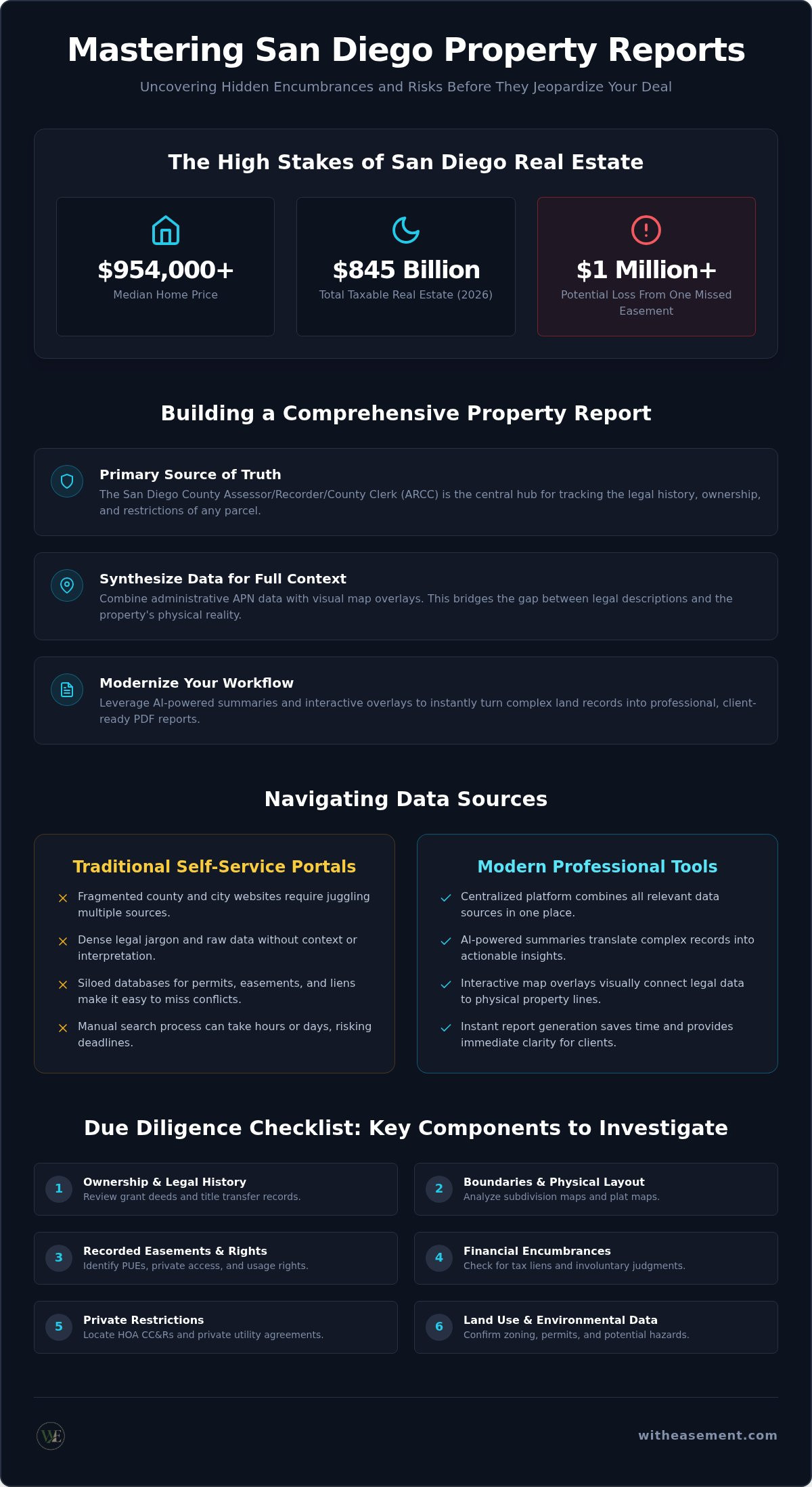
Due Diligence Checklist: Building Your San Diego Property Report
Success in San Diego real estate depends on what you find before the inspection contingency expires. While physical inspections cover the structure, a property's legal health requires a different set of tools. An encumbrance is any claim or liability attached to the property. Identifying these early is the only way to avoid "deal-killers" that emerge after you've already committed time and money. To build a comprehensive property report San Diego, you must follow a methodical workflow that verifies data across multiple county and private sources.
Relying on a single source of truth is a risk you shouldn't take. Documents recorded decades ago can still impact your rights today. By following a sequential checklist, you ensure that no hidden utility line or outdated zoning restriction goes unnoticed. This process turns raw data into a shield for your investment and ensures your due diligence is truly exhaustive.
Step 1: Parcel Identification and Basic Stats
Start by confirming the basics. Verify the APN and legal description against the most recent grant deed to ensure you're researching the correct boundaries. Check the Treasurer-Tax Collector's records for any outstanding tax liens or special assessments. You also need to identify the specific zoning code for the parcel. Understanding zoning implications is vital if you plan on future development or adding an accessory dwelling unit (ADU), as San Diego's local ordinances are specific about setbacks and usage.
Step 2: Easement and Encumbrance Search
Next, dive into the recorded documents. Search for easements that grant others the right to use your land. Utility lines for sewer, gas, and water are common, but they can severely restrict where you can build a pool or an extension. Don't just look at the maps; read the fine print in the recorded documents. Using AI-generated summaries allows you to quickly spot 'Right of Way' issues or private access agreements that might not be visible during a physical walkthrough. You can start your easement search here to uncover these hidden restrictions instantly.
Step 3: Risk and Administrative Review
A comprehensive property report San Diego isn't finished until you look at the external factors. Overlay FEMA flood maps to determine if the property sits in a high-risk zone, which could trigger mandatory insurance requirements. If the parcel is part of a planned development, locate the HOA management company. Public records often lack this contact info, yet you must verify their current fee structures and any pending litigation. Once your research is complete, generate a professional PDF report to document your findings and provide your client with total clarity.
Modernizing Research: How WithEasement Simplifies San Diego Reports
Government portals provide the pieces of the puzzle, but they don't solve it for you. WithEasement acts as the bridge between raw San Diego data and professional clarity. It consolidates fragmented records into a single, intuitive interface. This platform empowers individual realtors to deliver the same level of 'big-firm' data once reserved for major developers. By centralizing your research, you save hours of manual searching across multiple city and county departments. In a market where the total taxable real estate has reached $845 billion, precision is your most valuable asset. Generating a comprehensive property report San Diego shouldn't be a multi-day project. You need a tool that handles the heavy lifting of data organization so you can focus on closing the deal.
The shift from manual record-pulling to digital property intelligence is changing how due diligence is performed. Traditional methods are slow and prone to human error in interpretation. Modern tools eliminate these barriers by providing a direct line to the most relevant land-use information. You no longer have to wait for a title officer to return your call to understand a basic easement. The power to visualize and interpret property data is now in your hands.
AI-Powered Summaries of Recorded Documents
Legal jargon in an easement can be intentionally dense. Our AI Summaries translate that complex language into plain English instantly. Instead of spending your afternoon reading through hundreds of pages of CC&Rs, you get a concise breakdown of the rules that matter. This technology doesn't just read the words; it understands the context of San Diego land use. This significantly reduces the risk of missing a critical detail buried in a 50-year-old land record. You gain the confidence to explain encumbrances to your clients without needing a legal degree. Whether you are dealing with a standard utility easement or a complex private access agreement, the summary gives you the bottom line immediately. It turns raw documentation into actionable intelligence.
Professional PDF Reports for Real Estate Professionals
Presentation is everything when you're justifying a property's valuation. With a single click, you can generate a comprehensive property report San Diego that is ready to share with your client. These branded PDF Property Reports include interactive map visuals, flood risks, and pipeline overlays. They serve as powerful negotiation tools during the due diligence period. These reports are more than just data sheets; they are a visual narrative of the land. By including flood zone and pipeline overlays, you provide a level of transparency that standard title reports simply don't offer. This professional approach ensures that your clients feel empowered and informed throughout the entire listing or purchase process. Having a professional document to back up your findings builds immediate trust and sets you apart from the competition. You can access these professional tools with a WithEasement Membership to start streamlining your workflow today.
Take Control of Your San Diego Due Diligence
Mastering San Diego's property data doesn't have to be a manual struggle through fragmented records. You've seen how combining legal land records with visual map overlays provides the clarity needed to avoid deal-breaking encumbrances. By following a structured workflow and using modern intelligence tools, you can identify hidden risks like private easements or pipeline locations before they become costly liabilities. This proactive approach turns raw data into a competitive advantage for your listings and purchases.
Generating a comprehensive property report San Diego is now about speed and accuracy. You can replace hours of searching with instant insights that protect your clients and your reputation. With the right resources, you'll interpret complex jargon effortlessly and present professional findings with total confidence. It's time to move beyond the limitations of basic public portals and embrace a faster way to work.
Ready to streamline your research? Start your comprehensive San Diego property report with WithEasement today and unlock instant San Diego easement searches, AI-powered property summaries, and interactive flood and pipeline maps. Empower your business with high-level data that's finally within reach.
Frequently Asked Questions
How do I find recorded easements on a property in San Diego County?
Identify your Assessor Parcel Number (APN) first to track down recorded documents at the County Assessor/Recorder/County Clerk office. You can perform a Property Easement Search through professional platforms to bypass manual record-pulling at government kiosks. These tools aggregate recorded maps and deeds, allowing you to visualize where utility or access rights cross your land without interpreting complex metes-and-bounds descriptions.
What is included in a comprehensive San Diego property report?
A comprehensive property report San Diego synthesizes legal, physical, and administrative data into one document. It includes current ownership via grant deeds, a full list of recorded easements, and HOA management contact details. Additionally, it features environmental risk overlays like flood zones and high-pressure pipeline locations. This level of detail ensures you see the "hidden" encumbrances that a standard title search might overlook.
Where can I look up San Diego County building permit records?
Access building permit history via the San Diego County Planning & Development Services (PDS) portal for properties in unincorporated areas. If the property is within an incorporated city like San Diego or Carlsbad, you must visit that specific city's building department website. Verifying these records is essential to ensure that additions, ADUs, or structural changes were legally permitted and signed off by inspectors.
How do I find the HOA for a specific address in San Diego?
Use specialized HOA Searches to identify management companies, as this information is rarely listed in raw public land records. These searches provide the management's contact info and help you locate the Covenants, Conditions, and Restrictions (CC&Rs) for the community. Finding this data early prevents surprises regarding monthly dues, pet restrictions, or pending litigation that could stall your real estate transaction.
Can I search for San Diego property records by APN online?
Official online APN searches were discontinued on December 9, 2024, following the implementation of California Assembly Bill 1785. Currently, you must visit one of the five San Diego County Assessor office locations to use an in-person kiosk for these lookups. Professional property intelligence tools remain the most efficient way to use an existing APN to instantly pull recorded documents and AI-generated summaries from your desk.
What are pipeline overlays and why do they matter for San Diego properties?
Pipeline overlays are digital map layers that show the location of high-pressure gas or water mains near a parcel. They matter because these lines often carry strict "no-build" zones that prevent you from installing pools, ADUs, or even certain types of landscaping. Identifying these infrastructure risks during due diligence protects you from purchasing a property with significant hidden physical restrictions.
Is a title report the same as a comprehensive property report?
No, a title report is primarily a tool for title insurance that focuses on ownership and financial liens. A comprehensive property report San Diego provides a broader scope of "Property Intelligence," including HOA management data and environmental risk overlays. It's designed for active due diligence, helping realtors and buyers understand the practical use of the land rather than just the legal chain of title.
How can I get an AI summary of a property's land records?
Submit your property's APN to a platform offering AI Summaries to receive a plain-English breakdown of recorded documents. These tools scan hundreds of pages of dense legal jargon in deeds and CC&Rs to highlight key encumbrances and rights. This technology allows you to understand a property's legal health in seconds, significantly reducing the time spent on manual document review and the risk of human error.


