

The traditional way of hunting down property records through San Diego's public portals is officially broken. You've likely felt the frustration of hitting a dead end on government websites that have disabled online APN searches or made it nearly impossible to find HOA documents by address San Diego. It's a common pain point for real estate professionals who need to identify restrictive CC&Rs or hidden fees before a client makes an offer. Relying on fragmented data across multiple portals often means discovering deal-breaking information far too late in the transaction.
You deserve a more efficient path to property intelligence. This guide explains how to bypass these administrative hurdles and find comprehensive HOA records using a simple street address. We'll show you how to gain instant confirmation of HOA presence and unlock full Bylaws without specialized training. You'll learn to move from initial curiosity to a professional PDF Property Report in seconds. By the end of this guide, you'll have the tools to provide your clients with deep, reliable insights while saving hours of manual research.
Key Takeaways
- Discover how to bypass San Diego government portal limitations that restrict online APN searches.
- Locate HOA documents by address San Diego to uncover restrictive CC&Rs and hidden fees before your client submits an offer.
- Identify the essential documents required by the Davis-Stirling Act to ensure a thorough property review.
- Compare three search methods to find the fastest way to verify HOA presence and access bylaws.
- Learn how professional PDF Property Reports and AI summaries can save hours of manual research during due diligence.
The Challenge of Finding San Diego HOA Records in 2026
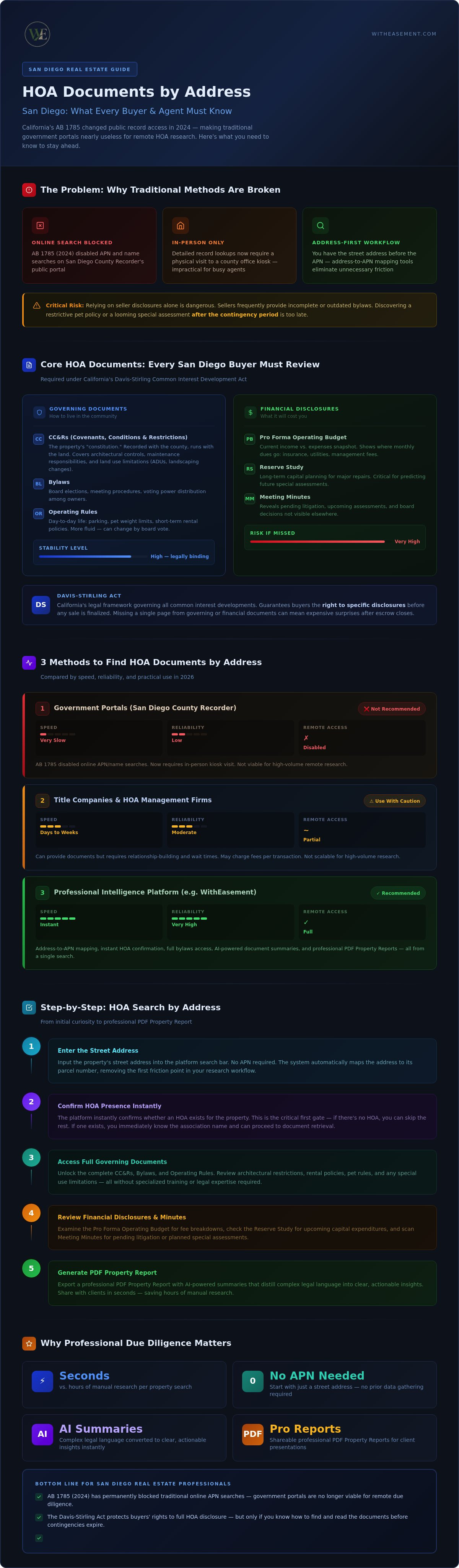
In San Diego's competitive real estate market, HOA documents represent the legal backbone of a property. These records include Covenants, Conditions, and Restrictions (CC&Rs), bylaws, and financial statements. They dictate how a homeowner lives, what they pay in monthly dues, and how they can use their land. Finding HOA documents by address San Diego has become the gold standard for due diligence, yet the path to this information is increasingly blocked by bureaucratic hurdles.
Relying solely on seller disclosures is a significant risk. Sellers often provide incomplete packages or outdated versions of bylaws. If you discover a restrictive pet policy or a looming special assessment after the contingency period, it's too late. You need independent verification to protect your clients and your reputation. The problem is that the traditional methods of gathering this data have fundamentally shifted.
Why Address-Based Search is Essential
Speed defines the modern real estate transaction. You usually have a street address long before you have an Assessor Parcel Number (APN). Forcing a workflow to pause while you hunt for a parcel number creates unnecessary friction. Address-based searches provide a faster entry point for preliminary research, allowing you to confirm HOA presence during the initial property walkthrough. Professional tech stacks now require integrated address-to-APN mapping tools to keep pace with client expectations. It's about removing barriers between curiosity and clarity.
The Shift in San Diego County Data Access
The landscape of public record access changed significantly following the passage of California Assembly Bill 1785. This 2024 law placed strict limitations on how government agencies display property data online, specifically restricting the ability to search by name or APN in public-facing portals. The San Diego County Recorder's office responded by disabling many of its online search functions. Today, the official government portal often requires an in-person visit to a physical kiosk for detailed lookups.
This shift has created a massive bottleneck for remote research. Professionals can't afford to drive to a county office every time they need to verify a deed or a lien. Government portals are no longer the fastest option for high-volume users. You need a centralized platform that can navigate these restrictions and deliver HOA documents by address San Diego instantly. Moving away from fragmented public sites toward professional intelligence platforms is the only way to maintain a competitive edge in 2026.
Core HOA Documents Every San Diego Buyer Must Review
Every common interest development in California operates under the Davis-Stirling Common Interest Development Act. This comprehensive legal framework ensures that buyers have a right to specific disclosures before a sale is finalized. However, knowing your rights is only half the battle. You need the actual paperwork to perform a real risk assessment. When you search for HOA documents by address San Diego, you are essentially auditing a multi-million dollar corporation that your client is about to join.
It's vital to differentiate between governing documents and financial disclosures. Governing documents tell you how to live, while financial disclosures tell you what it will cost. Missing a single page from either category can lead to expensive surprises after the close of escrow. Professional due diligence requires a look at both the current rules and the long-term fiscal health of the association.
CC&Rs, Bylaws, and Operating Rules
Governing documents establish the legal ground rules for the community. The Covenants, Conditions, and Restrictions (CC&Rs) act as the property's constitution. They are recorded with the county and stay with the land regardless of ownership. These documents outline architectural controls, maintenance responsibilities, and land use limitations. If a client wants to build an ADU or change their landscaping, the answer is in the CC&Rs.
Bylaws focus on the administration of the association. They dictate how the board of directors is elected, how meetings are conducted, and how voting power is distributed among owners. Finally, the Operating Rules cover the granular details of daily life. These include parking regulations, pet weight limits, and short-term rental policies. Rules can often be changed by a board vote, making them more fluid than the CC&Rs.
Financial Health and HOA Meeting Minutes
A community can have beautiful landscaping and still be a financial disaster. This is why financial disclosures are vital. The Pro Forma Operating Budget provides a snapshot of current income and expenses. It shows exactly how much of the monthly dues goes toward insurance, utilities, and management fees. A healthy budget is the first sign of a well-run association.
The Reserve Study is perhaps the most important document for long-term planning. It evaluates the remaining life of major components like roofs, elevators, and pavement. If the association hasn't saved enough to cover these future costs, homeowners face special assessments. These are one-time fees that can cost tens of thousands of dollars. Checking the last 12 months of meeting minutes is the best way to spot these issues early. Minutes often mention upcoming repairs or legal disputes long before they appear in a formal budget. To streamline this process, many realtors use a WithEasement Membership to verify HOA presence and access reports quickly. Finding HOA documents by address San Diego through a dedicated platform ensures you aren't missing these critical financial red flags.
How to Find HOA Documents by Address: 3 Proven Methods
The process of locating property records has shifted from manual filing cabinets to digital databases, yet many professionals still struggle with access. You have three primary paths to find HOA documents by address San Diego. Each method offers a different balance of speed, cost, and data depth. Choosing the right one depends on whether you're in the middle of escrow or performing a quick preliminary check for a new client.
Pro Tip: Use a San Diego property easement search alongside your HOA search. This reveals hidden land use restrictions and utility access points that aren't always mentioned in the standard bylaws. Combining these searches gives you a complete picture of the property's legal landscape.
Method 1: The San Diego County Recorder (In-Person)
The San Diego County Recorder operates five branch offices. You can visit locations in Downtown, Chula Vista, San Marcos, Santee, or El Cajon. While these offices provide the most official records, the process is strictly manual. You must use in-person kiosks to search by owner name or APN. It's a reliable way to get certified copies, but it's time-consuming. Expect to pay per-page copy fees and account for travel and wait times. This method is best for final legal verification rather than rapid daily research.
Method 2: Title Company Preliminary Reports
Requesting a Preliminary Title Report is a standard part of opening escrow. Title companies pull recorded documents to identify liens, encumbrances, and HOA status. However, this method has significant limitations for early-stage analysis. A "Prelim" often takes several days to generate. It may also miss unrecorded assessments or recent board rule changes that haven't hit the public record yet. If you're an investor looking at multiple leads, waiting for a title report on every property isn't a sustainable strategy.
Method 3: Professional Intelligence Platforms (WithEasement)
Professional intelligence platforms offer the modern solution for 2026. These tools allow you to find HOA documents by address San Diego without needing an APN or a trip to a government office. You get instant access to management company details and community data that public portals have restricted. This empowers you to perform due diligence before escrow even begins. It's a proactive approach that saves hours of manual work and builds immediate trust with your clients. You can generate a PDF Property Report in seconds, ensuring you never walk into a showing without the full facts.
Step-by-Step: Performing an HOA Search by Address
Performing a professional search shouldn't take all morning. Since the San Diego County Recorder restricted online APN lookups in late 2024, the old manual workflow is obsolete. You can now execute a professional search for HOA documents by address San Diego in under five minutes using a modern intelligence platform. This speed allows you to verify property details while you're still on-site for a showing or preparing a listing presentation.
Confirming if a property is actually part of a mandatory association is your first priority. San Diego is unique because it contains many "voluntary" HOAs. These organizations may look like traditional associations but lack the legal power to enforce liens or record CC&Rs. A simple street address search reveals the mandatory status immediately. Once confirmed, you can move from a basic address to a full property profile that includes overlays for flood zones and pipelines. Having this level of intelligence for HOA documents by address San Diego ensures you never overlook a critical property encumbrance.
Identifying the Association Management
Identify the legal name of the association first. This name isn't always the same as the neighborhood name on the entry sign. Once you have the legal name, locate the contact information for the management company or the board of directors. Verify the "Certificate of Status" through the California Secretary of State if you suspect the entity is inactive. This step ensures the HOA is in good standing and has the legal authority to operate. If you aren't sure where to start, you can access our search tools to find these management details instantly.
Requesting the Disclosure Package
Request the disclosure package once you identify the management. California law, specifically Civil Code Section 4525, regulates this process. Associations are allowed to charge statutory fees for document preparation. These fees must be reasonable and based on the actual costs of reproduction. Keep the "10-day rule" in mind. Associations have ten days to provide the requested documents once they receive the request and payment. Plan your contingency periods accordingly to account for this window.
Using an address-based platform simplifies this timeline. You can often see if the necessary documents are already on file from a recent search. This prevents you from waiting the full ten days for a standard request. After you secure the files, read San Diego HOA Documents: A Buyer’s Guide (2026) for a deep dive into analyzing the fine print. This ensures you translate raw data into actionable advice that protects your buyer's interests.
Streamlining Due Diligence with WithEasement Membership
The shift in San Diego's data landscape requires a shift in your professional toolkit. You've seen how government restrictions and manual processes can stall a transaction. A WithEasement Membership provides the professional bridge between fragmented public records and the immediate insights you need to close deals. By centralizing HOA data, property easements, and flood risk information, the platform eliminates the need to navigate multiple outdated portals. It's the definitive solution for the "No Online APN Search" problem, allowing you to pull a complete profile using only a street address.
Transitioning from manual research to automated reporting doesn't just save time. it changes how you interact with your clients. Instead of waiting days for a title report or a county clerk, you can provide answers during the first phone call. Searching for HOA documents by address San Diego becomes a seamless part of your workflow rather than a bureaucratic hurdle. This high-tech approach ensures that you always have the most current data on flood zones, pipeline overlays, and association status at your fingertips.
AI-Powered Summaries of HOA Records
Reviewing a set of CC&Rs can feel like a full-time job. These documents often span hundreds of pages of dense legal language. WithEasement utilizes AI Summaries to distill these records into clear, actionable points. The platform identifies "red flag" clauses such as rental caps, pet restrictions, or ongoing litigation in seconds. This technology allows you to reduce the time spent on manual document review by up to 80%. You can focus on advising your clients on the implications of the rules rather than hunting through footnotes for hidden restrictions.
Professional PDF Property Reports for Clients
Building trust with a buyer requires transparency and speed. You can generate branded PDF Property Reports that include HOA documents by address San Diego, easement locations, and environmental risk overlays. Delivering this level of detail early in the process positions you as a tech-forward innovator and a knowledgeable local specialist. These reports are a value-add for listing presentations, giving sellers a clear view of their property's legal standing before the home hits the market. Making a WithEasement Membership a core part of your tech stack ensures you never walk into a meeting without comprehensive property intelligence. It's about working smarter, moving faster, and providing the professional clarity your clients expect in 2026.
Secure Your Competitive Edge in San Diego Real Estate
The days of navigating restricted government portals and waiting for title reports are over. You now have the roadmap to bypass administrative hurdles and verify property details in minutes. Finding HOA documents by address San Diego is no longer a manual chore but a strategic advantage for professionals who value their time. By focusing on address-based intelligence, you eliminate the friction of APN lookups and provide your clients with immediate, reliable answers during every showing.
Professional due diligence in 2026 requires specialized tools that handle the heavy lifting for you. You can now access AI-powered document summaries and interactive property risk maps that highlight flood zones and pipelines instantly. This level of clarity protects your buyers from hidden costs and establishes you as a tech-forward leader in the local market. Relying on specialized San Diego County property data ensures you never miss a restrictive clause or a looming assessment.
Don't let fragmented data or outdated government sites slow your momentum. Unlock instant San Diego HOA data with a WithEasement Membership and transform your research process today. Your clients will appreciate the speed, and you'll appreciate the professional certainty that comes with every report.
Frequently Asked Questions
Can I find San Diego HOA documents for free online?
Finding a complete set of San Diego HOA documents for free online is rarely possible. While some basic association info might appear on public maps, official CC&Rs and bylaws require a fee. The County Recorder charges per page for recorded documents. Management companies also charge for the full disclosure package required during escrow, which includes financial statements and meeting minutes not available to the general public.
Why did the San Diego County Recorder stop allowing online APN searches?
The San Diego County Recorder restricted online APN searches to comply with California Assembly Bill 1785. This legislation aims to protect property owner privacy by limiting the digital display of parcel and ownership data. Professionals now must visit a physical kiosk in person at one of the five county offices or use private intelligence platforms to bridge this data gap. These changes have made remote research more difficult for realtors.
How do I know if a San Diego property is in an HOA by its address?
You can verify if a property belongs to an association by using a search tool that identifies HOA documents by address San Diego. These platforms map street addresses to recorded tract maps and association boundaries. You can also check the property's preliminary title report or the legal description on the most recent grant deed for mentions of a homeowners association. This is the fastest way to confirm mandatory membership before a client views a home.
How long does it take to get HOA documents in California?
California law requires homeowners associations to provide the requested disclosure documents within 10 days of a written request. This timeline starts once the association receives the request and the required payment. It's best to request these files early in the contingency period to avoid closing delays, as some management companies use the full 10-day window. Waiting until the last minute can put your client's earnest money deposit at risk during escrow.
What is the difference between a recorded CC&R and HOA rules?
Recorded CC&Rs are permanent legal documents filed with the county that stay with the land regardless of ownership. They act as the community's constitution. HOA rules, or operating rules, are adopted by the board of directors to manage daily life like parking or trash. While CC&Rs require a membership vote to change, rules can often be updated by a board vote after a 28-day member comment period.
Are there different rules for HOAs in the City of San Diego vs. the County?
All homeowners associations in California follow the Davis-Stirling Act, regardless of whether they are in the City of San Diego or unincorporated county areas. However, local municipal codes regarding short-term rentals or accessory dwelling units (ADUs) can differ. An HOA's bylaws must comply with both state law and the specific zoning ordinances of its local jurisdiction. Realtors should check both the association rules and the local city planning department for complete accuracy.
Can an HOA refuse to provide documents to a potential buyer?
An HOA cannot refuse to provide documents, but they typically only interact with the current homeowner. The seller is legally obligated to provide a full disclosure package to a potential buyer. If you are a buyer, you must request these through the seller or use a professional platform to find HOA documents by address San Diego independently before making an offer. This proactive approach helps you identify restrictive rules before entering a binding contract.
How much do HOA disclosure packages typically cost in San Diego?
The cost of an HOA disclosure package varies depending on the management company and the specific documents requested. California law requires these fees to be reasonable and based on the actual cost of preparation. While prices change based on the complexity of the association, professionals should account for these costs as a standard part of the escrow process. Some associations may also charge additional fees for rushed delivery or electronic document access.


