

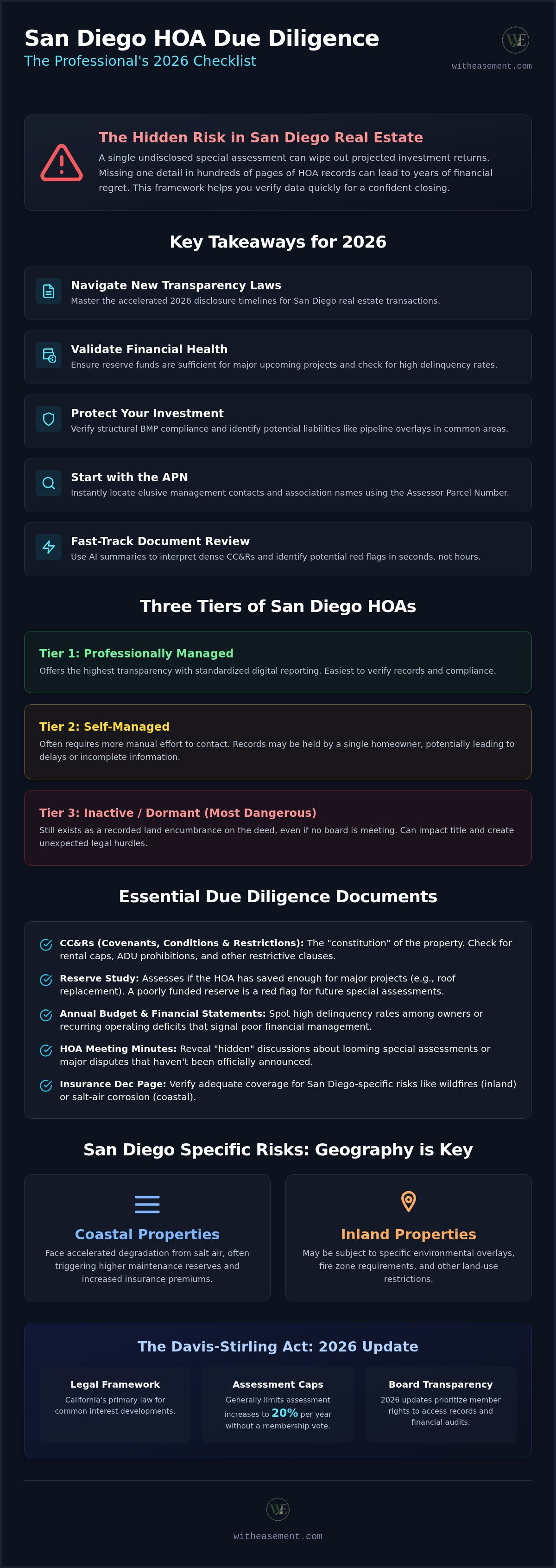
A single undisclosed special assessment can wipe out your projected investment returns before you even receive the keys to your new property. You already know that San Diego's real estate market moves at a breakneck pace, often leaving buyers and agents with little time to parse through hundreds of pages of association records. It's a high-stakes environment where missing one detail in a budget report can lead to years of financial regret. This San Diego HOA due diligence checklist provides the professional framework you need to verify data quickly and move toward a confident closing.
We've designed this 2026 guide to help you master the complexities of local records while protecting your investment from hidden liabilities. You'll learn how to identify red flags in financial statements, locate elusive management contacts for smaller associations, and use modern tools to interpret dense CC&Rs. We'll show you exactly how to streamline your research process, reduce manual search times, and ensure every recorded land encumbrance is accounted for. It's time to replace the guesswork of traditional property research with a clear, data-first approach that prioritizes your time and your bottom line.
Key Takeaways
- Navigate the 2026 transparency laws that have accelerated the disclosure timeline for San Diego real estate transactions.
- Use our San Diego HOA due diligence checklist to validate financial health and ensure reserve funds are sufficient for major upcoming projects.
- Protect your investment by verifying structural BMP compliance and identifying pipeline overlays that intersect common areas.
- Locate elusive management contacts and association names instantly by starting your search with the Assessor Parcel Number (APN).
- Fast-track your document review using AI summaries to interpret dense CC&Rs and identify potential red flags in seconds.
The 2026 Landscape of San Diego HOA Compliance
HOA due diligence is the systematic verification of an association’s legal, financial, and physical standing. It's the process that prevents a buyer from inheriting a five-figure debt or a legal nightmare. In 2026, new transparency laws have accelerated the disclosure timeline for San Diego realtors. You now have less time to gather more data, making a standardized San Diego HOA due diligence checklist essential for every transaction. This verification ensures that what is promised in a listing matches the reality of the association's books.
You'll encounter three distinct tiers of associations in our region. Professional management companies offer the highest transparency with standardized digital reporting. Self-managed associations often require more manual effort to contact, as records may be held by a single homeowner. Inactive associations are the most dangerous; they still exist as recorded land encumbrances on the deed even if no board is currently meeting. Distinguishing between these statuses is your first step toward protecting a client's interest. You must also separate active management compliance from recorded land encumbrances, as the latter can impact title even if the HOA is dormant.
The Impact of the Davis-Stirling Act
The Davis-Stirling Act serves as California’s primary legal framework for common interest developments. It sets strict statutory limits on assessment increases, generally capping them at 20% per year without a membership vote. The 2026 updates to this act prioritize board transparency. Members now have expanded rights to access records and financial audits, reducing the risk of decisions that lead to unexpected special assessments. Understanding these limits helps you advise clients on whether a proposed fee hike is legally enforceable or a potential red flag.
Why Local San Diego Context Matters
Geography dictates risk in San Diego County. Coastal properties face accelerated degradation from salt air, which often triggers higher maintenance reserves and insurance premiums. Inland properties might deal with different environmental overlays or fire zone requirements. The San Diego County Assessor tracks these association boundaries, but it's the realtor's job to verify if there are unresolved violations on a specific unit. Buying into an HOA with existing fines means the new owner becomes responsible for those costs. Using a comprehensive San Diego HOA due diligence checklist helps you identify these localized risks before they become your client's problem. It's about looking beyond the surface to find the hidden liabilities that only a local expert would spot.
Essential Documents for Your San Diego HOA Checklist
Every successful property search starts with a paper trail. You can't rely on verbal promises during a walkthrough; you need the hard data found in the association's official records. Adding these specific documents to your San Diego HOA due diligence checklist ensures you aren't blindsided by restrictive rules or massive financial shortfalls. These records act as the association's DNA, revealing its history and its future liabilities.
- Covenants, Conditions, and Restrictions (CC&Rs): This is the "constitution" of the property recorded at the county level. It dictates everything from architectural standards to pet policies.
- The Reserve Study: This document assesses if the association has saved enough for major 2026-2030 projects, such as roof replacements or elevator modernizations.
- Annual Budget and Financial Statements: Review these to spot high delinquency rates among owners and recurring operating deficits.
- HOA Meeting Minutes: These records often reveal "hidden" discussions about looming special assessments that haven't been officially announced yet.
- Insurance Dec Page: Verify coverage levels for San Diego-specific risks like wildfire in inland areas or salt-air corrosion along the coast.
You can instantly verify these recorded documents and clear the first hurdles of your research through a professional HOA search.
Decoding the CC&Rs and Bylaws
Don't just skim the CC&Rs. Look for restrictive use clauses that directly impact property value, such as strict rental caps or prohibitions on Accessory Dwelling Units (ADUs). It's also vital to verify the amendment history in the San Diego County Recorder index. Boards sometimes distribute "current" rules that were never legally recorded, making them difficult to enforce. Compare the recorded versions against the board's provided handbook to ensure your client is following the legally binding version of the law.
Analyzing Financial Health and Reserve Studies
The "percent funded" ratio in a reserve study is the most critical number for your San Diego HOA due diligence checklist. A ratio below 30% indicates a high risk of an immediate special assessment to cover emergency repairs. Check the 12-month delinquency report for any San Diego community; if more than 5% of owners are behind on dues, the association's cash flow is in jeopardy. A funding gap occurs when the projected cost of future repairs exceeds the cash the HOA has set aside in its reserve account, often leading to sudden, large payments for every homeowner. Identifying these gaps early allows you to negotiate credits or walk away from a volatile investment.
San Diego Specific Risks: Environmental and Infrastructure Due Diligence
San Diego’s unique geography introduces risks that standard disclosure packages often miss. You aren’t just buying into a set of rules; you’re buying into a physical environment governed by strict local mandates. A professional San Diego HOA due diligence checklist must account for environmental compliance and infrastructure encumbrances that can lead to unexpected costs. These factors often exist outside the standard financial reports but carry just as much financial weight.
FEMA map updates in 2026 have shifted the insurance landscape for many local communities. You must verify if a property has recently moved into a high-risk flood zone, as this change will spike the association’s master insurance policy premiums. Additionally, San Diego’s "Very High Fire Hazard Severity Zone" mandates specific disclosures and vegetation management. If an HOA fails to maintain these defensible spaces, they risk losing their insurance coverage entirely. This leaves homeowners vulnerable to massive out-of-pocket losses or unmarketable properties.
Stormwater BMP Compliance
Stormwater Best Management Practices (BMPs) are a major hidden liability in San Diego. The county issues significant fines to associations for poorly maintained drainage systems that allow pollutants to enter the ocean. You should request maintenance records for structural BMPs during the escrow period. If an association hasn't budgeted for these specialized repairs, it will eventually drain their reserves. Environmental compliance is directly linked to the association’s long-term financial health, and neglecting it is a common red flag for aging San Diego developments.
Infrastructure and Map Overlays
Understanding what lies beneath the common areas is just as important as reading the governing documents. Identifying utility easements is a critical step in your San Diego HOA due diligence checklist. These easements may limit how the HOA can use its property or prevent future expansions like new clubhouses or ADUs. High-pressure gas lines or major water mains often require specific access rights that can disrupt common area landscaping or parking lots during repairs.
You can identify these risks quickly by using Flood Zone and Pipeline Overlays to visualize how these utilities intersect with the property boundaries. Seeing these lines on a map provides a level of clarity that a text-based report cannot match. It allows you to evaluate the impact of flood zones on the association’s master insurance policy with precision. This data-first approach ensures you aren't surprised by infrastructure limitations after the contingency period has passed.
Step-by-Step: Conducting Your HOA Search by Address
Searching by street address is a common mistake that leads to incomplete data. You must start with the Assessor Parcel Number (APN) to ensure you are targeting the correct legal entity. This number is the foundation of your San Diego HOA due diligence checklist, as it links the physical property to its recorded land records. Once you have the APN, use a property intelligence platform to identify the specific association name and current management contact. This step eliminates the guesswork of tracking down obscure associations that don't appear in standard search engine results.
Cross-reference this information with the San Diego County Recorder index. This allows you to find the most recent CC&Rs and any subsequent amendments that might be missing from the seller's initial disclosure packet. To finalize the financial verification, request an Estoppel Letter or HOA Demand. This document confirms the specific unit’s standing, including current dues, outstanding fines, or pending assessments. You should also review HOA documents by address San Diego to check for unrecorded liens that could cloud the title before you close escrow.
Using Parcel Maps and APN Lookups
Searching by address alone often misses sub-associations. In complex San Diego developments, a single home might be subject to both a master association and a specific neighborhood HOA. Verify this by checking the parcel maps, which define common area maintenance responsibilities. These maps show exactly where the HOA's jurisdiction begins and ends. It prevents future disputes over who is responsible for a failing retaining wall or a shared private road. Identifying these overlapping layers is a critical part of a professional San Diego HOA due diligence checklist.
Identifying and Contacting Management
Finding management contacts for small or self-managed San Diego HOAs is often the most time-consuming part of the process. If a professional manager isn't present, you'll need to contact the board president directly. Ask about recent meeting attendance, pending litigation, and any planned projects not yet reflected in the budget. When dealing with unresponsive associations during a short escrow, document every attempt to contact the board. This protects your client's interests if disclosures are delayed beyond the contingency period.
Streamline your search process and get instant access to association data by signing up for a WithEasement Membership today.
Streamlining Due Diligence with WithEasement Intelligence
The manual era of property research is over. Efficiency in 2026 requires a centralized database that merges San Diego HOA data with recorded land records. You don't have time to bounce between the County Recorder's office and management company portals. WithEasement simplifies this by providing a single point of access for all association intelligence. You can verify the San Diego HOA due diligence checklist items in a fraction of the time it takes to perform traditional searches. This speed allows you to provide answers to clients while your competitors are still waiting for callbacks.
Visualizing risk is just as important as reading about it. Interactive map overlays allow you to see high-pressure pipelines, flood zones, and easements directly on the property boundaries. You can identify if a common area pool sits on a utility easement or if a new flood zone designation will trigger insurance hikes. Once your research is complete, you can generate professional PDF property reports. These reports provide instant value to your clients and serve as a clear record of your thoroughness during the transaction.
The Power of AI in HOA Document Review
Reading through three hundred pages of CC&Rs is a poor use of your professional time. AI Summaries can instantly interpret these complex documents to flag restrictive clauses or assessment risks in seconds. This technology identifies specific keywords related to rental caps, ADU prohibitions, or looming litigation that you might miss during a manual scan. It significantly reduces the risk of human error when navigating dense legal governing documents. A WithEasement membership empowers realtors with instant property intelligence, turning hours of manual county research into seconds of actionable insight.
Standardizing Your Due Diligence Process
Consistency is the best defense against liability. Integrating San Diego property easement searches into your HOA checklist ensures you never overlook a recorded encumbrance. Top-performing realtors in 2026 are moving away from manual county record searches because they value accuracy and speed. Using downloadable reports allows you to document your due diligence for E&O insurance protection. It proves you followed a rigorous, data-driven process for every client. This standardized approach builds trust, reduces friction, and ensures that your San Diego HOA due diligence checklist is fully completed before any contingencies are removed.
Secure Your Transaction with Professional Intelligence
Mastering your San Diego HOA due diligence checklist is about more than just checking boxes; it's about protecting your client's financial future. You've seen how 2026 transparency laws and environmental mandates like stormwater BMP compliance have changed the stakes for local real estate. Success now depends on your ability to validate recorded land encumbrances against association-level health with speed and precision. By prioritizing data-first research, you eliminate the risk of undisclosed special assessments and hidden infrastructure liabilities.
Modern technology has turned what used to be a week-long paper chase into a streamlined digital process. You can now access centralized San Diego HOA and easement data, use AI-powered property summaries for instant clarity, and visualize risks with interactive map overlays for flood and pipeline risk. These tools ensure you never miss a critical detail in a dense CC&R document or a complex parcel map. It's time to replace manual searches with a high-tech utility that values your time.
Start your San Diego HOA due diligence with WithEasement to fast-track your research and close with confidence. You have the framework and the tools to lead your clients through a seamless, risk-free transaction. We've done the heavy lifting so you can focus on what you do best.
Frequently Asked Questions
How do I find out if a San Diego property is in an HOA?
Check the property's preliminary title report or use a specialized property intelligence platform to reveal recorded CC&Rs. These sources identify if an association legally exists and has the authority to govern the land. You can also search the San Diego County Assessor records using the APN to identify any mandatory membership requirements attached to the property's deed. Identifying the association name early prevents significant delays during the escrow period.
What is the most important document in a San Diego HOA due diligence checklist?
The Reserve Study is the most critical component of a San Diego HOA due diligence checklist. It provides a financial roadmap for major repairs and reveals if the association has sufficient funds for upcoming projects. Without this document, you can't accurately assess the risk of sudden special assessments or significant monthly fee hikes. It serves as the best predictor of the association's long-term financial stability and management quality.
Can I search San Diego HOA records by address for free?
You can search basic recorded documents through the San Diego County Recorder's online index for free, but viewing full documents usually requires a fee. While the index shows document titles, downloading the actual CC&Rs or bylaws typically involves a per-page payment. Most realtors use professional platforms to save time and ensure they are looking at the most recent, legally binding versions of these complex records without navigating multiple portals.
What is an HOA Estoppel Letter and why do I need it in San Diego?
An HOA Estoppel Letter is a legally binding document that certifies the current financial status of a specific unit. You need it to confirm that the seller doesn't have outstanding dues, fines, or unresolved violations that would transfer to the buyer at closing. It protects your client from inherited debts that don't appear in a standard title search or a general association budget report.
How do I check for special assessments in a San Diego condo building?
Review the last twelve months of HOA meeting minutes and the current annual budget to identify pending assessments. These documents often mention proposed projects or funding shortfalls before they become official. You should also check the association's financial disclosures for any "planned assessments" that the board has already discussed or voted on during recent executive sessions or annual membership meetings.
What happens if the HOA is not in compliance with the Davis-Stirling Act?
Non-compliance can lead to legal challenges, unenforceable rules, and difficulty securing financing for potential buyers. If an association fails to follow statutory requirements for meetings or record-keeping, homeowners may have grounds to dispute assessment increases. Lenders often refuse to fund loans in buildings with significant regulatory or transparency failures, which can lower the property's market value and extend closing times.
How do I find the CC&Rs for a property in San Diego County?
Locate the CC&Rs by searching the San Diego County Recorder’s official records using the property’s legal description or Assessor Parcel Number. These documents are public records because they are covenants that run with the land. Using a professional search tool can speed up this process by instantly linking the address to the correct recorded document numbers and any subsequent amendments that have been filed.
What is the difference between an HOA and a Mello-Roos fee in San Diego?
An HOA fee pays for private common area maintenance, while Mello-Roos is a special tax used for public infrastructure like schools and parks. HOA dues are managed by a private board of directors. Mello-Roos fees appear on the annual property tax bill and are governed by local public agencies. It's common for newer San Diego developments to have both types of monthly obligations for homeowners.


