

Rooftop solar panels are legally personal property until proven otherwise, and an unexpected fixture filing can freeze your real estate closing in its tracks. Escrow is stressful enough without discovering surprise equipment contracts days before funding. How do you find out if that sleek rooftop array comes with active liens or encumbrances? Whether you are sorting through regional filings like San Diego solar easements or evaluating residential parcels across the country, distinguishing between owned panels, leased equipment, and power purchase agreements is critical to protecting your investment.
You shouldn't have to waste hours decoding dense county recorder grantor indexes or guessing if a buyer will inherit decades of payment liabilities. In this guide, you'll learn how to detect hidden solar lease liens, locate recorded UCC-1 fixture filings, and confirm solar access rights directly from public records. We outline the exact process to verify ownership status, streamline contract transfers, and eliminate closing delays before escrow stalls.
Key Takeaways
- Distinguish between owned systems, third-party leases, and Power Purchase Agreements (PPAs) to clarify equipment liabilities before making an offer.
- Discover how recorded access agreements, including registered San Diego solar easements, secure unobstructed sunlight across adjacent parcels.
- Master the 5-step verification process to locate active UCC-1 fixture filings and prevent surprise liens from freezing escrow.
- Structure seamless lease transfers or execute seller buyouts funded through transaction proceeds to ensure a clean title transfer.
- Streamline due diligence by using modern recorded document search tools to surface easements and decode complex title encumbrances in minutes.
Understanding Solar Lease Liens and Solar Easements on Real Property
Rooftop solar installations create complex legal footprints on real property. While a utility focuses on grid interconnection, county land records track who holds legal rights to the equipment and the sky above it. Buyers often assume panels are permanent real estate fixtures that transfer automatically with the deed. In reality, financed and leased arrays remain personal property belonging to an outside financier. When a third-party installer funds hardware, they record a security claim against it. As the industry standard dictates, "A solar lease lien legally prevents clear title transfer until satisfied." Escrow cannot close with unaddressed third-party equipment claims looming over the property.
Separating physical hardware liens from airspace rights is essential during due diligence. A recorded solar easement protects collector surfaces from shade cast by neighboring additions or trees, while equipment filings protect financial lenders. Recognizing how both mechanisms function prevents severe settlement roadblocks.
What Is a Solar Fixture Filing and UCC-1 Lien?
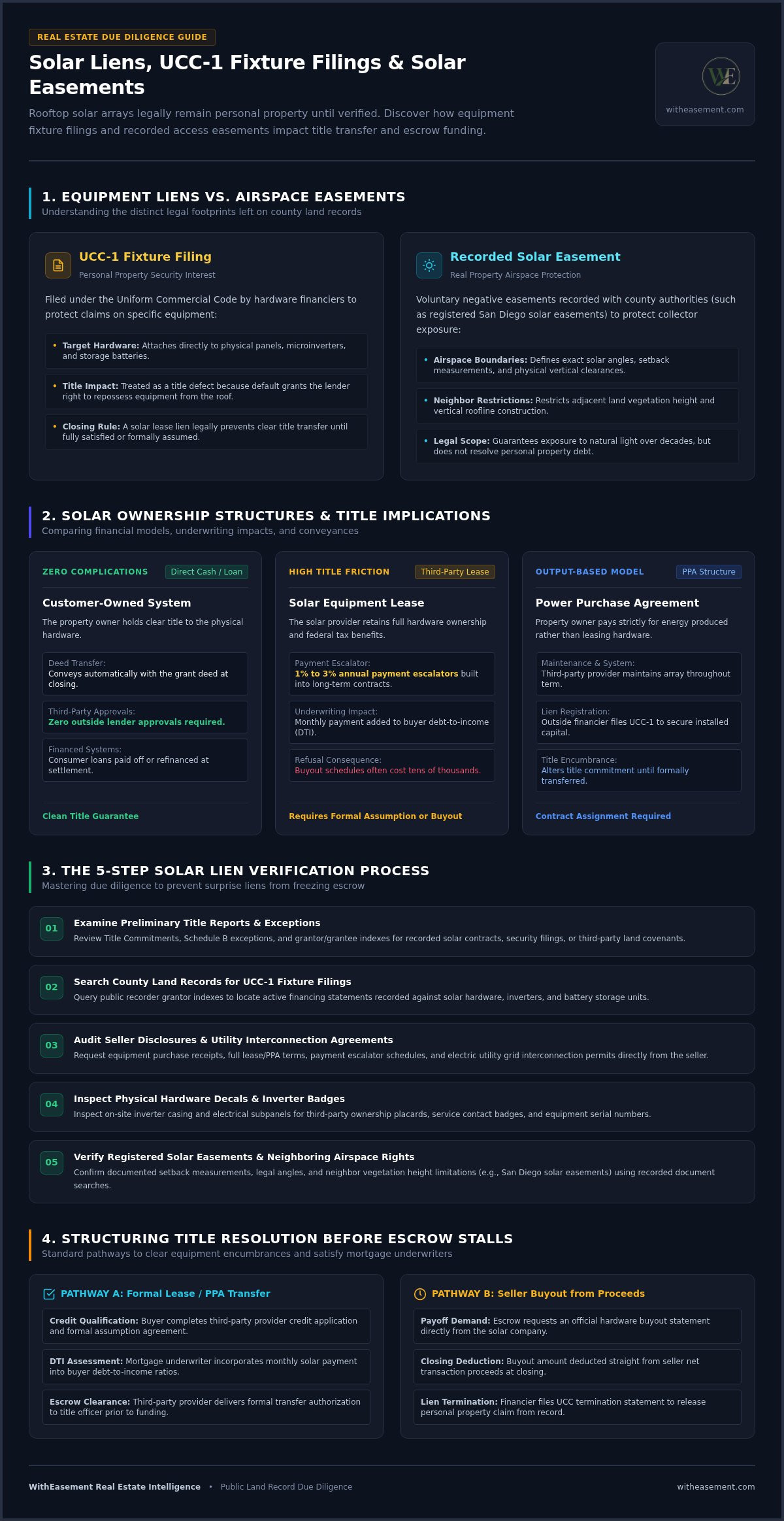
Financiers secure their capital investments by filing a UCC-1 financing statement under the Uniform Commercial Code. This document acts as a public notice that a lender holds an active security interest in personal property attached to the premises. The fixture filing specifically identifies the solar panels, microinverters, and storage batteries. It attaches to the physical hardware rather than the underlying parcel. Even so, title companies treat these filings as title defects because equipment default allows the lender to repossess the system directly from the roof.
How Solar Easements Protect Sunlight Rights
Solar easements serve an entirely different legal purpose than equipment liens. Instead of securing debt, they function as voluntary negative easements that restrict neighboring landowners from obstructing direct sunlight. These legal instruments require precise statutory language filed directly with the county recorder, including:
- Specific solar angles, setback measurements, and airspace boundaries.
- Definite restrictions regarding adjacent vegetation height and roofline construction.
- Explicit conditions governing potential easement modification or termination.
Reviewing recorded instruments like San Diego solar easements demonstrates how legal boundaries protect panel productivity over decades. While recorded access easements guarantee exposure to natural light, they do not resolve personal property debts. Clearing title requires identifying both the physical airspace rights documented in San Diego solar easements and any active UCC-1 hardware claims before escrow instructions become binding.
Solar Ownership Structures: Leases, PPAs, and Easement Agreements
Every solar array carries a distinct legal identity based on how it was purchased. Customer-owned systems bought with cash convey instantly with the grant deed, creating zero title complications. Financed systems involve consumer loans that must be paid off or refinanced at settlement. Leases and power purchase agreements, however, introduce third-party ownership that alters title commitments. Mortgage underwriters scrutinize these monthly commitments closely; if a buyer must assume a lease, the payment gets added straight into their debt-to-income calculation. Discovering an unrecorded lease contract days before closing can break loan approval immediately.
Confirming equipment rights early prevents these last-minute disruptions. Running a quick property easement search reveals recorded land agreements, lighting protections, and structural burdens before underwriting flags them.
Direct Ownership vs. Third-Party Solar Leases
Direct ownership means the property owner holds clear title to the physical hardware. When the home sells, the solar installation transfers automatically without requiring outside approval. Third-party leases work on an entirely different model:
- The solar company retains full equipment ownership and claims all federal depreciation benefits.
- Contracts regularly include annual payment escalators between 1% and 3%, steadily increasing energy costs over time.
- Buyers who refuse to assume the lease force sellers to trigger rigid buyout schedules, which often cost tens of thousands of dollars to clear.
Power Purchase Agreements and Associated Encumbrances
Power Purchase Agreements (PPAs) mirror leases in structure, but you pay for energy production rather than the panels themselves. The provider installs, maintains, and owns the rooftop hardware while billing the occupant for generated kilowatt-hours. These contracts span 20 to 25 years and run with the land through assignment clauses, legally binding future heirs and purchasers.
PPAs also come with strict operational covenants. Providers often retain structural access rights, dictate specific roofing materials during renovations, and prohibit owners from planting shade-producing trees. State frameworks, such as California's Solar Rights Act, limit unreasonable homeowner association restrictions on installation, but they do not eliminate third-party contract obligations. Buyers who analyze San Diego solar easements and public land records alongside private PPA terms can evaluate exactly what airspace protections exist and whether third-party equipment claims jeopardize clean title transfer.
How to Identify Solar Lease Liens on a Property: A 5-Step Process
Uncovering hidden equipment claims requires an orderly audit of both the physical structure and the public registry. Waiting on standard title disclosures can backfire, especially when sellers misunderstand their own contracts. Follow this field-tested 5-step process to verify system ownership before escrow contingencies expire:
- Step 1: Inspect hardware placards. Examine on-site inverters, subpanels, and AC disconnect boxes for third-party ownership tags.
- Step 2: Collect foundational paperwork. Request the original installation contract, warranty assignments, and twelve months of electric statements.
- Step 3: Scrutinize title commitments. Review Schedule B exceptions specifically looking for recorded fixture filings or UCC financing statements.
- Step 4: Search county land records. Query grantor and grantee indexes using the Assessor Parcel Number (APN) to pinpoint personal property claims.
- Step 5: Run modern parcel intelligence checks. Utilize recorded document software to identify airspace covenants and adjacent property burdens.
Conducting Physical and Document Inspections
Start your assessment at the main electrical service panel. Installers place metallic placards near inverter enclosures detailing system specifications. If the equipment is leased or tied to a third-party PPA, these labels explicitly identify the corporate asset owner. Reviewing SEIA's consumer protection resources helps clarify standard disclosure standards used across the residential industry. Next, verify the monthly utility bill to ensure the seller isn't paying separate solar generation charges to an outside provider.
Searching Title Reports and Public Records
Check the preliminary title report thoroughly. UCC-1 statements often hide deep within the Schedule B exclusions as general fixture filings. Do not stop there; manual county recorder indexes require running the seller's legal name and the APN through the grantor/grantee index. For detailed tactics on extracting these filings from clerk archives, study this professional property easement search guide.
Using Modern Property Intelligence Tools
Manual title searches miss critical boundaries if neighbouring parcels hold unindexed claims. Use digital intelligence platforms to pull parcel boundaries and cross-examine nearby airspace restrictions immediately. Real estate professionals leverage interactive property map tools to inspect recorded encumbrances, utility alignments, and parcel limits at a glance. Evaluating regional data frameworks alongside registered San Diego solar easements confirms whether an array has secured legal sunlight access or sits vulnerable to future shade. Run your digital parcel checks early to generate comprehensive reports before submitting a non-contingent offer.
Managing Solar Encumbrances During Real Estate Transactions
Rooftop equipment agreements regularly stop escrow closings just days before scheduled funding. Settlement agents cannot issue a clear title policy while an outstanding UCC-1 filing clouds the title. To safeguard your transaction timeline, insert specific solar contingency clauses into the purchase contract early. These provisions give buyers the legal right to cancel or demand seller resolution if a third-party solar provider delays assignment documents or refuses to cooperate.
Transferring an Existing Solar Lease to a Buyer
Assuming a lease isn't as simple as signing closing paperwork. Major solar providers mandate a formal transfer process that typically spans 30 to 45 days. The leasing company runs an independent credit check on the incoming buyer to verify payment eligibility. During this review window, mortgage underwriters add the monthly solar obligation directly to the buyer's qualifying debt-to-income ratio. The transaction cannot fund until the lender receives an executed lease assignment certificate, making early submission mandatory.
Lien Releases, Subordinations, and UCC-3 Terminations
When buyers decline to inherit existing equipment contracts, sellers must execute a buyout using gross sale proceeds at closing. The escrow officer orders an official payoff demand letter directly from the hardware lessor. Once funds disburse at settlement, the provider files a formal UCC-3 termination statement with the county clerk to extinguish the fixture filing completely.
If a buyer chooses to assume the lease, the primary mortgage lender still requires first-lien priority over the real estate. Solar leasing entities resolve this by executing a temporary UCC subordination agreement. This document temporarily steps down their equipment position so the purchase mortgage can record first.
Clean transactions require separating these personal equipment contracts from perpetual land rights. While property instruments like San Diego solar easements preserve sunlight access across boundaries indefinitely, financing claims demand active paperwork management. Before drafting contingencies, search recorded property records with WithEasement to identify active fixture filings, confirm airspace rights, and eliminate escrow delays.
Modernizing Property Due Diligence with WithEasement
Traditional public document searches are notoriously sluggish. Sifting through county recorder indexes or waiting days for preliminary title commitments creates unnecessary friction in competitive real estate deals. WithEasement changes this workflow entirely. By centralizing recorded easements, land use overlays, and underlying property data into a single national dashboard, the platform lets professionals evaluate parcel constraints instantly. Simply type in a street address or Assessor Parcel Number to access clean, actionable property intelligence on demand.
Speed matters when escrow timelines are tight. Modern property research tools bridge the gap between complex legal registries and rapid deal execution, delivering deep parcel clarity without administrative delays.
Instant Property Encumbrance and Easement Discovery
Uncovering critical encumbrances shouldn't require manual microfiche reviews or fragmented online portal searches. The platform maps out recorded boundaries, utility pathways, and access limitations directly across interactive parcel maps. Real estate teams can leverage AI for real estate due diligence to translate dense, multi-page title exceptions into clear summaries in seconds. Instead of deciphering archaic legal descriptions by hand, you get direct visibility into whether a property benefits from recorded airspace covenants or carries restrictive third-party access rights.
Empowering Professionals with Automated Due Diligence
Resolving potential title issues before listing a property protects transactions from sudden fallout. Real estate professionals use WithEasement to verify title clarity ahead of buyer showings, uncovering unreleased equipment filings and land restrictions before they trigger escrow disputes. The system allows users to generate polished, one-click PDF property reports containing verified parcel insights:
- Comprehensive easement boundaries and recorded public document indexes.
- Clear summaries separating personal property equipment claims from real property burdens.
- Instant mapping of nearby utility corridors and access restrictions.
Whether you need to confirm whether an installation benefits from protected sunlight rights like San Diego solar easements or need to confirm equipment ownership across a national residential portfolio, verified documentation keeps deals on track. Discover recorded easements and property data with WithEasement to verify title stability, streamline transaction due diligence, and eliminate costly closing surprises before contracts are signed.
Take Control of Solar Due Diligence Before Closing
Rooftop solar arrays shouldn't trigger last-minute escrow crises or delay loan funding. Catching unrecorded fixture filings early gives you the leverage needed to negotiate seller buyouts, initiate lease transfers, and protect buyer financing. Distinguishing personal property debts from recorded airspace protections like San Diego solar easements ensures a clean title transfer while safeguarding long-term energy generation.
You don't need to spend hours parsing dense recorder indexes to uncover hidden liabilities. WithEasement provides a comprehensive property easement and recorded document intelligence platform that streamlines due diligence. Search any parcel instantly by address or APN to pinpoint active encumbrances, deploy AI-driven summaries that translate dense title encumbrances instantly, and export centralized PDF reporting tools for clients and lenders. Accelerate your property due diligence with WithEasement and close your next transaction with complete confidence.
Frequently Asked Questions
Does a solar lease automatically transfer to the buyer when a home is sold?
No, a solar lease does not transfer automatically with the grant deed. The incoming buyer must submit a formal transfer application to the solar provider and pass an independent credit evaluation. The leasing company then drafts an assignment agreement that both parties must sign before settlement. If a buyer rejects the contract terms or fails credit qualification, the seller must buy out the remaining balance before closing.
What happens if a seller does not disclose an active solar lease lien?
Undisclosed solar leases create major title defects that can halt escrow immediately. Mortgage underwriters will pause loan approvals upon discovering personal property claims on Schedule B title commitments. In this scenario, buyers maintain the right to cancel the purchase contract, recover earnest money deposits, or demand that the seller clear the fixture filing using transaction proceeds prior to closing.
Can a mortgage lender deny financing because of a solar UCC-1 fixture filing?
Yes, mortgage lenders regularly suspend or deny loan files over unaddressed UCC-1 fixture filings. A primary purchase mortgage requires first-lien priority on the underlying real estate. If a solar financier holds an active filing that clouds title priority, the underwriter will demand a formal UCC subordination agreement. Without an executed subordination or a full debt payoff before settlement, the lender won't fund the mortgage.
How do I remove a solar lien from a property's public record?
Removing a solar lien requires an official contract payoff followed by a recorded legal release. Escrow officers request a formal payoff demand from the equipment lessor and disburse funds directly at settlement. Once satisfied, the solar creditor drafts and records a UCC-3 termination statement with the county clerk. This official filing extinguishes the creditor's security interest and clears the public record completely.
Is a solar easement the same thing as a solar lease lien?
No, they represent completely different legal mechanisms. A solar lease lien is a financial security claim securing physical hardware attached to the roof. Conversely, recorded instruments like San Diego solar easements are real property rights protecting direct sunlight access across neighboring boundaries. Equipment liens cloud title and impede financing, whereas access easements legally safeguard generation capacity against adjacent structural shade.
Will standard title insurance protect buyers against unrecorded solar leases?
Standard owner title insurance policies rarely protect against leased solar hardware. Most policies explicitly exclude personal property, unrecorded agreements, and UCC fixture filings under standard Schedule B exceptions. Because leased solar arrays remain the personal property of an outside corporation rather than permanent real estate fixtures, buyers must inspect equipment placards and run targeted public record searches independently before closing.
How can real estate agents quickly verify solar ownership on a new listing?
Agents should inspect the physical inverter for ownership placards and review twelve months of electric statements. To verify legal title standing without waiting on title commitments, leverage modern platforms like WithEasement. Searching the parcel number or street address surfaces recorded documents quickly, while AI document summaries confirm whether active fixture filings or San Diego solar easements impact the property.


