

The difference between a profitable San Diego investment and a legal nightmare often comes down to a single recorded document you didn't know existed. In a market where the total assessed value of taxable real estate has hit a record $845 billion, the stakes for property due diligence San Diego have never been higher. You shouldn't have to spend days at the County Recorder's office or wait weeks for a title search just to find out if a utility easement blocks your planned construction. It's a common fear, and the slow pace of manual municipal research only adds to the stress.
We believe that high-level property intelligence should be effortless and accessible. This guide will show you how to leverage modern data tools to uncover hidden risks, from recorded easements to restrictive HOA covenants. You'll learn how to generate professional-grade reports and gain instant access to flood and pipeline overlays. We'll walk through the process of visualizing every encumbrance on a single map, ensuring you have the clarity to move forward without the threat of expensive, "hidden" surprises.
Key Takeaways
- Understand why San Diego's unique coastal regulations and complex terrain require a systematic approach to verifying property facts.
- Execute professional property due diligence San Diego by uncovering hidden utility easements and HOA restrictions that traditional searches might miss.
- Replace time-consuming trips to the County Recorder with modern data intelligence to access recorded documents and AI-powered summaries instantly.
- Mitigate risk by visualizing critical environmental factors like flood zones and pipeline overlays on a single interactive map.
- Enhance your professional workflow by generating downloadable PDF reports that provide clear, actionable intelligence for your clients.
What is Property Due Diligence in San Diego?
Property due diligence is the systematic verification of facts to ensure a real estate asset is exactly what it appears to be. In a broad sense, What is Due Diligence refers to the care a reasonable person takes before entering into an agreement. For local investors and professionals, property due diligence San Diego specifically focuses on uncovering encumbrances that could restrict your rights or drain your capital. It's about finding the "invisible" legal lines that dictate how you can use the land.
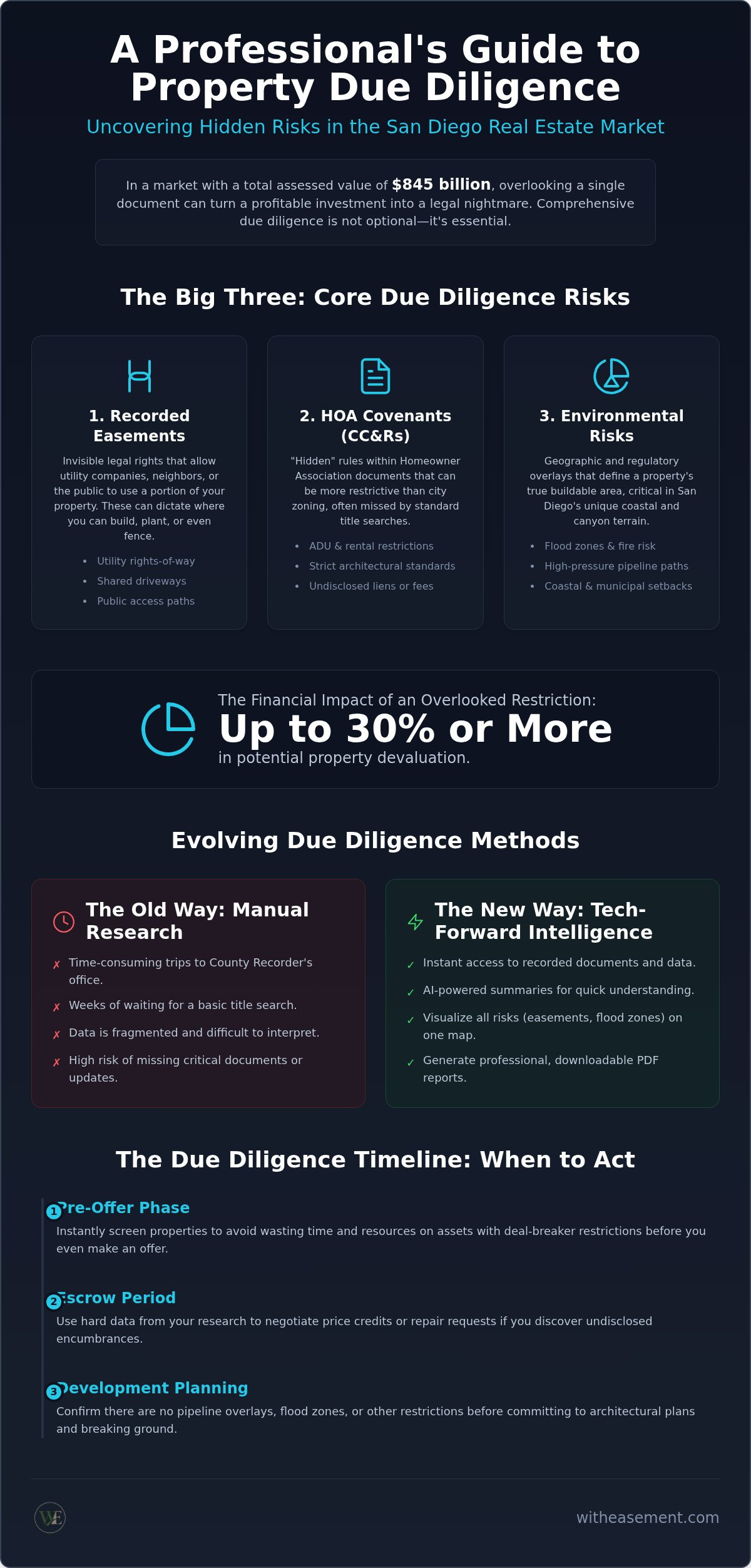
San Diego presents unique challenges. Our complex canyon terrain and strict coastal regulations mean a parcel that looks buildable might be legally locked by environmental protections or municipal setbacks. With the San Diego County tax roll reaching a record $845 billion in 2026, the financial stakes are massive. An overlooked utility easement or a private right-of-way can devalue a property by 30% or more. These restrictions often prevent planned additions like ADUs, pools, or decks, turning a high-potential investment into a stagnant asset.
The process has evolved rapidly. We've moved away from slow, manual record-pulling at the County Recorder’s office toward instantaneous digital intelligence. This shift empowers you to visualize risks before they become liabilities. Professional property due diligence San Diego now relies on modern data overlays that reveal what a physical walkthrough cannot see.
The Core Components of a Property Audit
A professional audit goes beyond a basic title search. It requires a deep dive into three specific areas to ensure complete clarity:
- Ownership and Title History: Verify the legal description and ensure the seller holds the rights they claim to transfer.
- Recorded Easements: Identify utility rights-of-way, shared driveways, or public access paths that aren't visible to the naked eye.
- Zoning and Land Use: Confirm the property meets current municipal codes and identify any restrictive overlays that limit future development.
When to Perform Your Research
Timing is everything in a competitive market. Perform your research at these critical stages to protect your interests:
- Pre-offer Phase: Screen properties instantly to avoid wasting time on assets with deal-breaker restrictions.
- Escrow Period: Use hard data to negotiate price credits or repair requests if you discover undisclosed encumbrances.
- Development Planning: Check for pipeline overlays or flood zones before committing to architectural plans or breaking ground.
Starting your research early saves both time and money. It turns a stressful transaction into a calculated, data-driven decision. You'll move forward with the confidence that you've uncovered every relevant fact about the land.
The Big Three: Easements, HOA, and Environmental Risks
A property's "buildable" area isn't defined by its fence lines. It's defined by the intersection of legal, administrative, and environmental constraints. Effective property due diligence San Diego requires looking beyond the physical dirt to see the invisible layers that dictate land use. If you miss a single utility easement or a restrictive HOA covenant, your plans for a pool or an ADU could be dead on arrival. These factors don't exist in isolation; they overlap to create a narrow window of opportunity for development.
Navigating San Diego Property Easement Searches
Easements are legal rights that allow others to use a portion of your land for specific purposes. You can start your research by performing an APN lookup to identify specific recorded documents tied to the parcel. Public utility easements often run along property borders, but private access easements can cut directly through a backyard. An easement in gross benefits a specific individual or entity, whereas an appurtenant easement is attached to the land itself and benefits a neighboring parcel. Identifying these early ensures you don't design a structure over a high-pressure water main or a neighbor's legal driveway.
Uncovering HOA Data and CC&Rs
Finding HOA management contact information in San Diego is notoriously difficult, yet these organizations hold immense power. Their Covenants, Conditions, and Restrictions (CC&Rs) often contain "hidden" rules that title companies might overlook. These documents can block short-term rentals or impose strict architectural standards that make ADU construction impossible. Beyond design, you must check the financial health of the association. Unpaid HOA liens or pending special assessments for balcony inspections can lead to unexpected five-figure costs shortly after closing. Verified market data shows that HOA transfer fees typically range from $250 to $500, while disclosure packages can cost up to $700.
Visualizing Environmental and Infrastructure Risks
Environmental overlays are the final piece of the puzzle. Under the California Environmental Quality Act (CEQA), environmental impact is a primary consideration for any new development. You need to interpret FEMA maps to identify flood zone overlays that might require expensive insurance or specific foundation types. Pipeline overlays are equally critical; locating gas and water mains is essential before breaking ground. While the 2026 tax roll shows record assessed values, these numbers often lag behind market reality. You can visualize these risks instantly on a single map to see how infrastructure and environmental hazards impact the true utility of your San Diego property.
Traditional vs. Tech-Forward Due Diligence Methods
For decades, property research meant driving to the County Operations Center in Kearny Mesa. You would wait in line, pay recording fees that started at $14.00 per document, and manually flip through thick binders of parcel maps. This "City Hall" approach is now obsolete for modern professionals. It's slow, prone to human oversight, and limits your ability to move quickly on competitive deals. Relying on manual record-pulling creates a bottleneck that can cost you a transaction in a market where the median home sells in just 18 days.
The "Lawyer approach" is another traditional path. While legal counsel is essential for complex litigation or title disputes, it's an expensive way to perform initial data gathering. You often wait days for a junior associate to review a deed that you could have accessed yourself in seconds. Modern platforms have democratized this information. They provide real-time access to centralized San Diego land records, allowing you to perform property due diligence San Diego with professional-grade accuracy. You gain immediate clarity on encumbrances without the administrative friction or high hourly rates.
Efficiency gains are the primary driver of this digital shift. Tech-forward methods reduce research time from several days to just a few minutes. You can screen a dozen properties in the time it used to take to research one. This speed allows realtors and investors to stay ahead of the market, identifying "red flag" properties before committing significant capital or time.
The Role of AI in Modern Property Research
Artificial intelligence has transformed how we interpret dense legal documentation. Using AI for real estate due diligence allows you to summarize 50-page deeds or complex CC&Rs in seconds. These tools are designed to identify "red flag" language automatically. They flag specific keywords related to utility rights-of-way, building height restrictions, or shared maintenance agreements. This automation reduces human error in land use analysis. It ensures you don't miss a single sentence buried on page 30 that could block your construction plans. You get a clear, digestible summary of the most critical facts immediately.
Cost-Benefit Analysis of Research Methods
The financial logic of switching to a digital platform is clear. A WithEasement membership provides unlimited access to San Diego County data for a fraction of what a single legal consultation costs. For realtors, this creates "speed to lead." You can provide prospective buyers with a PDF property report during the first walkthrough. This level of service builds trust and accelerates the decision-making process. Scalability is the final advantage. You can perform high-level property due diligence San Diego on ten properties simultaneously. This allows you to cast a wider net and find the best investment opportunities without increasing your overhead or administrative workload.
The San Diego Property Due Diligence Checklist
Structure your research to ensure you don't overlook a critical detail during your property due diligence San Diego. A repeatable workflow allows you to move with speed while maintaining professional-grade accuracy. This checklist serves as your roadmap for verifying every facet of a parcel before capital is committed. By following these steps, you turn a complex search into a streamlined, data-driven process.
Step 1: Identifying the Parcel
Begin with the basics. Street addresses often lack precision, especially for vacant land or recently subdivided lots. You must verify the Assessor’s Parcel Number (APN) to ensure you're researching the correct legal entity. This unique identifier is the key to unlocking the property’s legal description, total acreage, and lot boundaries. Checking the assessed value history is equally vital. With 2026 tax regulations and Prop 19 impacting how inherited properties are taxed, understanding historical tax roll data helps you project future carrying costs accurately. Don't rely on a simple address search when the APN provides the only definitive link to recorded county records.
Step 2: Analyzing Encumbrances
Visualize the parcel's legal constraints immediately. Use the San Diego interactive property map to see recorded easements and infrastructure overlays in real time. Look specifically for "floating" easements. These are blanket rights-of-way that don't have a fixed location, meaning they could potentially impact any part of the parcel. You should also identify potential encroachments from neighboring properties, such as fences or retaining walls that cross property lines. Seeing these layers on a map provides clarity that a text-based deed simply cannot offer.
Complete your audit by verifying the remaining high-risk factors. Confirm active HOA management and pull the most recent CC&Rs to identify restrictions on ADUs or short-term rentals. In San Diego, these documents are frequently updated to reflect new wildfire safety regulations or mandatory balcony inspection requirements for 2026. Next, overlay FEMA flood risk maps and high-pressure pipeline data to define the safe buildable area. Finally, generate a comprehensive PDF report. Having a permanent record of these findings protects your interests and provides immediate value to your clients. You can generate your property reports now to access these professional-grade insights instantly.
Streamlining Your Workflow with WithEasement
Efficiency defines the modern real estate market. WithEasement centralizes disparate San Diego County data sources into a single, intuitive interface. You no longer need to toggle between FEMA flood maps, the County Recorder's portal, and private HOA lists. This integration is the core of effective property due diligence San Diego. It gives you total control over the data without paying a premium for third-party project management. By visualizing every layer of a parcel simultaneously, you reduce the friction that often stalls transactions. Transparent data sharing builds trust between agents and clients, ensuring everyone moves forward with the same set of facts. You're empowered to provide high-level intelligence that usually requires hours of manual cross-referencing, all within a few clicks.
Generating Professional PDF Reports
A professional property intelligence report is more than a collection of maps. It's a comprehensive dossier that includes the APN, legal descriptions, and AI-powered summaries of recorded easements. You use these reports to justify asking prices or defend offer amounts during negotiations. If a property has a clean record with no pipeline or flood risks, the data proves its premium value. Creating a "Due Diligence Vault" for every listing ensures you're prepared for any question a buyer's agent might ask. By presenting all potential encumbrances upfront, you eliminate the "eleventh-hour" surprises that often kill deals in escrow. These reports provide expert-level insights without the need for expensive legal intermediaries or specialized training.
Membership vs. One-Off Research
Active San Diego realtors benefit from ongoing access rather than one-off searches. The local landscape is constantly shifting. New pipeline recordings, updated zoning ordinances, and 2026 wildfire safety regulations mean yesterday's data might be obsolete today. A membership ensures you stay ahead of these changes across your entire portfolio. You can screen new prospects as they hit the market, identifying opportunities before your competitors even finish their initial research. This scalability allows you to perform high-quality property due diligence San Diego on every deal you touch. It's a no-nonsense approach to staying informed and protecting your clients' investments. Join WithEasement today to unlock professional property data.
The transition from manual research to digital intelligence is a competitive necessity. By centralizing your workflow, you save time, reduce risk, and provide a superior service level to your clients. You'll spend less time searching for documents and more time closing deals with confidence. Start building your digital property library today and see how effortless professional research can be.
Secure Your San Diego Investment with Modern Intelligence
Mastering property due diligence San Diego no longer requires weeks of manual research or excessive legal fees. You've seen how shifting from traditional "City Hall" methods to tech-forward data platforms provides a clear view of every recorded easement and environmental restriction. This systematic approach ensures that "hidden" encumbrances never derail your development plans or investment goals. You now have the checklist needed to verify APNs, analyze overlays, and confirm HOA financial health before committing capital. It's about replacing uncertainty with professional-grade data.
Efficiency is your greatest competitive advantage in the fast-moving 2026 real estate market. You can leverage instant access to recorded easements and HOA data to stay ahead of the competition. Use AI-powered property summaries and professional PDF reporting tools to share critical insights with clients and move through escrow with complete confidence. Start your San Diego property search with WithEasement to unlock the intelligence you need to succeed. You're ready to navigate the complexities of local land records with effortless precision and expert-level clarity.
Frequently Asked Questions
What is property due diligence in San Diego?
It's the systematic process of verifying ownership, land use rights, and legal encumbrances before a transaction. In San Diego, this involves identifying "invisible" factors like utility easements, HOA restrictions, and coastal regulations that impact buildability. Effective property due diligence San Diego protects your capital by uncovering risks that physical inspections miss. It ensures you know exactly what you're buying before you commit to a record-breaking 845 billion dollar market.
How do I find recorded easements on my property?
You can find recorded easements by searching the San Diego County records using the property’s address or Assessor’s Parcel Number (APN). While you can visit the County Recorder's office, digital platforms now provide instant access to these documents. These tools allow you to visualize utility rights-of-way and private access paths directly on an interactive map. Identifying these early prevents you from planning structures over critical infrastructure like high-pressure water mains.
Can I perform property due diligence without a lawyer?
Yes, modern data intelligence platforms empower users to gather and interpret land records independently. You can access recorded easements, HOA data, and environmental overlays without high hourly legal rates. While complex litigation requires an attorney, most initial research is now a data-science task. AI-powered summaries help you understand 50-page deeds in seconds. This allows you to perform professional-grade property due diligence San Diego while maintaining full control over your timeline and budget.
Where can I find HOA documents for a specific address?
Finding HOA documents often requires searching centralized databases that link specific addresses to their governing associations. In San Diego, these records include CC&Rs, bylaws, and financial health reports. Traditional title searches might overlook these "hidden" rules that block ADUs or short-term rentals. Using a specialized search tool allows you to pull these documents instantly. This helps you identify potential special assessments or liens before they become your financial responsibility after closing.
What is an APN and why is it important for property research?
An APN, or Assessor’s Parcel Number, is a unique identifier assigned to every piece of real estate in San Diego County. It's more precise than a street address, which can be vague for vacant land or large subdivided lots. The APN serves as the primary key for accessing all recorded documents, including tax history and easement data. Using this number ensures your research is tied to the correct legal boundary and prevents costly errors during the audit.
How do flood zone overlays affect property value in San Diego?
Flood zone overlays identify areas at higher risk for water damage, which can significantly impact insurance premiums and construction requirements. If a property falls within a FEMA-designated zone, you may face mandatory insurance costs or foundation height restrictions. These factors often decrease a property's market value or increase development overhead. Visualizing these overlays on a map allows you to project carrying costs accurately and negotiate price credits during the escrow period.
What are pipeline overlays and why should I check them?
Pipeline overlays show the exact location of underground gas, water, and sewer mains that cross a parcel. These infrastructure lines often carry "floating" easements that restrict where you can build permanent structures like pools or ADUs. Checking these overlays is a critical step in risk mitigation. It prevents you from breaking ground on a project that the utility company could legally force you to remove, saving you from devastating financial losses.
How long does a professional property due diligence search take?
Traditional manual searches at municipal offices can take several days or even weeks. However, using a tech-forward platform reduces this timeframe to just a few minutes. You can instantly pull recorded documents, generate PDF reports, and view environmental overlays for any San Diego County address. This "speed to lead" is vital in a competitive market where the median home sells in just 18 days. You get the intelligence you need without the administrative delay.


