

What if your most promising listing in La Jolla or North County is currently sitting on a hidden liability that could tank a loan in 48 hours? It happens more often than most agents care to admit, usually because critical information stays buried in a stack of delayed paperwork. Spotting San Diego HOA red flags early in the listing process is no longer just a "nice to have" skill. It is a requirement for professional deal security in 2026.
You likely agree that nothing kills momentum like an unexpected $20,000 special assessment appearing mid-escrow. It's exhausting to manage buyer panic when HOA documents arrive weeks late with news of pending litigation or depleted reserve funds. This guide gives you the tools to identify these financial and legal hazards before they become expensive surprises. We will walk through the essential markers of association health, from court records to regulatory compliance, so you can deliver bulletproof reports to your clients and keep your transactions on track.
Key Takeaways
- Identify critical San Diego HOA red flags like construction defect litigation and low reserve funds before they impact your buyer's loan.
- Navigate updated transparency requirements under the Davis-Stirling Act to ensure your due diligence meets 2026 standards.
- Recognize the specific financial markers, including reserve levels below 70 percent, that trigger non-warrantable status for major lenders.
- Streamline your workflow by using AI summaries to transform dense CC&Rs into clear, professional reports for your clients.
The Evolution of HOA Due Diligence in San Diego
In the context of a modern real estate transaction, San Diego HOA red flags are the subtle, often buried indicators of financial instability or brewing legal conflict within a community. They represent the cracks in the foundation of a deal that, if ignored, lead to collapsed escrows and frustrated clients. By 2026, the landscape of due diligence has shifted significantly. Increased transparency requirements under the Davis-Stirling Act have made more data available to the public; however, this abundance of information creates a new burden of proof for real estate professionals. You can no longer claim that information was hidden when the state has mandated its availability.
The days of relying solely on a standard 17-day contingency period to uncover association issues are over. Waiting for the official document package to arrive is a reactive strategy that puts your commission and your reputation at risk. In California, the "I didn't know" defense no longer protects your license. Professional standards now require a proactive approach where agents identify potential deal-killers before an offer is even signed. It's about moving from a position of discovery to a position of authority. When you can spot a problem during the first walkthrough, you save your client time and protect your professional standing.
Modern due diligence requires a shift in mindset. You are no longer just a facilitator of paperwork; you are a researcher. With the San Diego Superior Court online indexing speed reaching new levels of efficiency in 2026, the expectation is that agents will perform preliminary checks on litigation and liens as part of their standard workflow. This proactive research ensures that you aren't blindsided by a "non-warrantable" status halfway through the loan process.
The High Cost of Missed Disclosures
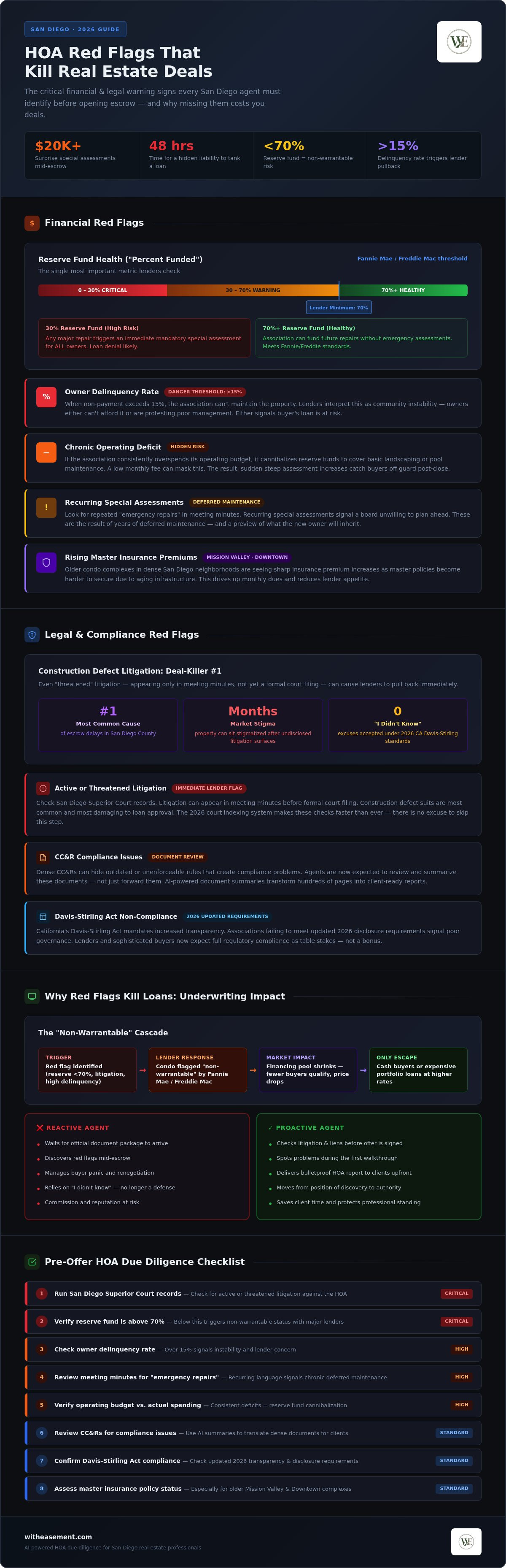
Undisclosed litigation is perhaps the most common reason for escrow delays in San Diego County. Even "threatened" litigation, which might only appear in meeting minutes rather than a formal court filing, can cause a lender to pull back immediately. This uncertainty tanks buyer confidence and can leave a property stigmatized on the market for months. To stay ahead of these issues, consult our San Diego HOA Due Diligence Checklist to ensure every base is covered before you open escrow.
San Diego Market Dynamics in 2026
The local market is currently facing unique pressures, particularly in high-density areas like Mission Valley and Downtown. Older condo complexes are seeing a sharp rise in insurance premiums as master policies become harder to secure due to aging infrastructure. Many associations are also struggling with lender requirements for reserve funds. If an association is "under-reserved," meaning they have not saved enough for future repairs, they may fail to meet the strict criteria set by Fannie Mae and Freddie Mac. Identifying these neighborhood-specific trends allows you to advise clients on the long-term viability of their investment.
Financial Red Flags: Beyond Monthly Dues
Monthly dues are just the tip of the iceberg. A low monthly fee might look attractive on a listing, but it often hides a lack of long-term planning. You need to look at the operating budget versus actual spending. If an association consistently runs an operating deficit, they're likely cannibalizing their reserve funds to pay for basic landscaping or pool maintenance. This is one of the most significant San Diego HOA red flags because it signals a board that is unwilling to make tough financial decisions. These imbalances eventually lead to sudden, steep increases in monthly assessments that can catch a buyer off guard.
Delinquency rates provide another window into the community's health. When owner non-payment exceeds 15 percent, the association's ability to maintain the property drops. Lenders view high delinquency as a sign of instability. It suggests that the owners either can't afford the property or are protesting poor management. Either way, it puts the buyer's loan at risk. A healthy association should have a robust collection policy to ensure every owner contributes their fair share to the collective pool of resources.
Decoding the Reserve Study
The reserve study tells you if the HOA can afford its own future. Lenders typically look for a "Percent Funded" level above 70 percent to consider an association healthy. Be wary of "window dressing" where a board might artificially inflate their numbers by excluding certain upcoming repairs from the report. In 2026, an HOA with a 30 percent reserve fund represents a high-risk liability where any major repair will likely trigger an immediate, mandatory special assessment for all owners. If you want to see these financial markers clearly, a PDF Property Report can help you visualize the data quickly.
The Special Assessment Trap
Special assessments are often the result of years of deferred maintenance. Look for recurring mentions of "emergency repairs" in the meeting minutes. If the board is constantly patching roofs instead of replacing them, a massive bill is coming. These costs often fall on the shoulders of the current owners, regardless of how recently they purchased their unit. You should also check for "Right of First Refusal" clauses in the governing documents. These clauses allow the board to match any offer on a unit, which can complicate or even stop a sale during escrow. For a deeper dive into what to look for, read our guide on San Diego HOA Documents: A Buyer’s Guide (2026).
Legal and Compliance Red Flags: Litigation and Rules
Legal entanglements are the silent killers of San Diego real estate deals. While a financial deficit might be solved with a credit, a legal conflict often presents a binary "yes or no" for lenders. Active litigation is the most severe of all San Diego HOA red flags, particularly when it involves construction defects. If a developer is being sued for structural issues, waterproofing failures, or soil instability, the project becomes "non-warrantable." This means major lenders like Fannie Mae won't touch it. Your buyer's financing will evaporate, and you'll be left with a dead deal and a frustrated client.
Beyond the courtroom, you must evaluate the board's leadership style. High turnover in board members is a classic sign of community friction. When leadership changes every few months, it usually indicates internal wars or a "vicious" board culture. Check the association's fine history in the meeting minutes. A board that aggressively fines owners for minor infractions, like the wrong shade of porch furniture or a slightly late trash can, creates a toxic environment that drives down property values. You're looking for a community that is well-managed, not one that is over-policed.
San Diego Superior Court Litigation Search
Accuracy in your search starts with the HOA's legal corporate name. Many associations use a "Doing Business As" name that differs from their filing in the San Diego Superior Court. Searching the manual court portals is notoriously slow and clunky for busy agents. It's vital to distinguish between a minor slip-and-fall case, which is typically covered by insurance, and a structural defect case that threatens the entire building's integrity. One is a nuisance; the other is a deal-killer. Proactive agents identify these filings before the preliminary title report even hits their inbox.
Rental Restrictions and 2026 Laws
San Diego's short-term rental (STR) ordinances have forced many HOAs to rewrite their rules. You must verify if an association has reached its rental cap or if they've banned STRs entirely. In 2026, some boards have also started restricting home-based businesses that involve client visits. These CC&R restrictions can be a deal-breaker for modern buyers who work from home or plan to use the property as an investment. To find these details quickly without digging through hundreds of pages, use our guide on HOA Documents by Address in San Diego to get the specific data you need.
Impact on Underwriting: Why Red Flags Kill Deals
Underwriters are the final gatekeepers of your transaction. While you focus on the property's aesthetic and location, they focus on the association's risk profile. In 2026, Fannie Mae and Freddie Mac have implemented even stricter standards for project eligibility. If an association falls onto the "Non-Warrantable" list, your buyer's financing options shrink instantly. Most traditional loans will be denied, forcing a pivot to high-interest portfolio lenders or cash-only buyers. This shift often results in a lower sale price or a completely collapsed escrow.
Lenders now use comprehensive questionnaires to probe for San Diego HOA red flags. They aren't just looking at the current budget; they're looking at the long-term viability of the community. Even the appraisal process is affected. If an appraiser notes significant deferred maintenance or a lack of insurance coverage, they may adjust the "comparable" value downward. This creates a value gap that the buyer must cover out of pocket. To avoid these late-stage disasters, professional agents use an HOA Search to uncover these issues before the underwriter even sees the file.
The Litigation Questionnaire
Underwriters scrutinize the "Register of Actions" for any sign of structural instability. They look for specific keywords like "water intrusion," "soil subsidence," or "structural failure." While small claims or settled cases might be overlooked, active construction defect cases are almost always deal-killers. If you find litigation early, you can help your buyer pivot to a lender that specializes in non-warrantable projects. This proactive move can save the deal, but it requires knowing the court status weeks before the lender requests the official questionnaire.
Insurance and Special Assessments
The "uninsurable" complex is a growing reality in San Diego. When an association loses its master policy due to litigation or aging infrastructure, no traditional lender will fund the loan. Furthermore, any new special assessment must be factored into the buyer's debt-to-income (DTI) ratio. If a buyer is already at the top of their budget, a new $400 monthly assessment for roof repairs can push their DTI past the limit. Talk to your lender the moment you spot a pattern of special assessments. Early communication allows the lender to re-qualify the buyer based on the true cost of ownership rather than just the listed dues.
Accelerating Research with WithEasement Intelligence
Traditional property research is often a slow, manual process that relies on fragmented data. You shouldn't have to spend hours guessing the legal corporate name of an association just to find a court filing. WithEasement simplifies this by offering an address-based search for San Diego County. Just enter the property address or APN to instantly unlock critical details. This tool acts as a shortcut to identifying San Diego HOA red flags before they become deal-breakers. It's about getting the data you need without the administrative friction.
The sheer volume of association paperwork can be overwhelming. Reading through 300 pages of CC&Rs and meeting minutes isn't an efficient use of your time. Our AI-powered summaries distill these dense documents into one page of actionable insights. You can quickly spot rental caps, litigation mentions, or upcoming special assessments without scanning every paragraph. This speed allows you to provide immediate answers to your clients, positioning you as a tech-forward expert who values their time and security.
The WithEasement Advantage for San Diego Realtors
Efficiency is your greatest competitive advantage in a fast-moving market. You can save hours of manual digging by avoiding the clunky San Diego Superior Court portal entirely. Our platform integrates multiple data layers into a single view. This means you can identify hidden easements that might conflict with HOA common areas or planned renovations. To understand how these layers work together, explore our San Diego Property Easement Search for a professional guide to faster results.
Mastering the 2026 Due Diligence Workflow
Modern due diligence requires more than just a cursory glance at a budget. You need to visualize the physical and regulatory risks simultaneously. Use our map overlays to spot physical red flags like flood zones or pipeline proximity that could affect insurance eligibility. Once your research is complete, you can generate a professional PDF Property Report in seconds. These reports are designed for client presentations, offering a polished, authoritative look that protects your brand and builds trust. Don't leave your transaction to chance when you can have total clarity. Start your San Diego HOA search with WithEasement today.
Mastering Professional Due Diligence in 2026
Success in the modern market requires a proactive approach to property research. You've seen how identifying San Diego HOA red flags early, from hidden litigation to reserve deficits, is the only way to ensure deal security. Waiting for escrow documents is a risk you don't need to take when the data is already within reach. Professional agents now use technology to stay ahead of lender requirements and buyer concerns.
WithEasement gives you a competitive edge by transforming how you handle complex association data. You can leverage address-based searches for all San Diego County parcels and receive AI-powered property record summaries instantly. These tools allow you to deliver comprehensive PDF reports that keep your clients informed and your transactions on track. It's about working smarter and delivering value quickly.
Get your San Diego HOA Red Flag report-Start your search now.
Take control of your workflow today and close every deal with absolute confidence.
Frequently Asked Questions
What are the most common HOA red flags in San Diego?
The most common San Diego HOA red flags include reserve funding levels below 70 percent, active construction defect litigation, and a history of frequent special assessments. These indicators suggest financial instability or deferred maintenance that could burden a new owner. You should also watch for delinquency rates above 15 percent among current owners. These factors combined create a high-risk profile that often leads to loan denials or unexpected costs shortly after closing.
How do I check if a San Diego HOA has pending litigation?
You can check for pending litigation by searching the San Diego Superior Court's online index using the association's formal corporate name. It's important to distinguish between minor small claims cases and major structural defect lawsuits. Since associations often use different names for their corporate filings than their community signage, using an address-based search tool is the fastest way to ensure you're looking at the correct legal entity and its court history.
Can a buyer get a conventional loan if the HOA has low reserves?
Buyers typically can't secure a conventional loan if the HOA's reserve funding is critically low or if the annual budget doesn't allocate at least 10 percent to reserves. Lenders view associations with low reserves as a high risk for future special assessments. If the association's funding falls into the "weak" category, the project may be flagged as non-warrantable. This forces buyers to seek alternative financing with higher interest rates and stricter requirements.
Where can I find HOA documents by address in San Diego County?
You can find HOA documents by address for any parcel in San Diego County using the WithEasement platform. Manual searches at the county recorder’s office or through title companies can be slow and often require the exact legal name of the association. Our address-based search bypasses these hurdles. It provides immediate access to CC&Rs, bylaws, and financial summaries, allowing you to perform due diligence without waiting for the official escrow package.
What is a "non-warrantable" condo in the 2026 market?
A non-warrantable condo is a property that fails to meet the specific eligibility criteria set by Fannie Mae and Freddie Mac. In the 2026 market, this often happens because of active litigation, excessive commercial space, or a single entity owning too many units. When a project is non-warrantable, it's ineligible for sale to the major government-sponsored enterprises. This limits the buyer's pool and often requires specialized portfolio lending to close the deal.
How much should a healthy HOA have in reserve funds?
A healthy HOA should maintain a reserve fund that is at least 70 percent funded according to its most recent reserve study. This level ensures the association has enough cash to cover major long-term repairs like roof replacements or elevator overhauls without needing special assessments. Funding levels between 30 and 70 percent are considered "fair," while anything below 30 percent is a significant warning sign of potential financial distress for the community.
Do San Diego HOAs have to disclose all lawsuits to realtors?
San Diego HOAs are legally required to disclose certain lawsuits under the Davis-Stirling Act, but they don't always provide the full context in the initial disclosure package. Some associations might only mention "threatened" litigation in board meeting minutes rather than formal disclosures. Professional realtors should verify these claims by checking court records independently. Relying solely on the association's voluntary disclosures can leave you and your buyer vulnerable to hidden legal liabilities.
How can AI help realtors summarize long HOA documents?
AI helps realtors by scanning hundreds of pages of CC&Rs and financial statements to extract critical data points in seconds. It identifies specific San Diego HOA red flags like rental restrictions, pet limits, and assessment history that might be buried in dense legal jargon. This technology transforms a three-hour reading task into a one-minute review. It allows you to provide your clients with a professional, easy-to-read summary of the property's regulatory and financial health.


