

In 2026, relying on manual property research isn't just a slow process; it's professional negligence. You know the stress of scanning dense legal descriptions and wondering if a hidden utility line will trigger a lawsuit months after closing. It's a heavy burden that slows down your workflow and keeps you up at night. Whether you are managing an easement disclosure San Diego real estate professionals find particularly complex or a standard residential transfer, the risk of missing a critical detail remains a constant threat to your business.
We believe that high-level data should empower you, not overwhelm you. This guide will show you how to master the art of thorough property disclosure to protect your business from costly litigation and build lasting client trust. You'll learn to replace time-consuming manual searches with a faster, more accurate due diligence process. We're previewing a modern checklist that leverages data-integrated verification to ensure your property reports are professional, defensible, and delivered in record time. It's time to achieve a zero-claim transaction history and reclaim your schedule.
Key Takeaways
- Understand how to define material facts accurately to navigate the heightened professional liability landscape of 2026.
- Discover why standard title reports often miss "invisible" encumbrances and how to master the easement disclosure San Diego real estate professionals need for bulletproof compliance.
- Follow a professional checklist to verify legal descriptions and conduct thorough recorded easement searches with total confidence.
- Move beyond traditional preliminary reports by using interactive map overlays to visualize flood zones, pipelines, and other environmental risks.
- Streamline your entire due diligence workflow using WithEasement Membership to generate AI-powered summaries and defensible PDF property reports instantly.
The High Cost of Nondisclosure in Modern Real Estate
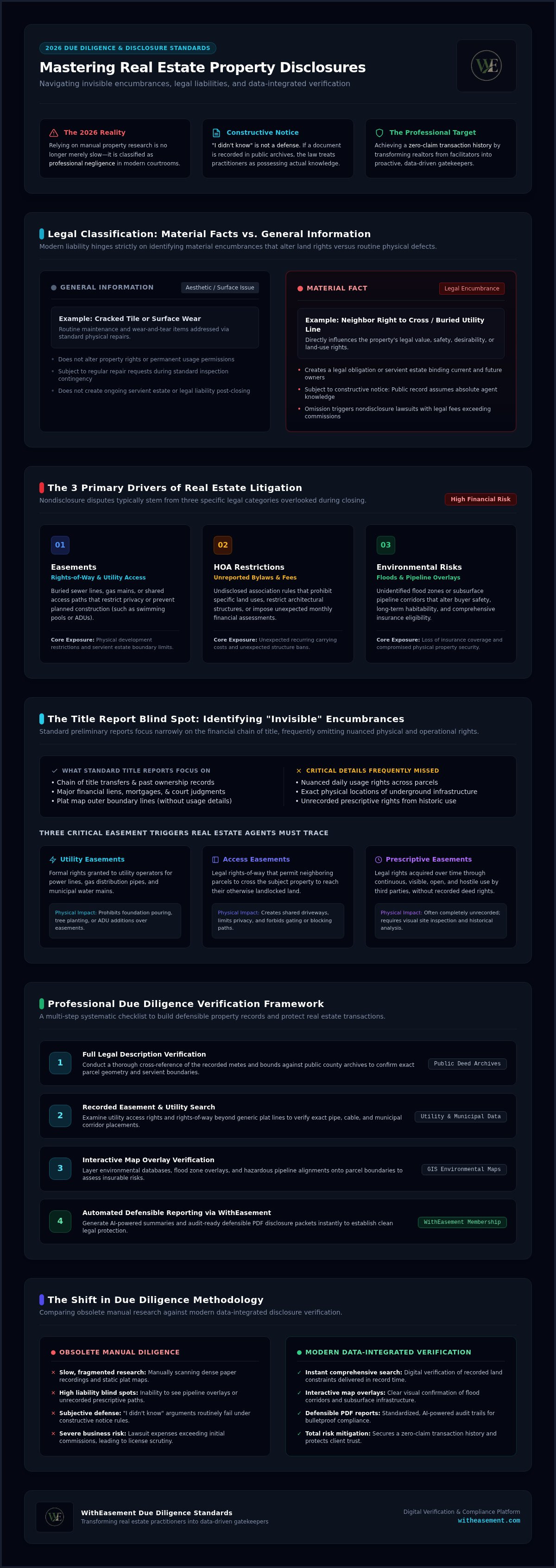
Property nondisclosure is the failure to reveal material facts that influence a property's value, safety, or desirability. It's the gap between what a buyer expects and the legal reality of the land they're purchasing. In 2026, this gap has become a legal minefield. The shift toward higher professional liability means realtors are no longer just facilitators; they're expected to be data-driven gatekeepers. A single oversight can lead to a chain reaction of financial loss and reputational ruin.
Litigation typically stems from three main areas:
- Easements: Hidden rights-of-way or utility access points that limit construction or privacy.
- HOA Restrictions: Unreported bylaws that prevent specific uses or add unexpected monthly costs.
- Environmental Risks: Flood zones or pipeline overlays that affect insurance eligibility and long-term safety.
For professionals managing an easement disclosure San Diego real estate deals often hinge on these "invisible" details. When a buyer discovers a buried sewer line or a prescriptive path after closing, the legal fees alone can exceed the original commission. Your reputation is your most valuable asset; don't let one missed record destroy years of brand building.
Material Facts vs. General Information
It's vital to distinguish between aesthetic flaws and legal encumbrances. A cracked tile is a general repair issue, but a neighbor's right to cross the backyard is a material fact. In modern courtrooms, "I didn't know" is no longer a valid legal defense. This is due to the principle of constructive notice. If a document is recorded in public archives, the law treats you as if you have actual knowledge of it. Mastering the legal principles governing easements ensures you identify these servient estates before they become liabilities. You aren't just selling a house; you're selling a clear title and peace of mind.
The Evolving Standards of Professional Diligence
The bar for what a realtor "should" know has moved. Because high-level data is now accessible with a few clicks, manual record searches are becoming obsolete. Professional diligence in the age of instant data is the proactive, digital verification of all recorded land constraints to ensure a transparent transaction. Failing to meet this standard doesn't just invite lawsuits. It puts your professional license at risk and causes insurance premiums to surge. Staying ahead requires a commitment to accuracy that matches the speed of the modern market. When executing an easement disclosure San Diego real estate experts now rely on integrated data platforms to provide a bulletproof defense against claims of negligence.
Identifying "Invisible" Encumbrances: Easements and Beyond
Standard title reports are essential, but they aren't exhaustive. They typically focus on the chain of title and major financial liens, often missing the nuanced usage rights that govern daily life on a property. These "invisible" encumbrances can range from a neighbor's right to use a shared driveway to a utility company's access to a buried sewer line. For those managing an easement disclosure San Diego real estate agents must look beyond the surface of a preliminary report to find these hidden details. Identifying these rights early prevents the shock of a post-closing discovery that could lead to litigation.
There are three common triggers you need to watch for:
- Utility Easements: Rights granted to companies for power lines, gas pipes, or water mains.
- Access Easements: Legal paths that allow neighbors to reach their land through the subject property.
- Prescriptive Easements: Rights gained through long-term, visible use by others, even if never officially recorded.
Hidden infrastructure like pipelines and sewer lines presents a unique danger. These don't just affect property rights; they limit physical development. If a buyer plans to install a pool or an ADU, a buried gas line could make that project legally impossible. Similarly, HOA restrictions can act as a form of encumbrance. If the bylaws restrict certain structures or uses, failing to disclose them is just as damaging as missing a recorded easement.
The Complexity of Recorded Easements
Reading a plat map is a good start, but it rarely tells the full story. Maps show boundaries, but they don't always detail the specific rights or limitations tied to those lines. To get the full picture, you need a detailed San Diego property easement search that identifies both appurtenant and in-gross easements. Appurtenant easements stay with the land forever, while in-gross easements are held by specific entities. You can simplify this research by using a WithEasement Membership to access centralized records instantly.
Environmental and Infrastructure Overlays
Environmental factors and underground infrastructure are critical material facts that buyers deserve to know. Flood zones and fire risk areas can drastically change insurance costs or building requirements. Pipeline overlays are particularly critical for residential development because they often carry strict "no-build" zones. Following the California Department of Real Estate disclosure provisions is the professional minimum, but modern diligence requires more. Using digital overlays allows you to see exactly where a gas line or flood plain sits in relation to the property line. This clarity ensures your reports are defensible and your clients are protected from unexpected site limitations.
The Ultimate Nondisclosure Prevention Checklist
Standard disclosure forms are often treated as a simple formality. They shouldn't be. To truly protect your business and your clients, you need a methodical research process that precedes the checkbox. This checklist moves beyond the basics, ensuring you uncover material facts before they become legal liabilities. By following these steps, you create a defensible record of your professional diligence that stands up to scrutiny.
- Step 1: Verify the APN and legal description. Start with the unique identifier. A single digit error in an Assessor Parcel Number (APN) can lead you to research the wrong property entirely.
- Step 2: Conduct a comprehensive recorded easement search. Use digital tools to identify every encumbrance attached to the title. When you conduct an easement disclosure San Diego real estate regulations require a level of precision that manual searches rarely provide.
- Step 3: Analyze HOA status and bylaws. Confirm the current monthly dues and look for any pending assessments or litigation involving the association.
- Step 4: Cross-reference maps with flood and pipeline overlays. Visualizing these risks on a map is more effective than reading a text description. It shows exactly how environmental factors impact the buildable area.
- Step 5: Generate a professional summary. Consolidate your findings into a single, easy to read report that becomes a permanent part of the disclosure package.
Verification of Property Boundaries and Access
Fences don't always mark the truth. Many property disputes arise because a physical boundary, like a stone wall or a fence line, doesn't align with the recorded parcel map. Cross-check the physical layout with the legal description to identify potential encroachments early. This is also the time to verify legal access. Ensure the property has clear ingress and egress through public roads or recorded private easements. If the access is shared, the maintenance agreement must be part of your disclosure. Identifying these issues during the due diligence phase prevents them from becoming post-closing nightmares.
HOA and Community Governance Diligence
Asking if a property has an HOA is just the beginning. You need to dig into the financial health and governing rules of the community. Buyers are often blindsided by "silent" liens or upcoming special assessments for roof repairs or road paving. These financial obligations are material facts that directly affect the property's value. You should learn what to look for in HOA documents to protect buyers. Reviewing the meeting minutes from the last six months often reveals hidden maintenance issues or planned fee hikes that haven't been officially billed yet. This level of detail builds trust and keeps your transactions bulletproof.
Modernizing Due Diligence: Beyond the Preliminary Title Report
Traditional title searches are a foundational part of the industry, but they have distinct limitations in a fast-paced market. A preliminary report often takes days to arrive and may focus heavily on financial liens while glossing over complex land use rights. In 2026, professionals need a 360-degree view of property risk that updates in real time. This is where modernizing your approach to easement disclosure San Diego real estate becomes a competitive advantage. You can now access high-level data overlays that show exactly where a property stands in relation to local infrastructure and environmental hazards.
Interactive map platforms transform static data into actionable insights. Instead of squinting at a black and white plat map, you can layer pipeline data, flood zones, and recorded easements on a single screen. This visual clarity ensures you don't miss a "hidden" utility line that could derail a development project. Consolidating this information into professional PDF reports provides a clear, defensible record of your due diligence process. It shows your clients and potential legal auditors that you performed a comprehensive search using the best tools available.
Using AI for Property Record Interpretation
The sheer volume of public records can be overwhelming for even the most experienced broker. Utilizing AI for real estate due diligence allows you to scan hundreds of pages of legal documents in seconds. These tools are designed to spot red flags that a human eye might overlook during a late-night research session. AI reduces the risk of manual data entry errors by cross-referencing multiple data points instantly. It turns dense, technical legal descriptions into plain-English summaries that are easy for buyers to digest. This transparency reduces friction and builds a higher level of trust throughout the transaction.
Visualizing Risk with Data Overlays
Visual data is inherently more persuasive than a stack of text documents. When you use interactive property maps, you can show a buyer exactly how a flood zone or a fire risk area interacts with their potential home. Stacking these data points on a single screen allows for a rapid assessment of the property's true footprint. This modern approach makes your disclosure package feel more professional and authoritative. It moves the conversation from "I think it's safe" to "Here is the data that proves it." To start automating your research and protecting your transactions, explore the tools available through a WithEasement Membership today.
WithEasement: Protecting Your Transactions with Data
Executing the 2026 checklist manually is a recipe for burnout and human error. WithEasement Membership transforms these complex tasks into a streamlined, digital process. By centralizing all critical disclosure data into one platform, you eliminate the need to jump between fragmented government portals. Whether you're finalizing an easement disclosure San Diego real estate professionals rely on for legal protection or verifying HOA bylaws, the platform puts the answers at your fingertips. It follows a "One-Click" philosophy designed to save you hours on every transaction. This speed doesn't come at the cost of accuracy; it's the result of organizing public records into a user-friendly, high-tech utility tool.
Building a "Defense File" for every listing is no longer a luxury; it's a necessity for modern risk management. WithEasement allows you to generate automated reports that serve as a permanent record of your due diligence. This transparency protects you from future claims of negligence by proving you investigated every recorded encumbrance. You aren't just buying a tool; you're joining a community of tech-forward professionals who value accuracy and efficiency above all else. By using AI summaries to interpret dense land records, you maintain a high level of authority without needing specialized legal training.
Professional Reporting for Client Confidence
Your expertise deserves a presentation that matches it. WithEasement enables you to generate downloadable PDF reports that look as professional as you are. These documents provide buyers with transparent, data-backed information that reduces anxiety and builds long-term trust. When you provide a comprehensive report early in the process, you significantly reduce friction in the escrow phase. Early disclosure prevents the "deal-killer" surprises that often arise when a buyer discovers an easement or a pipeline risk at the eleventh hour. Buyers feel empowered to move forward because they have a clear, plain-English understanding of the property's legal and physical footprint from day one.
Streamlining Your Workflow
Efficiency is the core of the WithEasement experience. You can search by address or APN to get instant results without the wait times associated with traditional title orders. The centralized dashboard allows you to access HOA management info, pipeline overlays, and flood risks all in one place. This consolidated view ensures you never miss a material fact that could trigger a lawsuit. It acts as a bridge between dense public records and your end-user, performing the role of a transparent facilitator. You can now deliver high-value insights to your clients faster than ever before. Join WithEasement today and simplify your due diligence.
Secure Your Professional Future with Data-Driven Diligence
The landscape of real estate liability has shifted. You can't rely on outdated manual searches or standard title reports to catch every material fact anymore. By adopting a data-integrated checklist, you move from guessing to knowing. You now understand how to identify "invisible" encumbrances and why modernizing your approach to easement disclosure San Diego real estate is the only way to build a bulletproof defense file. This proactive strategy doesn't just prevent lawsuits; it builds the kind of professional trust that defines a lasting career.
Efficiency and accuracy are now within reach for every professional. WithEasement Membership provides the tools you need to streamline your workflow instantly. You'll gain access to AI-powered property summaries, a comprehensive easement and HOA database, and a professional PDF report generator that delivers results in seconds. Don't let a single missed record put your business at risk. Take control of your due diligence today and provide your clients with the clarity they deserve. Start your WithEasement Membership for faster, safer disclosures.
Frequently Asked Questions
What is the most common reason for a property nondisclosure lawsuit?
Failure to disclose material facts like water intrusion, structural defects, or unrecorded easements remains the leading cause of litigation. These issues directly affect the property's value and desirability. When a buyer discovers a neighbor's right to use a driveway after closing, it often triggers a costly lawsuit. Professionals use a thorough checklist to identify these "invisible" encumbrances early. This proactive approach ensures all parties have a clear understanding of the land's legal footprint before signing any documents.
Does title insurance protect a seller from nondisclosure claims?
Title insurance primarily protects the buyer and lender from historical title defects; it doesn't shield the seller from nondisclosure claims. If a seller knows about an easement but fails to mention it, the title policy won't cover the resulting legal battle. Sellers have a strict legal obligation to reveal all known material facts. Relying on title insurance as a safety net is a common mistake that leads to expensive post-closing disputes and reputational damage.
How do I find utility easements that are not on the plat map?
You must search recorded documents and local agency records to find easements that aren't visually represented on a standard plat map. Many utility companies hold rights-of-way that were recorded decades ago. Using a specialized platform for an easement disclosure San Diego real estate professionals recommend allows you to see these hidden layers instantly. These tools cross-reference multiple public databases to reveal buried pipelines and sewer lines that traditional maps often overlook, ensuring a complete research process.
What is the realtor’s specific duty regarding HOA document disclosure?
Realtors are responsible for ensuring the buyer receives a complete set of HOA governing documents, including CC&Rs, bylaws, and current financial statements. You must also disclose any known pending assessments or litigation involving the association. Simply asking if an HOA exists isn't enough to meet modern professional standards. You need to facilitate the discovery of "silent" liens or upcoming fee hikes that could financially impact the buyer after the transaction is finalized, protecting everyone involved.
Can I be sued for nondisclosure if I truly didn’t know about a defect?
Yes, you can still face legal action under the principle of constructive notice. If the information was available in public records, the law assumes you "should" have known about it. Courts often view the failure to find recorded data as a breach of professional diligence. This is why manual record searches are inherently risky. Using automated tools ensures you capture all recorded encumbrances, protecting you from claims of negligent nondisclosure even if you weren't personally aware of the specific defect.
How does AI help in the property disclosure process?
AI transforms the disclosure process by scanning hundreds of pages of legal descriptions and public records in seconds. It identifies specific red flags, such as conflicting usage rights or environmental hazards, that a human eye might miss during a manual search. This technology reduces the risk of data entry errors and provides plain-English summaries of complex documents. It allows you to deliver a more accurate and transparent report to your clients without spending hours on tedious paperwork or research.
What should be included in a professional property data report?
A comprehensive report should include the verified APN, a summary of all recorded easements, and current HOA status. It also needs to feature interactive map overlays showing flood zones, fire risks, and underground infrastructure like pipelines. These data points provide a 360-degree view of property risk. Including these details in a downloadable PDF format creates a defensible record of your due diligence. This professional presentation helps build immediate confidence with potential buyers while streamlining the entire escrow process.
How often are property flood zone maps updated?
FEMA typically updates its Flood Insurance Rate Maps (FIRMs) every few years, but the process varies by region based on new environmental data or infrastructure changes. However, digital platforms often integrate these updates much faster than paper records can be distributed. Staying current is vital because a shift in flood zone status can drastically change insurance requirements and property value. Always verify the most recent data overlays to ensure your disclosure reports are accurate and reflect the latest environmental risks.


