

What if you could bypass the two-week administrative wait for Chula Vista HOA document retrieval with a single click? You've likely spent hours chasing down property management companies, only to be met with slow responses and unexpected fees for simple PDF copies. It's frustrating when dense legal language in CC&Rs stalls your due diligence process. You're trying to close a deal, but the paperwork is stuck in a manual queue.
Accessing essential property records doesn't have to be a manual waiting game. This guide shows you how to leverage professional property intelligence to bypass administrative delays and view HOA data with total clarity. You'll learn how to identify property encumbrances instantly, use AI-powered summaries to decode complex bylaws, and generate professional PDF reports that keep your deals moving. We'll also cover the latest California regulations on document fees to ensure you never overpay for basic records. From visualizing property overlays to unlocking hidden restrictions, you're about to transform how you handle community data.
Key Takeaways
- Understand why manual HOA requests lead to closing delays and learn how to identify hidden administrative fees before they impact your bottom line.
- Master the process of Chula Vista HOA document retrieval by using specific property addresses or Assessor Parcel Numbers to find recorded association data instantly.
- Discover how AI-powered summaries can digest hundreds of pages of CC&Rs and bylaws, extracting critical restrictions in seconds rather than hours.
- Learn why mapping HOA records alongside flood zones and recorded easements is essential for a complete property intelligence profile.
- Streamline your entire due diligence workflow by consolidating all San Diego County property data into a single, professional PDF report.
The Challenges of Traditional HOA Document Retrieval
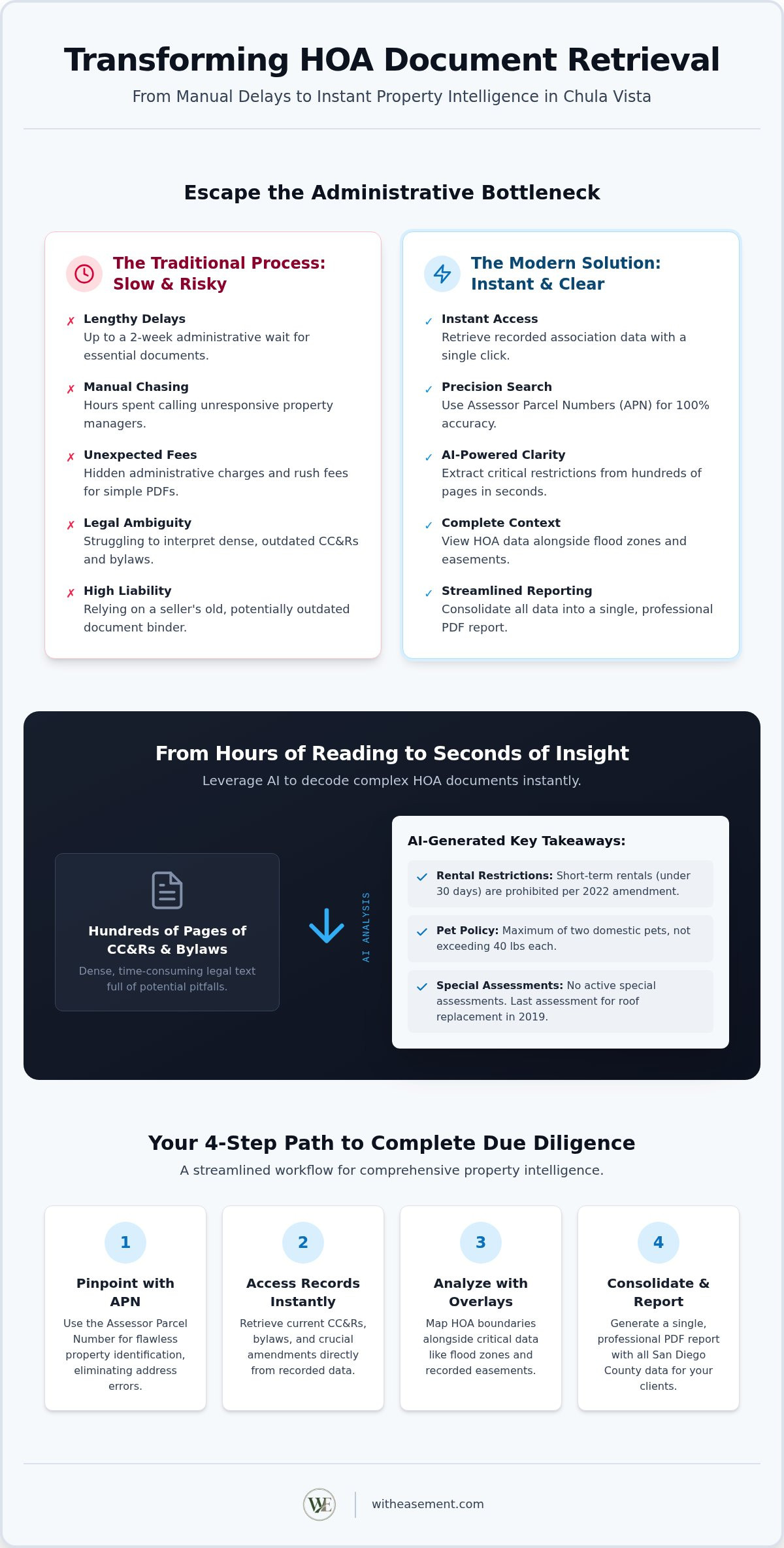
Traditional Chula Vista HOA document retrieval often feels like a relic of a slower era. While most property data is now available at the touch of a button, HOA records remain siloed behind manual request forms and unresponsive property managers. This friction creates a bottleneck that can jeopardize time-sensitive transactions. A Homeowner association (HOA) operates as a private entity, meaning their governing documents aren't always part of the public digital stream. Relying on phone calls and paper checks isn't just slow; it's a strategic risk for any realtor working in San Diego County. You need a process that matches the speed of the modern market.
Why Real Estate Professionals Can't Wait
Contractual deadlines are absolute. If you can't provide CC&Rs or financial statements within the due diligence window, your buyer loses their protection. This delay often results in rushed decisions or missed contingencies. Beyond timing, these documents hold the keys to financing. Lenders won't fund a mortgage if the association is involved in active litigation or shows signs of financial insolvency. You need these answers on day one, not day ten. Providing instant data builds professional trust. It shows your clients that you have a handle on every detail of the parcel, from pet restrictions to special assessments.
Common Roadblocks in the Request Process
Identifying the correct management company for your Chula Vista HOA document retrieval is often the first hurdle. Many developments in Chula Vista have changed management multiple times. You might spend days leaving voicemails for boards that meet only once a month or use antiquated filing systems. Then there's the financial impact. While California law limits what HOAs can charge for actual copying, many boards still attempt to levy high rush fees or administrative surcharges that create friction in the closing process. These hidden costs add up and frustrate clients who expect transparency.
Relying on a seller's old binder is a massive liability. Bylaws change. Rules regarding short-term rentals, parking, or solar installations evolve. Using outdated documents means your client makes a purchase based on false assumptions. This exposure can lead to legal disputes long after the commission is paid. You need a centralized, digital-first method to verify current records without the administrative headache. Waiting for a management company to mail a PDF is a gamble you don't need to take. Professional property intelligence allows you to bypass these roadblocks and secure the data you need in minutes.
How to Perform a Chula Vista HOA Document Retrieval Search
Executing a successful Chula Vista HOA document retrieval starts with precision. You can't rely on a simple street address alone. Addresses are prone to typos and don't always align with the way legal records are filed. To get accurate results, you must identify the specific parcel using its unique identifier. This ensures you're pulling data for the correct lot, especially in high-density developments where multiple associations might overlap or share similar names.
Starting with the APN
The Assessor Parcel Number (APN) is the fingerprint of the land. It's far more reliable than a street address for legal research. When you use a San Diego interactive property map, you can pinpoint the exact boundaries of a lot and extract its APN instantly. This step is critical. It allows you to search recorded land records directly, ensuring the legal description matches the property in your transaction. By starting with the APN, you eliminate the risk of looking at the wrong association or missing a sub-association that might also have governing authority over the parcel.
Accessing Recorded CC&Rs and Bylaws
Once you have the APN, you can locate the recorded governing documents. It's vital to understand the legal framework provided by California's Davis-Stirling Act, which establishes the rules for how these associations must manage and disclose their records. You're looking for more than just the original articles of incorporation. You must verify the current status of the Covenants, Conditions, and Restrictions (CC&Rs) and search for any recorded amendments.
Amendments are where many realtors get tripped up. A 20-year-old CC&R document might allow short-term rentals, but a recorded amendment from last year could have banned them entirely. You also need to watch for "zombie" HOAs. These are associations that appear in the land records but have become inactive. Verifying whether an association is active or defunct is a key part of professional due diligence. Always distinguish between governing documents, which are recorded with the county, and financial disclosures, which are held by the management company. For a truly comprehensive view, you should run an automated HOA search to see all linked records in one dashboard.
A professional search doesn't stop at the HOA. You must cross-reference this data with other recorded encumbrances, such as utility easements or flood zones. This creates a full property intelligence profile. After gathering this data, generate a professional PDF report. This documents your findings for the transaction file and provides your client with a clear, authoritative summary of all property restrictions. This level of detail protects your professional credibility and ensures your clients move forward with total confidence.
Leveraging AI for Faster HOA Record Interpretation
Reading through a stack of CC&Rs is a notorious time-sink. A typical association disclosure package can easily exceed 200 pages of dense, legalistic prose. For realtors managing multiple listings, manual review isn't just exhausting; it's inefficient. AI-powered property summaries change the game by scanning these massive files in seconds. Instead of hunting for needle-in-a-haystack clauses, you can use technology to extract key restrictions instantly. Efficiency is the new standard for Chula Vista HOA document retrieval.
This shift from manual searching to automated synthesis is essential for staying competitive. You can pinpoint specific terms like 'pet weight limits' or 'short-term rental caps' without flipping a single physical page. A 2025 survey of 500 finance leaders revealed that 76% see the value in using AI to improve efficiency and decision-making. Real estate professionals are seeing similar gains. This level of speed allows you to answer client questions during a showing rather than days later, keeping the momentum of the deal alive.
From Raw Data to Actionable Insights
AI doesn't just find words; it understands context. By utilizing AI for real estate due diligence, you can flag unusual restrictive covenants that might otherwise go unnoticed. This includes identifying aging infrastructure assessments or unusual maintenance responsibilities that could impact a buyer's long-term costs. You're moving from simply possessing data to truly understanding it.
- Extract financial health indicators such as reserve fund percentages and recent special assessments.
- Identify specific architectural guidelines for exterior modifications or solar installations.
- Flag litigation history or pending legal actions mentioned in meeting minutes.
These insights lead to faster decision-making. When you know the association's financial standing and rule strictness immediately, you can advise your clients with higher precision. It transforms the Chula Vista HOA document retrieval process from a clerical task into a strategic advantage.
Creating Professional PDF Reports
Turning raw data into a client-facing asset is the final step in a modern workflow. Once the AI has parsed the documents, you can generate a professional PDF property report. These reports act as a branded summary that translates complex bylaws into an easy-to-read format for buyers. It's a high-tech utility that makes you look like the expert you are.
Beyond client satisfaction, these reports serve as a critical paper trail. Documenting every due diligence step helps protect your professional reputation and provides clear evidence for E&O insurance purposes. You can also share these summaries with lenders and title officers. This transparency streamlines the closing process by ensuring everyone is on the same page regarding property encumbrances and association rules. It's about moving from a chaotic pile of paperwork to a streamlined, professional intelligence file.
Analyzing HOA Documents Alongside Property Overlays
HOA rules don't exist in a vacuum. A successful Chula Vista HOA document retrieval provides the "what" of community rules, but overlays reveal the "where" and "why" of the physical land. You might find that an HOA allows a pool in the bylaws, but a hidden utility easement makes construction impossible. Visualizing these layers together prevents costly post-closing surprises and ensures your due diligence is truly comprehensive. It's about seeing the full picture before your client signs on the dotted line.
Easements vs. HOA Restrictions
Understanding who has the "right of way" is vital for accurate property intelligence. While an HOA manages the aesthetic standards of a neighborhood, a recorded easement represents a legal right for a third party to use a portion of the land. It's essential to perform San Diego property easement searches alongside your document review. This step identifies utility lines, access paths, or conservation areas that governing documents might not mention.
A recorded easement often overrides an HOA's architectural approval. If a homeowner gets HOA permission to build a structure over a pipeline path, the utility company can still demand its removal. Use map overlays to visualize utility lines and pipeline paths before your client commits. You can also identify when HOA common areas, like shared walkways or landscaping, encroach on private property boundaries. Clear visualization turns abstract legal descriptions into immediate, actionable insights.
Environmental Risks in HOA Communities
Environmental factors like flood zones add another layer of complexity to association living. Properties within managed associations aren't immune to natural risks. Check the flood zone status for every parcel to understand the potential for future liabilities. High-risk designations impact more than just the individual homeowner; they affect the entire association's insurance premiums and can lead to sudden spikes in homeowner dues or special assessments.
Visualizing risk data allows you to provide a comprehensive buyer advisory that goes beyond the standard paperwork. If a property sits near a flood-prone area, your client needs to know how that interacts with the HOA's master insurance policy. This integrated approach to Chula Vista HOA document retrieval ensures you aren't just reading documents but visualizing the entire property landscape. Start your comprehensive property search today to see how HOA rules and environmental overlays intersect on a single, interactive map.
Streamlining Your Due Diligence with WithEasement
Manual property research is a liability in a fast-paced market. Chasing board members and waiting on mailed PDFs creates unnecessary friction that can stall a transaction. WithEasement membership transforms this process by offering a professional alternative to calling management companies. It's the ultimate tool for San Diego realtors who value their time and their clients' trust. By centralizing Chula Vista HOA document retrieval alongside critical land data, you move from a state of uncertainty to total property intelligence.
Efficiency is the core of the platform. You no longer need to jump between fragmented county records and private association portals. Everything you need for a comprehensive due diligence file is available in a single, intuitive interface. This no-nonsense approach to high-level property data ensures you spend less time on administration and more time closing deals. It's about empowering you with the same depth of information used by specialized analysts, without the need for intermediaries or technical training.
The Membership Advantage
A WithEasement membership acts as a bridge between dense, intimidating records and clear, actionable insights. You gain access to proprietary data and professional reporting tools designed specifically for the San Diego market. The platform performs the heavy lifting of organizing information, so you don't have to. It's a tech-forward solution that prioritizes utility and speed above all else.
- Integrated Data: View HOA data, recorded easements, and flood zones in one place.
- AI Summaries: Extract key takeaways from hundreds of pages of bylaws instantly.
- PDF Property Reports: Generate professional, easy-to-read summaries for your transaction files.
- Interactive Overlays: Visualize pipeline paths and flood risks directly on a parcel map.
This comprehensive suite of tools allows you to work with confidence. You're not just providing a service; you're offering a higher level of professional advisory. With specialized data at your fingertips, you can identify potential deal-breakers before they become expensive problems for your buyers.
Getting Started with Professional Property Research
Signing up is a simple, straightforward process. Once you've joined, you can begin your first Chula Vista HOA document retrieval search using either a property address or an Assessor Parcel Number (APN). The results are instantaneous. You'll immediately see the impact on your workflow as the hours typically spent on manual research disappear. Your clients will notice the difference, too. Providing them with a professional PDF report on day one sets you apart as a tech-forward innovator who values their time.
Don't let administrative delays stall your momentum. Move beyond the waiting game and embrace the future of property intelligence. Explore the platform's full capabilities and see how easy it is to unlock the data you need. It's time to streamline your due diligence and take control of your property research process today.
Take Control of Your Property Due Diligence
The days of waiting weeks for property management responses are over. You now have the tools to execute Chula Vista HOA document retrieval with professional speed and precision. By integrating recorded association data with physical land overlays like easements and flood zones, you provide a level of advisory that sets you apart in the San Diego market. This integrated approach ensures that no hidden restriction or environmental risk goes unnoticed during the due diligence period.
Technology doesn't just provide data; it provides clarity. AI-powered summaries turn hundreds of pages of CC&Rs into actionable insights in seconds. You can now generate professional PDF reports for your clients that document every restriction and encumbrance with total transparency. This shift from manual searching to instantaneous property intelligence protects your deals and your professional reputation. It's about working smarter, not harder, to deliver the results your clients expect.
Stop chasing paper trails and start leading with data. Unlock Instant HOA Data and Property Reports with WithEasement and transform your workflow today. You've done the heavy lifting of building your business; let the right tools handle the data.
Frequently Asked Questions
How do I find out which HOA manages a property in Chula Vista?
Start by searching the property's address or APN on a specialized property intelligence platform. This reveals the recorded association name linked to the land record. You can also check the preliminary title report or look for a notice of assessment in recorded county documents. Using an automated search tool is the fastest way to identify the management entity without calling multiple offices or waiting for a seller's disclosure package to arrive.
What is the difference between CC&Rs and HOA bylaws?
CC&Rs (Covenants, Conditions, and Restrictions) are recorded land documents that run with the land and detail property use restrictions. Bylaws govern the internal operations of the association itself, such as board elections and meeting procedures. While CC&Rs tell you what you can do with your lot, bylaws explain how the association makes decisions and enforces those rules. Both documents are essential for a complete due diligence file and professional risk assessment.
How long does it typically take to get HOA documents manually?
Manual requests to management companies often take between 10 and 14 business days. Under California law, associations have up to 10 days to provide records after receiving a written request, but administrative delays are common. You can bypass this waiting period by using a digital platform for Chula Vista HOA document retrieval. This provides instant access to recorded governing documents and association data without the need for manual follow-ups.
Can I access HOA documents for free through public records?
You can view recorded CC&Rs at the County Recorder's office for a small fee per page, but bylaws and financial disclosures are rarely part of the public record. These unrecorded documents typically require a direct request to the association. Professional property platforms consolidate these disparate sources into a single search. This saves you the time and expense of visiting government offices or paying high administrative fees for basic electronic document copies.
What should I look for in an HOA financial statement during due diligence?
Focus on the reserve study and the percentage of funded reserves. A healthy association should have a clear plan for future infrastructure repairs to avoid sudden special assessments. Also, check for active litigation or high delinquency rates among homeowners. These indicators suggest financial instability that could affect buyer financing or lead to significant increases in monthly dues shortly after closing. Always verify these details against the latest financial disclosures.
Do all properties in Chula Vista belong to a Homeowners Association?
No, many older neighborhoods or custom lots do not have a mandatory HOA. However, newer developments and master-planned communities almost always require membership. You should never assume a property is HOA-free based on its appearance. Always verify the association status using a professional Chula Vista HOA document retrieval search. This confirms if the parcel is subject to any recorded governing documents, sub-associations, or assessment liens that could impact the sale.
Are HOA documents recorded with the County of San Diego?
CC&Rs and their amendments must be recorded with the County of San Diego to be enforceable against the property. However, operational documents like meeting minutes, budgets, and specific bylaws are often kept privately by the board or management company. A comprehensive search identifies both the recorded encumbrances on the title and the contact information for the entity holding the unrecorded operational records. This ensures you have a complete picture of all property restrictions.
How can AI help me understand complex property records?
AI-powered summaries scan hundreds of pages of legal text to extract key restrictions and financial indicators instantly. Instead of manually searching for pet weight limits or rental caps, the technology flags these clauses for your review. This process transforms dense, intimidating records into actionable insights. It allows realtors to provide immediate answers to clients and document their due diligence steps with professional efficiency, reducing the risk of missing critical property data.


