

A single hidden easement can turn a prime La Jolla development site into an expensive garden overnight. Most investors and professionals don't realize how easily a recorded utility line or a forgotten access path can block a multi-million dollar project. You've likely felt the frustration of clicking through outdated government portals or waiting weeks for a property report that should take minutes. It's exhausting to manage high-stakes coastal investments when critical data feels locked behind a wall of bureaucracy.
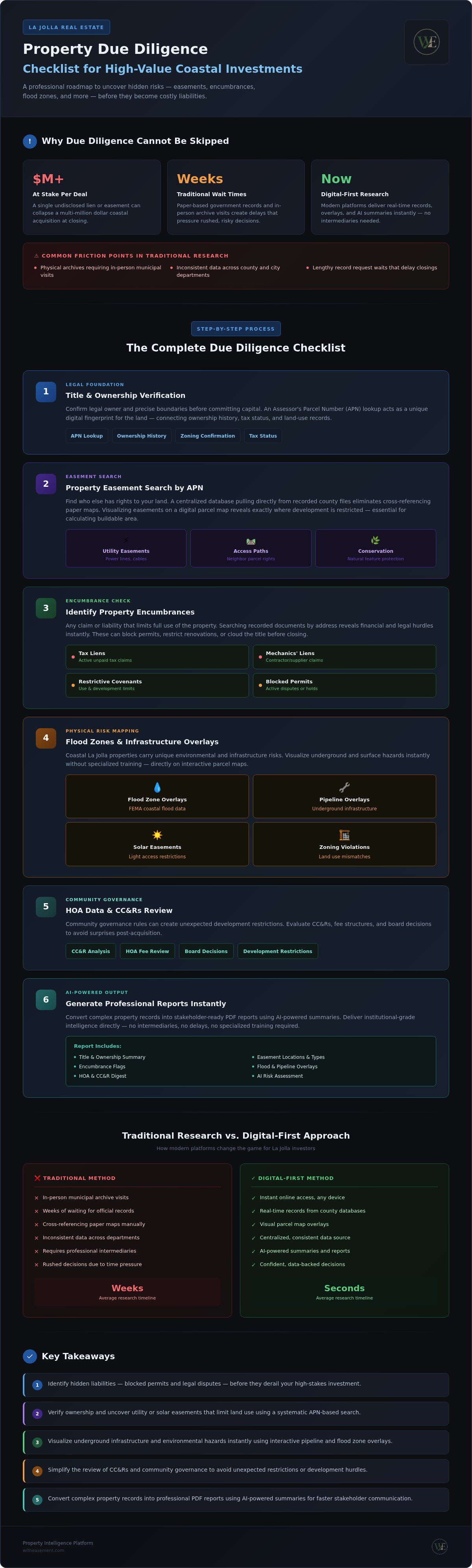
We understand that your time is too valuable for manual research. This La Jolla property due diligence checklist provides a streamlined, professional roadmap to uncover hidden risks before they become liabilities. You'll learn how to master the complexities of property research with modern tools that deliver immediate results. We'll show you how to access recorded easements instantly, interpret complex HOA data using AI, and visualize pipeline overlays. By the end of this guide, you'll have the power to generate professional reports for your stakeholders in seconds, ensuring your next acquisition is backed by clear, verified intelligence.
Key Takeaways
- Identify hidden liabilities like blocked permits and legal disputes before they derail your high-stakes investment.
- Follow a streamlined La Jolla property due diligence checklist to verify ownership and uncover utility or solar easements that limit land use.
- Visualize underground infrastructure and environmental hazards instantly using interactive pipeline and flood zone overlays.
- Simplify the review of CC&Rs and community governance to avoid unexpected restrictions or development hurdles.
- Convert complex property records into professional PDF reports using AI-powered summaries for faster stakeholder communication.
Why Every Real Estate Transaction Requires a Due Diligence Checklist
Due diligence isn't just a legal formality; it's the critical window where you uncover every hidden liability attached to a parcel of land. In high-value markets, skipping this step is a gamble with your capital. Using a comprehensive La Jolla property due diligence checklist ensures you don't miss the fine print that could stall a multi-million dollar closing. It transforms a complex, intimidating process into a manageable roadmap, giving you the confidence to move forward or walk away from a bad deal. By treating research as an essential phase of the acquisition, you protect yourself from the unexpected encumbrances that frequently haunt coastal properties.
The Cost of Overlooking Property Records
Missing a single recorded document can have cascading effects on your project. An undisclosed lien might appear days before closing, forcing a settlement or a total collapse of the deal. Zoning violations are equally dangerous. They can slash property value instantly if your intended use doesn't align with local codes. You might discover that a planned renovation is prohibited by a forgotten easement or a restrictive covenant. Traditionally, finding these red flags meant dealing with slow turnaround times and confusing government record systems. This friction often leads to rushed decisions, but the cost of an oversight is far higher than the time spent on verification. Common friction points include:
- Inaccessible physical archives that require in-person visits to municipal offices.
- Inconsistent data across different county and city departments.
- Lengthy waiting periods for official records requests that delay closing timelines.
Transitioning to Tech-Forward Research
The year 2026 marks a definitive shift toward digital-first property intelligence. Manual city hall visits and paper-based requests are becoming relics of the past. Modern investors now rely on a WithEasement Membership to get instantaneous results. This no-nonsense approach replaces weeks of waiting with immediate data access. By using professional tools, you can visualize risks like flood zones or pipeline overlays without needing specialized training. It's about efficiency. You get the same high-level data used by institutions, delivered directly to your screen. This shift empowers the average user to act as their own expert, unlocking insights that were previously hidden behind professional intermediaries. A digital-first strategy ensures that your La Jolla property due diligence checklist is fueled by real-time data, not outdated files from a dusty office.
The Legal Foundation: Verifying Title and Recorded Easements
Every professional La Jolla property due diligence checklist begins with absolute title verification. You must confirm the legal owner and precise boundaries before committing capital or signing contracts. An Assessor’s Parcel Number (APN) lookup is the most reliable way to initiate this search. It acts as a unique digital fingerprint for the land, connecting you to historical ownership records and current tax status. This step prevents identity-related fraud and ensures you're negotiating with the rightful seller. Analyzing land use records at this stage also confirms that the property’s current zoning matches your development goals, saving you from acquiring land you can't actually use.
Executing a Property Easement Search
Finding out who else has rights to your land is vital for any coastal project. You can find easements by APN using a centralized database that pulls directly from recorded county files. This eliminates the need to cross-reference multiple paper maps or visit municipal offices. Common types you'll encounter include utility easements for power lines, private access paths for neighboring parcels, and conservation easements that protect natural features. Visualizing these locations on a digital parcel map allows you to see exactly where development is restricted. It's the only way to accurately calculate your buildable area and avoid future legal disputes with neighbors or utility companies.
Identifying Property Encumbrances
An encumbrance is any claim or liability that limits your full use of the property. This category includes active tax liens, mechanics' liens, or restrictive covenants that cloud the title. Searching for recorded documents by address reveals these financial and legal hurdles instantly. It's about clarity. A recorded easement is a legal right for another party to use specific land for a defined purpose. These are often perpetual and stay active even after a sale. Checking for these ensures the property’s legal standing matches its intended purpose. If you discover a solar easement or an underground gas line, you can negotiate or pivot your design before closing. Utilizing a WithEasement Membership provides the professional clarity needed to interpret these records without specialized training.
Mapping Physical Risks: Flood Zones and Infrastructure Overlays
Physical due diligence moves beyond what you can see on the surface. While title records confirm who owns the land, physical overlays reveal if the land is actually buildable or if hidden encumbrances will stall your timeline. A robust La Jolla property due diligence checklist must account for environmental hazards that dictate insurance premiums and structural requirements. Coastal properties are particularly sensitive to flood zone designations. These zones can shift over time, impacting both your safety and your wallet. By reviewing current flood risk data, you determine whether a site requires specialized drainage systems or if building elevations must be raised to meet strict local compliance standards.
Using Map Overlays for Risk Analysis
Visualizing risk requires more than a static PDF. Utilizing a San Diego interactive property map allows you to toggle layers that expose hidden infrastructure instantly. Pipeline and gas line overlays are essential for preventing accidental damage during the excavation phase. One wrong dig can lead to catastrophic delays, environmental hazards, and massive fines. Checking for flood zone status before making an offer gives you significant leverage in negotiations. If a parcel sits in a high-risk area, you can factor the increased insurance costs and potential building restrictions into your financial model before the due diligence period expires.
Assessing Infrastructure and Utilities
Every development project relies on seamless utility connectivity. You need to locate sewer and water lines early to understand how they impact your site plan and future renovations. For undeveloped land, verifying utility access points is the difference between a quick hookup and an expensive infrastructure extension. It's also wise to analyze assessed values at this stage to understand the property's financial trajectory. This data helps you see if the investment aligns with market trends in the surrounding area. Interactive overlays turn flat maps into actionable property intelligence. This data-driven approach ensures you aren't surprised by underground obstacles after the heavy machinery arrives on site. It transforms the way you view a property, moving from simple observation to deep technical insight.
Evaluating Community Governance and HOA Data
Community governance often presents more immediate hurdles than municipal zoning. If a property sits within a Homeowners Association (HOA), you aren't just buying land; you're entering a legal contract with your neighbors. This makes HOA verification a mandatory step on your La Jolla property due diligence checklist. You need to identify if an association exists and immediately request the governing documents. This includes the Covenants, Conditions, and Restrictions (CC&Rs), bylaws, and the last twelve months of meeting minutes. These records reveal the true culture and financial stability of the community. Meeting minutes are particularly valuable because they highlight ongoing disputes, pending litigation, or upcoming maintenance projects that haven't been officially billed yet.
The HOA Search Framework
Knowing what to look for in HOA documents saves you from inheriting someone else's debt. Surprise fees often stem from special assessments, which are one-time charges for major repairs like roof replacements or private road paving. Review the association's reserve study to see if they have enough cash to cover future liabilities. Finding management contact information by address is the fastest way to get these answers. If the association is underfunded, you might face a significant bill shortly after closing. A healthy association should have a clear plan for capital improvements and a robust reserve fund to avoid sudden spikes in monthly dues. This financial transparency ensures that your investment remains predictable over the long term.
Interpreting Restrictive Covenants
Restrictive covenants go beyond basic zoning. While the city might allow a certain structure, the HOA might ban specific materials, colors, or even landscaping choices. Land use summaries help you decode these hidden community rules without reading hundreds of pages of legalese. It's vital to understand the difference between city-level zoning and HOA-specific restrictions, as the stricter rule always wins. Look for specific clauses regarding pet policies, vehicle parking, or short-term rental bans. These restrictions can drastically impact your property's marketability or your personal lifestyle. If you plan to use the property as a vacation rental, a single line in the CC&Rs could render your entire business model illegal. It's about ensuring your vision for the property is legally permitted by the people who live next door. Don't let hidden bylaws catch you off guard. You can secure a professional HOA search with a WithEasement Membership to get the clarity you need instantly.
Modernizing Research with AI-Powered Property Summaries
The final phase of any La Jolla property due diligence checklist involves synthesizing vast amounts of data into a clear, actionable format. In the past, this meant spending hours manually typing out findings or paying consultants to interpret complex legal descriptions. Today, technology has eliminated these barriers. By centralizing your research on a single platform, you can finalize your investigation in a fraction of the time. This modern approach doesn't just save hours; it ensures that no critical detail is lost in the transition from raw data to a final decision. You gain a competitive edge by moving faster than the market without sacrificing the depth of your research. It's about empowering yourself with the same high-level data used by institutional investors.
The Role of AI in Real Estate Due Diligence
Reading through hundreds of pages of recorded documents is a bottleneck for even the most experienced professionals. Utilizing AI for real estate due diligence allows you to extract key facts instantly. The platform’s AI Summary feature scans dense legalese to identify specific mentions of maintenance responsibilities, usage restrictions, or financial liabilities. An AI property summary is a tool that distills complex land records into clear, functional insights. This technology acts as a transparent facilitator; it performs the heavy lifting of organization so you can focus on high-level strategy. You no longer need to be a land use expert to understand the risks associated with a specific parcel. The result is a no-nonsense interpretation that you can trust.
Creating Professional PDF Property Reports
Sharing your findings with stakeholders requires more than a collection of browser tabs. You need a formal document that builds trust and demonstrates thoroughness. Generating a comprehensive report is a simple, four-step process:
- Step 1: Enter the property address or APN into the platform to pull the latest county data.
- Step 2: Review the interactive map and the AI-generated summary to confirm all details are accurate.
- Step 3: Download the professional PDF property report to finalize your due diligence file.
- Step 4: Share the report with your client or lender to provide immediate transparency.
This workflow reduces the friction of manual data entry. It creates a standardized, shareable asset that you can use to justify an offer price or secure financing. By providing a clean, organized report, you position yourself as a tech-forward professional who values accuracy and speed. It’s the ultimate way to complete your La Jolla property due diligence checklist, ensuring every stakeholder has the same high-level intelligence at their fingertips. This streamlined efficiency is the standard for real estate success in 2026.
Take Command of Your Coastal Investment
Real estate success in 2026 depends on a combination of speed and technical precision. By following a structured La Jolla property due diligence checklist, you eliminate the guesswork that often leads to costly legal disputes or environmental delays. You've now seen how identifying hidden easements and interpreting dense HOA data early can protect your buildable area and project budget. Modernizing your workflow with interactive maps and AI summaries ensures you aren't just reacting to data; you're mastering it before the closing date arrives.
Don't let buried liabilities or slow government systems stall your next acquisition. You can start your research with a WithEasement Membership to gain instant access to recorded easements, AI-powered property summaries, and a professional PDF report generator. This platform acts as your digital partner, performing the heavy lifting of record organization so you can focus on high-level strategy. Secure your coastal vision with the clarity, authority, and confidence of a local specialist.
Frequently Asked Questions
What is the most important item on a property due diligence checklist?
The most critical item is the verification of recorded easements and title encumbrances. These legal rights allow third parties to use your land, which can block construction or reduce property value. A comprehensive La Jolla property due diligence checklist prioritizes these findings early in the escrow period. Uncovering a utility line or a private access path before closing prevents expensive legal disputes and ensures your development plans are actually feasible on the specific parcel.
How do I find recorded easements on my property online?
You can find recorded easements by using a centralized property data platform that pulls records by address or APN. Traditional methods involve visiting the county recorder's office, but modern tools provide instant access to digital archives. These platforms allow you to visualize easement locations directly on a parcel map. This digital-first approach replaces weeks of manual research with immediate results, making it easier to identify utility, access, or conservation easements from any device.
What happens if I find an undisclosed easement after closing?
Finding an undisclosed easement after closing often leads to legal complications or restrictions on how you use your land. If the easement was recorded but missed during your research, it typically remains enforceable. This can prevent you from building fences, pools, or home extensions. You may need to consult a legal professional to determine your rights. This risk is why completing a thorough La Jolla property due diligence checklist during the contingency period is so vital for every buyer.
Can a property data platform replace a traditional title search?
A property data platform provides immediate intelligence and is an essential tool for preliminary research and daily decision-making. It excels at uncovering easements, HOA data, and physical risks instantly. However, it does not sell title insurance. Professionals use these platforms to screen properties quickly and identify red flags before committing to the final, formal title insurance process. It's about gaining high-level data early in the journey to save time and reduce friction.
How do I check if a property is in a flood zone?
Checking flood zone status is best handled through interactive map overlays that display current FEMA data. Modern platforms allow you to toggle flood risk layers directly over a property's boundaries. This reveals if a parcel sits in a high-risk area that requires specialized insurance or specific building elevations. Reviewing this data before making an offer gives you leverage in negotiations and helps you calculate the true cost of ownership and compliance.
What is included in a professional PDF property report?
A professional PDF property report distills complex data into a shareable, organized document. It typically includes an AI-powered summary of land records, interactive map screenshots with pipeline and flood overlays, and detailed HOA information. These reports also feature assessed values and recorded easement details. Having this information in a standardized format makes it easy to share with lenders, clients, or partners to build trust and ensure everyone has the same verified intelligence.
How does AI help in summarizing property records?
AI assists by scanning hundreds of pages of dense legal documentation to extract critical facts instantly. It identifies specific clauses related to maintenance responsibilities, usage restrictions, and financial liabilities that might be buried in fine print. This technology turns a time-consuming manual task into a fast, automated process. It provides a clear, functional summary that helps you interpret complex property records without needing specialized legal training or hours of tedious reading.
Where can I find HOA documents by address quickly?
The fastest way to find HOA documents is through a specialized search tool that connects property addresses to management contact information. These platforms identify if a property belongs to an association and provide the necessary pathways to obtain CC&Rs, bylaws, and meeting minutes. Instead of searching through fragmented public records, you get a centralized starting point. This allows you to verify the association's financial health and any pending special assessments before the due diligence period expires.


