

A single recorded document you haven't seen yet could be the difference between a successful closing and a legal nightmare. Most real estate professionals feel the same pressure when opening a thick title report. You're likely overwhelmed by dense legal jargon and the constant fear of missing a hidden restriction that could kill a deal. Spending hours on manual research in public records isn't just frustrating; it's a drain on your productivity. Mastering the skill of interpreting property easement reports San Diego professionals use is the key to protecting your investments and your reputation.
You deserve a process that works as fast as you do. This guide shows you how to decode complex property easement and title reports to identify land use restrictions quickly. We'll strip away the technical noise to give you a clear understanding of what those exceptions actually mean for your property value. You'll gain the confidence to present accurate due diligence to your clients in record time. We will walk through the essential sections of a title report, explain how to visualize easement boundaries, and show you how to transition from manual searching to effortless digital insights.
Key Takeaways
- Understand the legal role of property easement reports in protecting your real estate investment during due diligence.
- Categorize common easement types to determine how utility or access rights affect your specific land use capabilities.
- Master a systematic, step-by-step process for interpreting property easement reports San Diego to pinpoint hidden restrictions before they stall your transaction.
- Learn to cross-reference title exceptions with parcel maps to avoid costly conflicts with planned improvements like pools or ADUs.
- Leverage modern AI summaries to transform hours of manual research into instantaneous, professional property insights.
What is a Property Easement Report?
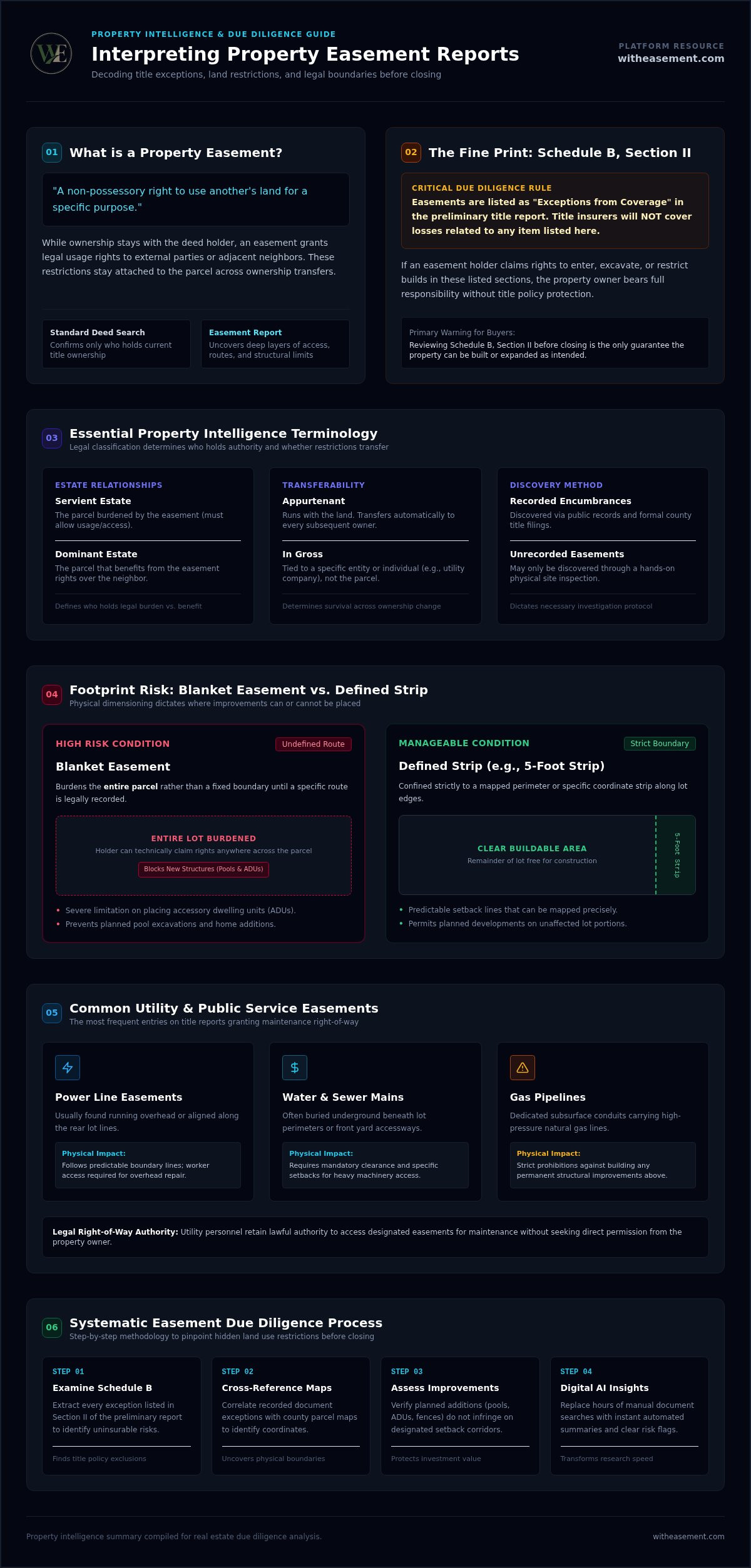
A property easement report is a vital document that details the legal rights individuals or entities have to use land owned by someone else. While a standard deed search confirms who holds the title, an easement report uncovers the layers of access and usage that stay attached to the parcel. Simply put, an easement is a non-possessory right to use another's land for a specific purpose. Understanding these details is a critical part of the due diligence process for any real estate transaction. It prevents surprises after the sale, such as discovering a neighbor has a legal right to drive across your new backyard. Mastering the art of interpreting property easement reports San Diego professionals rely on ensures that no restriction goes unnoticed.
Relying on a basic title search often leaves your client exposed. A dedicated easement report provides a deeper dive into the "why" and "where" of land restrictions. It acts as a bridge between dense legal filings and practical land use. When you are interpreting property easement reports San Diego data, you're looking for any cloud on the title that could limit future development or resale value. This level of scrutiny is what separates a standard agent from a high-value consultant. It transforms raw data into a clear map of what can and cannot be built on a specific lot.
The Role of Preliminary Title Reports
Easements don't always announce themselves. They are usually buried within a preliminary title report, specifically under Schedule B, Section II. This section lists "exceptions" from coverage. If an easement is listed here, the title insurance company won't cover losses related to it. Think of Schedule B, Section II as the fine print of real estate. It's the most important part of the preliminary report for identifying potential deal-breakers. If a utility company has a right-of-way through the middle of a proposed building site, it will be listed here. Reviewing these documents before closing is the only way to guarantee the property can be used as the buyer intends.
Key Terminology for Property Intelligence
To navigate these reports, you need to speak the language of land use. The servient estate is the property burdened by the easement, while the dominant estate is the one that benefits. You will also encounter common types of easements classified as either appurtenant or in gross. Appurtenant easements run with the land and transfer to new owners automatically. Easements in gross, however, are tied to a specific person or entity, such as a utility company. Finally, distinguish between recorded encumbrances found in public records and unrecorded ones that may only be discovered through a physical site inspection. Using modern tools helps you bridge the gap between these complex legal categories and actionable property intelligence.
Common Types of Easements Found in Title Reports
When you begin interpreting property easement reports San Diego real estate deals often hinge on, you'll find that easements are categorized by their functional impact. They aren't just abstract legal concepts; they dictate where a fence can go or where a neighbor can drive. In a standard title policy, these appear as exceptions to coverage. This means the title insurer won't protect you against the specific rights granted to others in those documents. If an easement is recorded, it's your responsibility to understand its physical footprint before you close. One of the most significant findings is a blanket easement. Unlike a specific 5-foot strip, a blanket easement burdens the entire parcel until a specific route is defined. This can severely limit your ability to place new structures like pools or ADUs because the easement holder could technically claim any part of the lot.
Utility and Public Service Easements
Utility easements are the most frequent entries on any property report. They grant legal rights to companies for essential infrastructure. While common, they are usually the least restrictive because they follow predictable routes along property boundaries. However, the legal right-of-way remains. This allows public service workers to enter the property for maintenance without your direct permission. According to the Legal Information Institute's analysis of easements, these nonpossessory interests are essential for regional infrastructure but must be carefully mapped to avoid building over critical conduits. Common utility findings include:
- Power Line Easements: Usually found overhead or along the rear of a lot.
- Water and Sewer Mains: Often buried and requiring specific setbacks for heavy machinery.
- Gas Pipelines: High-pressure lines that may prohibit any permanent structures within a wide corridor.
- Telecommunications: Rights for fiber optic cables or traditional phone lines.
Private Access and Shared Driveways
Private easements often involve shared driveways or access roads. These are common in neighborhoods where a landlocked parcel needs a path to the street. If you're interpreting property easement reports San Diego buyers should pay close attention to maintenance agreements. These documents often specify who pays for gravel, paving, or repairs. In undeveloped land, undefined access easements carry high risks. If the route isn't clearly surveyed, a future dispute could lead to expensive litigation. You can simplify this review by using an AI-powered property summary to highlight these access rights instantly. Understanding who has the right to cross the land is the first step in protecting your investment.
How to Read a Preliminary Title Report: A Step-by-Step Guide
Reading a preliminary title report for the first time often feels like looking at a puzzle with missing pieces. You need a systematic approach to ensure you don't miss a single detail that could impact a sale. Mastering the process of interpreting property easement reports San Diego realtors encounter daily requires a methodical eye. You can't just skim the document; you must verify how each legal exception physically sits on the land. By following a structured review, you transform a stack of legal papers into a clear blueprint for your client's property rights.
Step 1: Locating the Exceptions Page
Skip the boilerplate language and go straight to Schedule B, Section II. This is where the title company lists every recorded document that they won't cover under the insurance policy. Each entry typically includes a recording date and a reference to a Book and Page number or a Document Number. These are the "grandfathered" rights that stay with the land regardless of who owns it. Pay close attention to any entry that mentions an easement. If you see multiple entries for the same utility provider, it often indicates several different layers of infrastructure that you'll need to account for in your due diligence.
Step 2: Cross-Referencing with Parcel Maps and Overlays
A legal description on a page doesn't tell you if a pool will fit in the backyard. You must visualize the easement on a physical map to understand its impact. Use interactive property maps to see digital overlays that place these recorded documents directly over satellite imagery. This step is crucial for identifying if a utility corridor or a neighbor's access path overlaps with a proposed building site. If the map shows an easement running through the center of the lot, it's a major red flag that requires immediate attention before the buyer removes their contingencies.
Step 3: Evaluating the Language of the Grant
The specific wording in the recorded document determines how much control the property owner retains. When you're interpreting property easement reports San Diego professionals should look for the distinction between exclusive and non-exclusive rights. A non-exclusive easement for "ingress and egress" means the owner can still use the area, provided they don't block the neighbor's path. Understanding the legal definition and types of easements helps you spot language that might include expiration dates or specific conditions for termination. If the grant doesn't specify a width or a route, you may be dealing with a blanket easement that burdens the entire parcel, which is a significant restriction on future land use.
Evaluating the Impact: When an Easement Becomes a Problem
Not every easement is a deal-breaker, but ignoring them is a gamble. When you're interpreting property easement reports San Diego real estate experts use, you must look for restrictions that could render a title "unmarketable." An unmarketable title doesn't mean the property can't be sold; it means the restrictions are so severe that a reasonable buyer might back out. This often happens when an easement significantly limits the owner's use of the land or creates a financial liability. If a title report shows a restriction that prevents the only logical building site from being used, the property value could plummet. Identifying these issues during the due diligence period is the only way to protect your investment.
A common objection from buyers is the belief that an unused utility easement can be ignored. This is a dangerous misconception. The legal right to use the land remains valid even if the utility company hasn't installed equipment in decades. If they decide to lay fiber optic cables or water mains ten years from now, they have every right to do so. They can even remove any structures you've placed in their path without compensation. You can't simply assume an easement is abandoned just because it's dormant. The legal grant is what dictates the future, not the current physical state of the lot.
Impact on Development and Construction
Easements often dictate the "buildable envelope" of a property. Utility companies frequently require specific setbacks, meaning you can't build within a certain distance of their lines. This becomes a major problem when planning improvements like fences, pools, or Accessory Dwelling Units (ADUs). If you build over an easement without permission, you face the risk of forced demolition at your own expense. It's critical to spend time checking for easements before building to ensure your plans don't conflict with recorded rights. A few feet of overlap could cost thousands in legal fees or construction losses.
Financial and Appraisal Considerations
Appraisers look at easements through the lens of marketability. A standard utility easement along a property line rarely impacts value. However, an access easement that allows a neighbor to drive through the center of a yard will likely lead to a lower appraisal. You should also consider the impact on title insurance. If a report identifies a restrictive easement, the insurer will exclude it from coverage, meaning you're on your own if a dispute arises. Affirmative easements grant a right to do something, while negative easements prohibit specific actions, like blocking a view. Both can alter a property's worth and its appeal to future buyers. To avoid these financial pitfalls, get a professional property report before you commit to a deal.
Streamlining Due Diligence with Property Intelligence Platforms
Manual research is a relic. Modern real estate professionals are moving away from the friction of paper-heavy title reports toward digital property intelligence. This shift allows you to spend less time on data collection and more time on strategic analysis. When you are interpreting property easement reports San Diego professionals encounter, you often face hundreds of pages of legal descriptions. Technology now does the heavy lifting by pulling these records into a single, searchable view. This centralized approach ensures you never miss a recorded encumbrance due to human error or simple exhaustion.
The Power of AI-Powered Property Summaries
Reading every line of a preliminary title report isn't a productive use of your time. AI-powered summaries scan these documents in seconds to identify key risks that might stay hidden. By using AI for real estate due diligence, you get instant clarity on where an easement sits and who holds the rights. This automation detects complex encumbrances with high accuracy. For realtors managing multiple listings, this technology provides a massive time-saving benefit. It allows you to assess a property's viability before you even schedule a site visit.
Generating Professional PDF Property Reports
Clarity is your biggest competitive advantage. Sharing high-level, readable reports with your clients builds trust and accelerates the decision-making process. WithEasement Membership provides a suite of tools that turn complex land use data into professional PDF property reports. These reports visualize easements and overlays in a way that non-professionals can actually understand. Instead of handing a buyer a dry legal packet, you provide a clear roadmap of the property's potential. This ability to offer instant due diligence positions you as a tech-forward specialist. Interpreting property easement reports San Diego data becomes a seamless part of your workflow rather than a hurdle.
Master Your Property Due Diligence
Decoding land use restrictions doesn't have to be a manual, time-consuming burden. By mastering the process of interpreting property easement reports San Diego real estate experts rely on, you protect your investments from hidden liabilities. You've learned that identifying exceptions in Schedule B and cross-referencing them with physical maps is the only way to confirm a property's true development potential. Whether you're planning an ADU or assessing market value, clarity on recorded rights is your most powerful asset.
Modern technology has finally closed the gap between dense public records and actionable intelligence. You can now replace hours of manual searching with instantaneous results. Access professional property reports and AI summaries with WithEasement to gain an immediate advantage in your next transaction. Our platform provides AI-powered property summaries, professional PDF property reports, and interactive map overlays that do the heavy lifting for you. These tools ensure you can present accurate, high-level data to your clients without the usual friction of legal research.
Take control of your real estate research today. With the right tools and a systematic approach, you can turn complex title data into a strategic roadmap for success. You're ready to make faster, more confident property assessments.
Frequently Asked Questions
What is the most important section of a preliminary title report?
Schedule B, Section II is the most critical part of a preliminary title report. This section lists every recorded encumbrance that the title company will not cover under its policy. You'll find utility rights, access agreements, and other land use restrictions here. Carefully reviewing these exceptions is a fundamental step in interpreting property easement reports San Diego professionals perform to ensure a clear title and protect their clients' future interests.
Can a property owner build a fence over an easement?
You generally can't build a fence over an easement without written permission from the easement holder. Even if you install one, the holder has the legal right to remove it at your expense if it blocks their access. Always check the specific language of the grant before starting any construction. Some agreements allow for removable structures, but permanent fences typically create a legal conflict that can stall a real estate sale.
How do I find out if my property has a hidden easement?
You can identify hidden easements by reviewing the exceptions listed in your preliminary title report or by conducting a targeted property easement search. Some easements aren't physically visible, such as underground pipelines or future utility corridors. Using a platform that provides AI summaries ensures you don't overlook these recorded documents during your due diligence process. It's the most efficient way to uncover restrictions that aren't apparent during a walkthrough.
What is the difference between an easement and an encroachment?
An easement is a legal, recorded right to use another person's land for a specific purpose. An encroachment is an unauthorized physical intrusion, such as a neighbor's shed or driveway crossing the property line. While an easement is a granted right, an encroachment is a potential legal dispute. Identifying these differences early helps you determine if a property has a valid land use agreement or a boundary issue that requires resolution.
Does an easement always decrease property value?
An easement doesn't always decrease property value. Standard utility easements for power or water lines are common and rarely impact a home's marketability. However, restrictive access easements that allow others to cross a private yard can lower the appraisal value. The impact depends on how much the easement limits your ability to build or enjoy the land. Professional investors use these reports to gauge long-term investment risks accurately before making an offer.
How can AI help in interpreting property records?
AI streamlines the due diligence process by scanning hundreds of pages of legal text in seconds. It identifies key risks and highlights specific encumbrances that might take hours to find manually. This technology is especially helpful for interpreting property easement reports San Diego real estate experts use to manage high volumes of listings. It transforms dense legal jargon into clear, actionable summaries, allowing you to focus on closing deals rather than reading fine print.
What should a realtor do if they find an undisclosed easement?
If you discover an undisclosed easement, you must immediately inform all parties involved in the transaction. Failure to disclose recorded land use restrictions can lead to legal liability and a failed closing. Once identified, evaluate how the easement impacts the buyer's plans, such as building a pool or an ADU. Providing a professional PDF property report to the buyer helps them understand the restriction and make an informed decision about the property.
How do I get a copy of an easement report without visiting a government office?
You don't need to visit a government office to obtain property records. Modern property intelligence platforms allow you to search for recorded documents by address or APN from any device. A WithEasement Membership provides centralized access to easement data, HOA information, and flood risk overlays. This digital approach saves you hours of manual research and delivers professional reports directly to your inbox, making due diligence faster and more reliable for every user.


