

What if a single overlooked line in a recorded document could derail your next development project before it even starts? In San Diego’s competitive market, where the median home price reached $1,099,000 in July 2026, the cost of missing a hidden easement or a flood zone is simply too high. You likely feel the drain of spending hours decoding complex legal jargon from government PDFs or trying to navigate the latest 2026 recording fee updates. Performing an online property records search San Diego shouldn't involve endless calls to the Assessor’s office or manual guesswork.
This guide promises to transform how you handle property intelligence by putting modern digital tools at your fingertips. You'll learn to master the art of San Diego property research using AI-powered summaries that cut through the noise. We'll preview how to visualize hidden risks like pipeline overlays and flood zones while generating professional PDF reports for your clients in seconds. It's time to move beyond raw data and start using integrated intelligence to secure your investments.
Key Takeaways
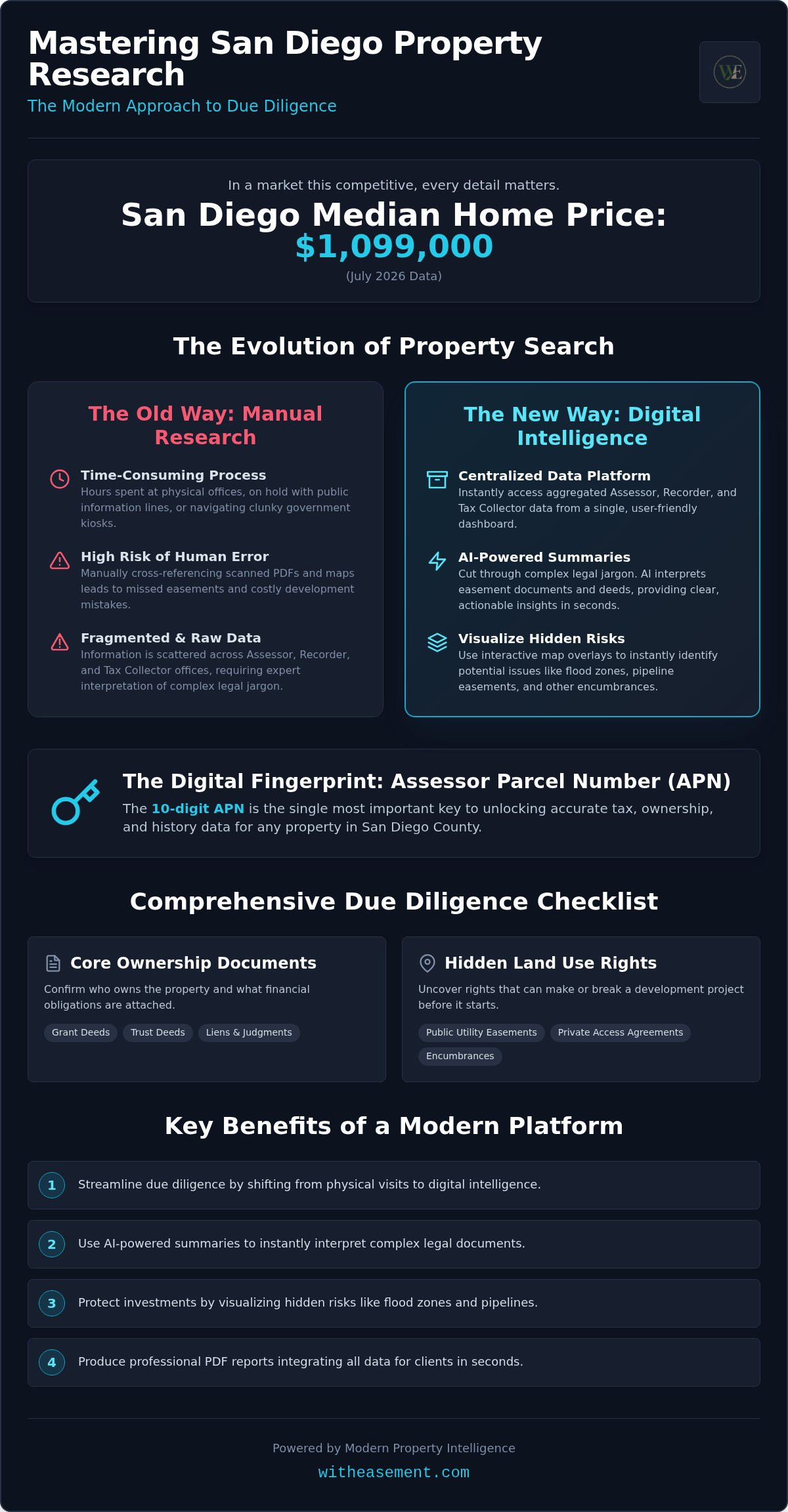
- Streamline your due diligence by shifting from time-consuming physical office visits to modern digital property intelligence.
- Master the online property records search San Diego by using a 10-digit Assessor Parcel Number (APN) to unlock instant results.
- Use AI-powered summaries to quickly interpret complex easement documents and legal jargon without requiring specialized training.
- Protect your development projects by visualizing hidden risks through interactive map overlays for flood zones and pipelines.
- Produce professional PDF reports that integrate HOA details and recorded easements to provide immediate value to your clients.
Why Traditional Property Record Searches in San Diego Are Changing
The landscape of San Diego real estate has reached a tipping point. With the 2026 tax roll hitting record highs, every square foot of land carries immense value. Professionals can't afford to wait for physical office hours or navigate clunky government kiosks. The shift to digital-first property intelligence is a necessity for anyone looking to stay competitive. It’s about moving from "finding data" to "using data" to make informed decisions.
The Problem with Manual Government Research
Relying on the old-school approach is a significant time drain. Calling the Public Information Line at 619-236-3771 often feels like a relic of a slower era. You spend hours on hold only to receive raw data that still requires heavy lifting to understand. Interpreting the legal descriptions found in property deeds is notoriously difficult. The process of Recording (real estate) is designed for legal compliance, not for user-friendly research. You’re often left squinting at scanned PDFs, trying to decipher metes and bounds without any visual context.
Human error is the biggest threat in manual research. When you're manually cross-referencing parcel maps with scanned documents, it's easy to miss a small detail. A single overlooked easement can ruin a development plan. These traditional methods lack the speed and accuracy required for modern due diligence. Recent regulations, like California Assembly Bill 1785, have even restricted online APN searches on government portals, forcing many to visit in-person kiosks for basic data. This creates a massive bottleneck for busy realtors and investors.
The Rise of Centralized Property Data Platforms
Efficiency is the hallmark of a modern online property records search San Diego. Modern platforms solve the fragmentation problem by aggregating Assessor, Recorder, and Tax Collector data into one accessible dashboard. You don't have to hunt for information across multiple agencies; it's presented to you in a unified format. This allows for a holistic view of a property's history and current status without the typical administrative friction.
These platforms offer more than just basic lookups. They provide:
- Integrated HOA and easement data in a single view.
- Mobile-friendly research for on-site property evaluations.
- Instant access to flood zone and pipeline overlays.
- Professional PDF reports ready for client presentation.
Moving toward centralized data means you can focus on strategy rather than logistics. Instead of spending your morning at a government kiosk, you can generate a professional report for a client in minutes. This transition to property intelligence ensures that you have the clarity needed to close deals faster and avoid costly surprises.
Essential Records Every San Diego Property Search Must Include
A successful online property records search San Diego starts with the right key. That key is the Assessor Parcel Number (APN). This 10-digit identifier acts as the digital fingerprint for every piece of land in the county. Without it, you're just guessing. While you can search by address, the APN is the only way to ensure you're looking at the exact parcel intended for development or sale. It connects you to the most accurate tax and ownership data available.
Beyond the APN, your search must uncover a complete paper trail. You need to pull Grant Deeds to confirm ownership and Trust Deeds to understand existing financing. Don't overlook liens or judgments that might cloud the title. These core documents form the foundation of a property's history. They reveal who truly owns the land and what financial obligations remain attached to it.
Understanding Recorded Easements and Encumbrances
Public utility easements often differ significantly from private access agreements. A utility easement might allow a city to maintain sewer lines, while a private agreement could give a neighbor the right to cross a driveway. An easement is a legal right to use another’s land for a specific purpose. Distinguishing between these rights is vital for any development project.
Hidden land use rights can make or break a deal. Using a San Diego property easement search tool helps you visualize these rights before they become expensive problems. You'll see exactly where sewer lines or access paths sit on the property map. If you need to verify these details quickly, you can access instant easement data through a centralized platform. This allows you to spot restrictions that traditional title searches might overlook until the final stages of a transaction.
HOA Data: Beyond the Basics
Verifying HOA status is a non-negotiable step in modern due diligence. Homeowners Association rules can restrict everything from exterior paint colors to short-term rental possibilities. If you miss these details, your buyer might face unexpected fines or project delays. It's not just about the monthly fees; it's about the governing documents that dictate how the land is used.
The real challenge isn't just knowing an HOA exists. It's finding current management contact info. Public records are often outdated, listing management companies that no longer handle the property. You need a reliable source for current documents and board contacts. For a deeper dive into these requirements, consult the San Diego HOA Documents Guide. This ensures you have the latest CC&Rs and financial statements before closing. Combining this with your parcel data gives you a full picture of the property's potential and its limitations.
San Diego County Portals vs. Modern Property Intelligence Platforms
Choosing the right tool for your online property records search San Diego depends on your end goal. Government portals like sdarcc.gov follow a "Self-Service" model. They provide raw data with high accuracy, but the burden of interpretation falls entirely on you. You're often digging through folders of scanned PDFs to find a single easement description. Modern property intelligence platforms offer a "Full-Service" alternative. These tools don't just give you a document; they give you an answer. The difference lies in the speed of insight. While sdarcc.gov boasts 99.5% accuracy on the 2026 tax roll, it lacks the interactive visualization and AI-powered summaries that save professionals hours of manual labor.
Efficiency is the primary driver for this shift. Professionals value their time and can't spend half a day navigating clunky government interfaces. A raw PDF deed is just a digital copy of a paper document. It's static and hard to read. An AI-summarized report, however, extracts the vital details instantly. It tells you who has access rights and where the boundaries sit without requiring you to read every line of legal jargon. This contrast between historical record-keeping and live interactive mapping is what defines the modern real estate landscape.
When to Use Official County Portals
Official government sites still serve a specific purpose. You'll need the Tax Collector's portal for secured property tax payments and verifying current billing status. If you need a certified copy of a record for a court proceeding or a formal closing, the County Recorder is your only source. These portals are built for administrative recording rather than rapid research. They're excellent for final verification but slow for initial discovery. Use them when you need the "official" stamp on a document you've already identified through faster means.
Why Professionals Choose WithEasement Membership
A WithEasement Membership replaces fragmented searching with a centralized dashboard. You can search by address or APN and get instant results. The real power comes from San Diego interactive property maps. These maps provide visual context that government sites simply don't offer. You can toggle proprietary pipeline and flood risk overlays to assess a property's vulnerability in seconds. This level of risk assessment is impossible with raw PDFs alone. It allows you to visualize hidden encumbrances and environmental factors before they become liabilities. By aggregating HOA data, easements, and risk maps, you secure a complete picture of any parcel with minimal effort.
How to Conduct a San Diego Property Search by APN or Address
Performing an online property records search San Diego requires a methodical approach to ensure accuracy. You don't need to be a GIS specialist to uncover high-level insights. The process starts with a simple identifier and ends with a professional report ready for your stakeholders. By following a streamlined workflow, you can bypass the friction of legacy systems and get straight to the facts.
- Step 1: Locate the 10-digit Assessor Parcel Number (APN) or the property address. If you only have the street location, modern platforms will automatically resolve the parcel ID for you.
- Step 2: Enter this data into a centralized search platform for instant results. You'll bypass the slow loading times and session timeouts often found on older government databases.
- Step 3: Review the interactive map for boundary lines and easement overlays. This visual layer is where you catch the details that text-only records miss, such as encroaching structures.
- Step 4: Generate a professional PDF report. This documents your findings for clients or lenders, providing a clear, authoritative record of your due diligence.
Decoding the Assessor Parcel Number (APN)
The San Diego APN follows a specific Book-Page-Parcel structure. The first three digits represent the Assessor's book, the next three indicate the page, and the final digits identify the specific parcel and sub-parcel. Understanding this hierarchy helps you navigate the county's internal filing system. However, if you only have a street address, you can find an APN instantly using a digital search tool. The APN is the most reliable way to track property history across different agencies. It ensures that the tax collector, recorder, and assessor are all referencing the exact same piece of land, eliminating confusion caused by similar street names.
Using Map Overlays for Risk Analysis
Modern research goes beyond ownership data to include environmental and infrastructure risks. You can toggle flood zone and pipeline overlays on an interactive map with a single click. Identifying gas lines is critical before any excavation or building begins. Striking a high-pressure line can lead to catastrophic project delays and safety hazards. These overlays allow you to see the exact path of underground utilities relative to your property lines, which is data typically hidden in dense legal descriptions.
You can also view assessed values displayed visually across a neighborhood. This helps you understand local market trends and tax obligations in a broader spatial context. Seeing how a property's value compares to its neighbors provides immediate context for investment decisions. To see these layers in action, you can start your San Diego property search now and visualize every hidden detail across the parcel.
Modernizing Due Diligence with AI Summaries and Professional Reports
Raw data is only half the battle. To truly master an online property records search San Diego, you need a way to interpret the results without spending hours in a legal dictionary. AI technology now performs the heavy lifting by analyzing recorded documents instantly. It identifies the "who, what, and where" of property restrictions, allowing you to focus on the deal instead of the paperwork. This shift from manual review to automated intelligence is the hallmark of a modern real estate professional.
Speed is the ultimate currency for high-volume realtors. Instant AI Summaries provide a clear overview of a property’s status in seconds. You don't have to wait for a title officer to call you back or for a legal team to review a standard easement. These tools identify key terms and obligations, flagging potential issues before they become deal-breakers. This proactive approach builds immense trust with buyers who value transparency and quick answers.
The Power of AI for Real Estate Due Diligence
AI excels at extracting critical terms from long, recorded legal documents that would otherwise take hours to parse. It scans through pages of boilerplate text to find specific mentions of maintenance obligations, expiration dates, or usage limits. This drastically reduces the legal review time for standard property transactions. By automating the extraction of these details, you eliminate the risk of missing a fine-print clause that could impact property value. For a deeper look at these capabilities, explore the AI for San Diego Real Estate Guide.
Generating Professional PDF Reports
A WithEasement Membership offers a one-click reporting feature that turns your research into a polished deliverable. These downloadable reports provide professional branding and clarity that raw government screenshots lack. They act as a single source of truth for all parties involved in a deal, from lenders to buyers. Each report integrates:
- Detailed easement summaries and locations.
- Current HOA status and management contacts.
- Visual risk overlays for pipelines and flood zones.
These reports don't just organize data; they present it in a way that speeds up the closing process. Lenders appreciate the thoroughness, and buyers feel more confident in their investment. By providing a clear, visual, and summarized view of an online property records search San Diego, you position yourself as a tech-forward leader in a competitive market. It’s about delivering professional clarity with minimal effort.
Take Control of Your San Diego Property Intelligence
Modern real estate requires more than just raw data. You've seen how shifting from manual government kiosks to digital platforms saves hours of administrative friction. By mastering the 10-digit APN and leveraging AI-powered summaries, you move from simple record lookups to true property intelligence. This approach ensures you never miss a hidden easement or a critical flood zone that could jeopardize a transaction. It’s about having the clarity to close deals with total confidence.
The landscape of online property records search San Diego is evolving rapidly. Don't let legacy systems slow down your professional growth. You can now access an interactive map with pipeline overlays, get AI-powered property summaries, and use a professional PDF reporting tool in one centralized location. It's time to empower your due diligence process and provide your clients with the standard of service they expect in 2026.
Access San Diego Property Records and AI Summaries with WithEasement today. Start discovering the hidden details of every parcel and lead the market with superior property intelligence.
Frequently Asked Questions
How do I find property records in San Diego online for free?
Official county sites like the Assessor/Recorder/County Clerk portal provide basic search tools for deeds and maps. You can search by name or document number to view index information. However, viewing full documents or downloading copies often requires a fee. For more comprehensive data like easements or flood risks, free portals usually fall short, requiring visits to physical kiosks for restricted data like Assessor Parcel Numbers (APNs).
What is the difference between the Assessor and the Recorder in San Diego?
The Assessor determines the value of all taxable property and maintains parcel maps with APNs. The Recorder maintains the official public record of documents like deeds, liens, and maps that affect property ownership. While the Assessor focuses on valuation and tax rolls, the Recorder focuses on the legal chain of title. You'll likely need data from both offices for a complete online property records search San Diego.
Can I find easements on a property map in San Diego?
Yes, but it requires specific tools beyond basic parcel maps. Standard Assessor maps show lot lines but often omit detailed easement locations. You must look for Recorded Maps or Parcel Maps in the Recorder’s database to see dedicated public utility or access easements. Modern intelligence platforms simplify this by overlaying these recorded easements directly onto an interactive map, saving you the trouble of manual cross-referencing.
How do I look up an HOA by address in San Diego County?
Finding HOA information through public records is difficult because associations aren't always listed on the deed. You can check the Covenants, Conditions, and Restrictions (CC&Rs) recorded against the property at the County Recorder's office. A more efficient method involves using a centralized property platform that aggregates HOA management contacts and document status by address. This bypasses the need to hunt through thousands of recorded legal documents manually.
How can I check for flood zones or pipelines on a property?
You can check FEMA maps for flood zones and the National Pipeline Mapping System for major transmission lines. However, these are separate databases that don't always align with local parcel lines. For professional due diligence, use an interactive map that provides proprietary overlays for both flood risks and underground pipelines. This allows you to visualize hazards directly on the property you’re researching without switching between multiple government websites.
Are San Diego property records public information?
Most property records are public information under the California Public Records Act. This includes deeds, mortgages, liens, and tax assessments. Anyone can request access to these documents, though some sensitive information like owner phone numbers or specific APN data on certain portals may be restricted due to privacy laws. Conducting an online property records search San Diego is the standard way for professionals to review these public files efficiently.
How long does it take to get a recorded easement document?
Obtaining a document through the County Recorder can take anywhere from a few minutes to several days. If you use an online index and pay for a digital copy, the delivery is usually immediate. If the document is older and not digitized, you may need to order a copy from the archives, which involves a longer wait. Using a modern property intelligence platform provides instant access to these documents alongside summarized results.


