

What if the title insurance policy you just signed doesn't actually protect you from the most common property usage restrictions? Many real estate professionals assume a standard title search catches everything. It's a common mistake that leads to expensive delays. Property encumbrance issues often remain hidden in dense legal filings, going unnoticed until construction starts or a sale is pending. You deserve a clearer view of the land before you commit your time and capital. Finding a clear title is only the beginning of modern due diligence.
You've likely felt the frustration of waiting on manual record searches or struggling to interpret complex easement maps. It's intimidating to navigate County Recorder documents when a high-stakes deal is on the line. We understand that pressure. This guide empowers you to identify common encumbrance types and streamline your research process with WithEasement. You'll learn to move from confusing data fragments to professional reports that provide total clarity for your clients or lenders. We'll break down how to spot hidden liens, visualize easements, and resolve title clouds with confidence and speed.
Key Takeaways
- Identify how a "cloud on title" stalls transfers and why recognizing property encumbrance issues San Diego real estate faces is vital for clear ownership.
- Discover how recorded easements and restrictive covenants impact property usage beyond what a standard title search might reveal.
- Understand the direct link between unresolved liens and your ability to secure traditional financing or maximize a property's buildable footprint.
- Learn to navigate the transition from slow manual record searches at the County Recorder to efficient digital data retrieval.
- Master the use of AI summaries and professional PDF reports to provide instant, high-level property intelligence for your clients.
Understanding Property Encumbrances and Title Clouds
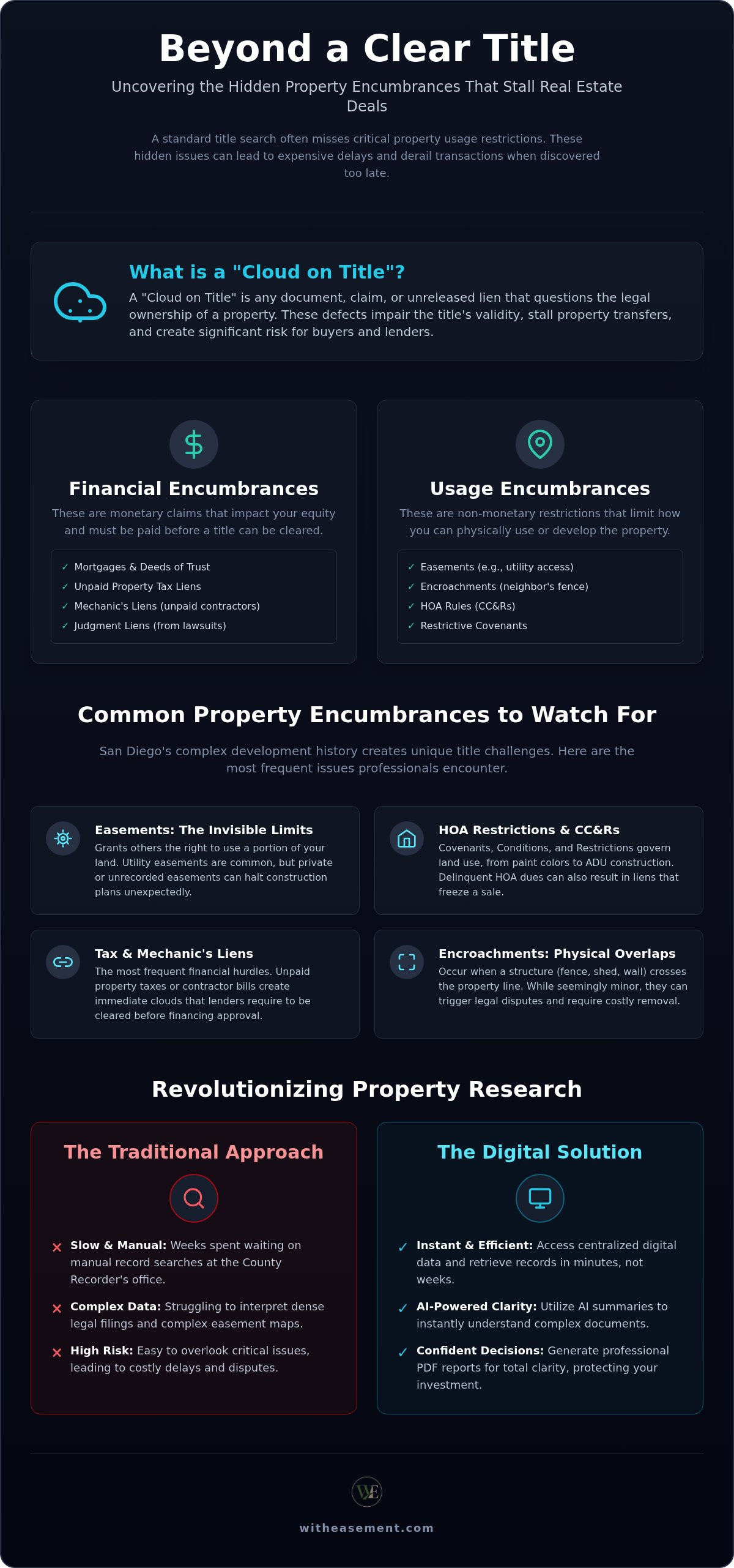
A property encumbrance is a third-party claim or liability attached to a piece of real estate. It doesn't stop you from owning the land, but it limits your control, use, or equity. When these claims go unresolved, they create a "Cloud on Title." This term describes any document, claim, or unreleased lien that impairs the title's validity. In our local market, property encumbrance issues San Diego professionals miss can stall a closing for months. You must identify these defects early to ensure a smooth transfer of ownership and protect your investment from hidden liabilities.
Encumbrances are categorized as either voluntary or involuntary. You create a voluntary encumbrance when you sign a mortgage or a deed of trust. It's a conscious choice to use your property as collateral for a loan. Involuntary encumbrances, like tax liens, mechanic's liens, or judgment liens, are placed on the title without your consent due to unpaid obligations. Both types cloud the title and must be addressed before the property is considered marketable. For instance, an involuntary tax lien often takes precedence over other claims, requiring immediate action to prevent a foreclosure or forced sale.
Financial vs. Usage Encumbrances
Financial encumbrances impact your equity. These include mortgages and tax assessments that require payment before a title clears. Usage encumbrances focus on the physical land, dictating how you can build or manage the property. Examples include easements for utility access, encroachments like a neighbor's fence, and restrictive HOA covenants. These issues are harder to detect because they don't involve specific dollar amounts, making them easy to overlook during a standard financial review or title search.
The Legal Framework in California
California Civil Code Section 1114 defines encumbrances to include taxes, assessments, and all liens on real property. State law protects buyers through implied warranties, where sellers promise the property is free from undisclosed issues. Local government offices maintain the official public record of these filings. Identifying property encumbrance issues San Diego sellers haven't mentioned is the only way to verify claims and avoid legal disputes or broken deals. Accessing this data quickly allows you to move forward with confidence.
Common Property Encumbrance Issues in San Diego
San Diego's diverse landscape and complex development history create a unique environment for title clouds. You aren't just looking for unpaid bills; you're looking for physical and legal restrictions that dictate how a property functions. Identifying these issues early prevents the friction that typically stalls local closings. Property encumbrance issues San Diego professionals encounter often range from simple tax defaults to complex usage rights that have existed for decades.
Financial clouds are the most frequent hurdles. Tax liens from the San Diego County Treasurer-Tax Collector attach to properties when owners fail to pay property taxes. Mechanic's liens are another common obstacle. These occur when contractors or suppliers claim they weren't paid for improvements made to the home. Both types of liens create immediate financial clouds that must be cleared before a lender will approve a new mortgage. You can verify these financial claims quickly through a centralized data platform to keep your transaction on schedule.
Encroachments represent a physical category of property encumbrance issues San Diego owners often discover too late. These happen when a structure, such as a fence, shed, or retaining wall, crosses the property line. While they seem minor, they can trigger legal disputes or require expensive modifications to clear the title. Recognizing these physical overlaps during the due diligence phase is essential for protecting your client's interests.
Navigating HOA Restrictions and CC&Rs
Homeowners Association (HOA) regulations are powerful encumbrances. Searching HOA documents by address reveals the Covenants, Conditions, and Restrictions (CC&Rs) that govern the land. These documents might limit paint colors, landscaping choices, or even the ability to build an Accessory Dwelling Unit (ADU). Furthermore, delinquent HOA dues can lead to liens that freeze a sale. Always check for outstanding balances to avoid unexpected costs at the closing table.
Easements: The Invisible Usage Limits
Easements are "invisible" limits that grant others the right to use a portion of the land. Finding recorded easements is critical for anyone planning to build or renovate. Utility easements for gas, water, and power lines are standard, but private easements can be more restrictive. A prior deed might grant a neighbor a right-of-way across the backyard, or a conservation easement might protect local vegetation from being cleared. These restrictions don't show up on a physical walk-through, making digital record searches indispensable for modern developers.
How Encumbrances Impact Property Value and Marketability
Property encumbrance issues San Diego investors encounter directly dictate a site's financial potential. A property with a clouded title is often unmarketable. Potential buyers shy away from uncertainty, and lenders won't fund a deal if their security is at risk. Unresolved liens or usage restrictions represent a financial liability that subtracts from the property's appraised value. You must view these issues as price adjusters rather than just legal footnotes.
An easement can significantly shrink a building's buildable footprint. If a utility line runs through the center of a lot, you can't build a pool, a garage, or an ADU there. This physical restriction lowers the land's utility and its market price. Lenders require a clear title to ensure they hold the primary claim to the asset. If a mechanic's lien or tax assessment is discovered late in the process, the loan will likely be denied. This creates a ripple effect, often leading to the collapse of the entire transaction.
Resolving these issues isn't free. You'll face legal fees, settlement costs, and significant time delays. These expenses eat into your profit margins and can turn a promising deal into a financial burden. Recognizing these risks early allows you to factor them into your initial offer or listing price.
Development and Renovation Roadblocks
Building over a pipeline or utility easement is a recipe for legal and physical disaster. Utility companies often have the right to clear any structures that interfere with their access. Also, flood zone designations impact more than just insurance premiums; they can limit where and how you build on the land. Using an interactive San Diego property map with overlays helps you visualize these physical impacts before you break ground. It's the difference between a successful project and a costly mistake.
Negotiation Leverage for Buyers and Sellers
Discovered encumbrances provide significant leverage during negotiations. A buyer can use a newly identified easement or lien to justify a lower purchase price or request that the seller clears the cloud before closing. Conversely, savvy sellers perform pre-listing due diligence to identify and fix these issues early. This proactive approach prevents last-minute surprises and keeps the sale on track. Professional PDF reports provide the documentation needed to back up your position at the bargaining table. It's about having the right data to prove your case quickly.
Researching Property Records: The Traditional vs. Digital Approach
Finding every title cloud requires a methodical research plan. Start by locating the Assessor’s Parcel Number (APN) to ensure you have the correct legal identifier. Next, search the San Diego County Recorder’s index for recorded deeds and liens. You must then review the Preliminary Title Report for listed exceptions. Verify physical usage through plot maps and easement overlays to see how the land is actually used. Finally, cross-reference these findings with HOA and municipal zoning data. This multi-step process is the only reliable way to uncover property encumbrance issues San Diego transactions often hide.
The Challenges of Manual Record Searching
Traditional research methods are notoriously slow and frustrating. You often have to navigate bureaucratic portals or visit government offices in person. Dealing with clunky interfaces wastes valuable time that could be spent closing deals. Manual searching for property encumbrance issues San Diego records contain is a recipe for delay. Interpreting the dense legal descriptions in recorded documents is another major hurdle. If you aren't trained in land use law, it's easy to misread a boundary or miss a "wild deed" that sits outside the standard chain of title. These unrecorded or poorly indexed encumbrances represent a significant risk for any buyer or developer.
Leveraging Property Intelligence Platforms
Modern property intelligence platforms act as a bridge between dense public records and your daily workflow. These tools aggregate HOA data, flood zones, and easement records into a single, searchable dashboard. You gain a massive speed advantage by using AI for real estate due diligence to summarize complex documents in seconds. Instead of hunting through disparate sources, you can generate professional PDF reports to summarize findings for your clients or lenders. This level of clarity builds immediate trust. To simplify your next search, access our centralized property data platform and clear your title clouds instantly.
Streamlining Due Diligence with WithEasement
Modern real estate moves at a pace that traditional research methods can't match. You don't have time to wait for manual records or decipher ancient legal filings while a deal hangs in the balance. WithEasement solves property encumbrance issues San Diego professionals face by centralizing critical data into one intuitive dashboard. You get instant access to recorded easements and HOA data without leaving your desk. It's about replacing guesswork with technical precision and professional clarity.
Our platform acts as a bridge between dense public records and actionable insights. Instead of navigating multiple government portals, you see everything in one place. This centralized approach reduces the friction typically associated with complex property research. It empowers you to perform high-level due diligence without requiring specialized legal training. You gain a competitive edge by identifying risks that others might miss during a standard title review. It's the modern standard for property intelligence.
Visualizing Risk with Map Overlays
Seeing is believing when it comes to land use. An interactive San Diego property map allows you to layer pipeline and flood overlays directly onto any parcel. This visualization is essential for avoiding underground infrastructure during construction or renovation projects. You can identify environmental risks instantly and analyze assessed values alongside usage restrictions. This bird's-eye view ensures you understand the physical reality of the land before making a financial commitment. It's a faster, more reliable way to conduct site analysis without the need for expensive intermediaries.
The Power of Professional Reporting
Data is only useful if it leads to a decision. AI-powered summaries translate complex legal jargon into plain English, ensuring you fully grasp every title cloud. You can generate a comprehensive PDF property report in minutes to share with stakeholders. These reports build immediate trust with clients and lenders by providing clear, documented evidence of a property's status. For high-volume professionals, a membership model provides superior ROI compared to the cost and time of manual searches. It's the most efficient way to manage property encumbrance issues San Diego presents in every transaction. You save time, reduce risk, and deliver better results for your clients through effortless efficiency.
Master Your Property Due Diligence
Identifying property encumbrance issues San Diego real estate often hides is the first step toward a successful closing. You've seen how hidden easements can shrink buildable space and how unaddressed liens can derail financing at the last minute. Moving from slow, manual searches to a digital-first approach isn't just about saving time; it's about protecting your professional reputation and your client's capital. You now have the framework to distinguish between financial clouds and usage restrictions with confidence.
WithEasement offers the tools you need to visualize these risks before they become problems. Access comprehensive San Diego County data, interactive maps with flood and pipeline overlays, and AI-powered property summaries that translate legal jargon instantly. These professional reports turn dense public records into actionable intelligence for your next deal. You can finally stop digging through clunky portals and start delivering results.
Start your property search and clear the clouds with WithEasement today. Clear titles lead to faster closings and better investment outcomes. You're ready to navigate the San Diego market with total clarity and speed.
Frequently Asked Questions
What is the most common property encumbrance issue in San Diego?
Mortgages and property tax liens are the most common financial encumbrances found in local records. Utility easements for water, gas, or electricity are the most frequent usage-based restrictions, appearing on almost every parcel. These issues often surface during a standard title search. Identifying these property encumbrance issues San Diego owners face early prevents closing delays. Digital tools help you spot these common hurdles before they stall your transaction.
Can you sell a property with an encumbrance on the title?
You can sell a property with an encumbrance, but it often complicates the transaction. Financial encumbrances, like mortgages or tax liens, are typically paid off at closing using the sale proceeds. Usage encumbrances, such as easements, remain with the property and transfer to the new owner. If a "cloud" makes the title unmarketable, most lenders will refuse to fund the buyer's loan until the issue is resolved.
How do I find out if there are easements on my property?
You can find easements by searching the San Diego County Recorder’s index or reviewing your preliminary title report. For a faster approach, use a centralized property intelligence platform to search by APN or address. This provides instant access to recorded documents without visiting a government office. Digital searches allow you to visualize these restrictions on an interactive map, helping you understand the physical impact on your land use immediately.
Does title insurance cover all types of property encumbrances?
Title insurance does not cover all encumbrances. Standard policies usually exclude "exceptions" listed in the preliminary report, such as known easements or zoning laws. They also don't cover unrecorded issues or physical encroachments that a survey would reveal. It's vital to perform your own due diligence beyond the title policy to uncover property encumbrance issues San Diego buyers might otherwise miss during a transaction.
What is the difference between a lien and an encumbrance?
A lien is a specific type of financial encumbrance that uses the property as collateral for a debt. All liens are encumbrances, but not all encumbrances are liens. Usage-based restrictions, like easements and restrictive covenants (CC&Rs), are encumbrances that don't involve debt. Understanding this distinction helps you prioritize which issues need immediate financial settlement and which require a review of physical land use rights or development limits.
How much does it cost to clear a cloud on a title?
The cost to clear a cloud on a title varies significantly based on the issue's complexity. Simple tax liens only require paying the outstanding balance plus interest. More complex issues, like disputed easements or "wild deeds," may require legal action through a quiet title lawsuit. You'll often face attorney fees and filing costs. Identifying these problems early allows you to negotiate these expenses before finalizing a purchase agreement.
Can an HOA place a lien on my property for unpaid fines?
Yes, a Homeowners Association (HOA) can place a lien on your property for unpaid fines or assessments. In California, HOAs have the legal authority to record a lien if you fall behind on your obligations. This cloud on the title can eventually lead to foreclosure if the debt remains unpaid. Always verify the current standing of HOA dues through a dedicated search to avoid unexpected financial liabilities at closing.
How do I remove an old, inactive easement from my property record?
Removing an inactive easement usually requires a "Release of Easement" or a quitclaim deed from the easement holder. If the holder is unreachable or refuses to sign, you may need to file a quiet title action in court. You must prove the easement was abandoned or is no longer necessary for its original purpose. This legal process clears the record and restores full usage rights to the current property owner.


