

What if the most critical data for your next real estate deal is currently invisible to you? In today's competitive real estate market, missing a hidden pipeline easement or an outdated flood zone classification can be a costly mistake. You've likely felt the frustration of jumping between disconnected government portals or waiting days for a simple HOA contact. It's time to change how you access essential property insights.
We agree that property research shouldn't feel like a legal scavenger hunt. You need clear, actionable data to move quickly and protect your clients. This guide promises to help you master the complexities of land records, from interpreting the latest official flood map updates to identifying new development opportunities under recent zoning or land use code changes. You'll learn how to use professional-grade intelligence tools, like those offered by WithEasement, to visualize property encumbrances and generate high-quality PDF reports instantly. We'll walk through the essential layers of modern property research, ensuring you have the technical edge to close deals with total confidence in today's fast-paced seller's market.
Key Takeaways
- Gain a competitive edge by mastering digital-first land records and the latest 2026 regulatory updates affecting local property values.
- Unlock deep San Diego county property insights by identifying hidden utility, access, and drainage easements that impact potential land use.
- Protect your investment with precise visual overlays for high-pressure pipelines and updated 2026 FEMA flood risk zones.
- Simplify your due diligence process with instant access to HOA governance details and fee structures before you enter escrow.
- Save hours of manual research by using AI-powered summaries and generating professional PDF property reports for your clients in seconds.
Understanding San Diego County Property Data in 2026
In 2026, professional San Diego county property insights represent the critical intersection of market value, legal encumbrances, and environmental risk. Relying on basic listing data isn't enough when deals involve million-dollar assets. True insight requires looking beneath the surface at recorded documents that dictate what you can actually do with a piece of land. You need to see the full picture before you commit to a transaction.
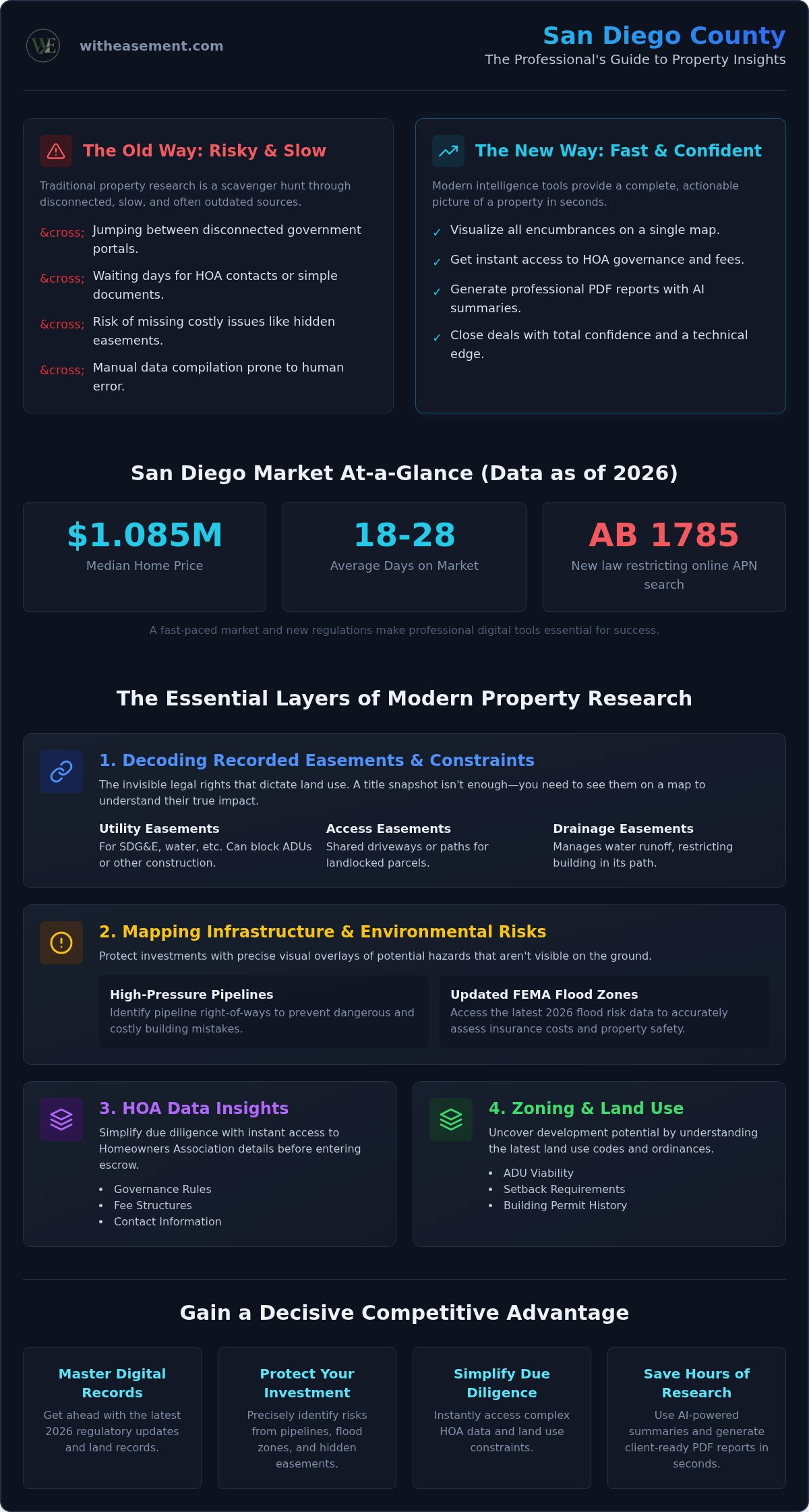
The landscape shifted significantly recently. Effective December 9, 2024, California Assembly Bill 1785 restricted online APN search functionality in the County Assessor's official record search. This change makes professional, digital-first intelligence tools mandatory for anyone competing in the local market. You can't rely on slow, manual processes if you want to win in a market where homes sell in an average of 18 to 28 days. Speed is now a prerequisite for accuracy.
Understanding the local landscape starts with a broad San Diego County overview to grasp the geographical diversity that impacts zoning and risk. Data typically flows from three primary hubs: the Assessor for valuation, the Recorder for legal documents like liens and easements, and the Planning department for land use rules. The Assessor Parcel Number (APN) acts as the master key to these silos, unlocking the specific history and constraints of any property.
The Evolution of Property Research
Property research has evolved from dusty hall-of-records searches to instant cloud access. In the past, finding a hidden easement could take days of manual digging. Today, real-time data prevents deal-killing surprises during the escrow process. You don't want to discover a drainage easement or a pipeline right-of-way after your contingency period has ended. Generic real estate platforms often fail here because they prioritize marketing photos over professional-level due diligence. They show you the kitchen; professional tools show you the legal foundation.
Key Metrics for San Diego Professionals
Professionals must distinguish between assessed values and market values. While the median home price in San Diego County reached $1,085,000 in June 2026, the assessed value is governed by Proposition 13, which caps annual increases. This gap creates unique tax implications for new buyers that must be calculated early. Additionally, land use designations dictate development potential, such as the ability to build ADUs under the April 2026 ordinance amendments. Property intelligence is the synthesis of public records into actionable risk assessments. Knowing these metrics allows you to advise clients with precision and authority.
Decoding Recorded Easements and Land Use Constraints
An easement is a legal right to use someone else's land for a specific purpose. In the local market, these recorded documents are often the deciding factor in property utility. They represent the invisible layer of San Diego county property insights that can either facilitate or frustrate your development goals. Common varieties include utility access for SDG&E, private access for landlocked parcels, and drainage pathways that manage runoff in hilly terrain.
Standard title snapshots often miss the nuances of these encumbrances. A hidden easement might not appear on a high-level summary but could still legally prevent you from building a pool, deck, or fence. You must look at the actual recorded maps to understand the spatial limits of these rights. These documents are the only way to confirm if a neighbor has a legal claim to cross your yard. To save time during due diligence, you can perform a San Diego property easement search using professional tools that pull directly from county records.
Utility and Public Access Easements
Identifying SDG&E and municipal water access points is vital before you apply for building permits. Public utility easements (PUEs) often run along property lines or through the center of a parcel. If you're planning an ADU under the April 2026 ordinance amendments, a buried utility line could force a costly redesign. Verify these access points early to ensure your project remains viable. You can often see these lines clearly on detailed parcel maps before you ever break ground. This proactive step prevents expensive delays once construction begins.
Private and Prescriptive Easements
Shared driveways and access rights are common in older neighborhoods like Hillcrest or Kensington. These private agreements aren't always obvious during a simple property walkthrough. Prescriptive easements are particularly tricky; they form through continuous use over time and might require historical record checks to uncover. These rights can emerge without a formal written agreement if the use has been open and notorious for years.
Accurate San Diego county property insights allow you to visualize these boundaries on interactive maps. This spatial clarity helps you understand exactly where one person's right of way ends and your property rights begin. Use these tools to spot potential conflicts before they become legal headaches. If you need to verify these details quickly, a professional easement search membership provides the tools you need to move forward with certainty.
Mapping Infrastructure: Pipelines and Flood Risk Overlays
What lies beneath the surface often dictates the safety and financial viability of your investment. While mainstream real estate sites offer generic risk scores, professional San Diego county property insights rely on exact spatial data. Visualizing high-pressure gas and water pipelines is essential because these features create permanent land-use restrictions. Proximity to major infrastructure doesn't just impact safety; it influences insurance premiums and future resale value in high-density areas.
Infrastructure and property value are intrinsically linked. A parcel situated directly over a primary transmission line may face strict limitations on heavy landscaping, hardscaping, or accessory structures. You need to see the actual path of these utilities to understand the true "buildable" area of a lot. This level of detail ensures you aren't surprised by a utility company's right-of-way during a renovation or sale.
San Diego Pipeline Overlays
Locating major transmission lines is a critical step for any property near industrial or transit corridors. The San Diego County Water Authority manages a complex system of pipelines, many of which undergo proactive relining to extend their service life. These lines often come with safety setbacks and "No-Build" zones where permanent structures are strictly prohibited. You can use San Diego interactive property maps to toggle infrastructure layers and see exactly how these transmission routes interact with specific parcel boundaries. This visibility helps you avoid purchasing a lot with unusable square footage.
Hydrological Risks and Flood Zones
Flood risk assessment in the region saw a significant update recently. New FEMA flood risk maps for areas along the San Diego River took effect on March 3, 2026. These formal updates to the Flood Insurance Rate Maps (FIRMs) can immediately change mortgage requirements and insurance costs for affected homeowners. It's vital to distinguish between the 100-year and 500-year flood plains, as the County often applies more stringent regulations than FEMA in overlapping areas. The 'Flood Factor' is a dynamic risk assessment based on 2026 climate modeling that accounts for changing precipitation patterns beyond historical data. Accessing these San Diego county property insights allows you to advise clients on necessary coverage before they reach the closing table.
HOA Data Insights: Navigating Governance and Fees
Homeowners Associations (HOAs) govern a significant portion of San Diego's residential landscape, particularly in master-planned communities like Carmel Valley or Eastlake. These organizations manage everything from common area maintenance to strict architectural standards. While market value and easements are foundational, HOA data is often the most overlooked component of San Diego county property insights. Missing a special assessment or a pending litigation case can derail an escrow timeline or burden a buyer with unexpected costs immediately after closing.
Accessing these records requires more than a simple search. Because there's no centralized government database for management contacts, professionals often waste hours tracking down the correct entity. You need a reliable method to identify current fee structures and management responsibilities by address. For a deeper analysis of what to look for in these files, consult our San Diego HOA documents guide to ensure no detail is missed.
HOA Search and Management Lookup
Identifying the management company is the first step in verifying a property's standing. It's common to find 'hidden' sub-associations in larger developments where a master association handles the community at large while a smaller group manages specific streets or condo buildings. Each layer carries its own monthly or quarterly fees. You must also verify the association's financial health by reviewing their reserve studies and meeting minutes. If an HOA lacks sufficient reserves for major repairs, a special assessment is likely on the horizon. This financial transparency is a core part of modern property intelligence.
The Impact of HOA Rules on Property Use
HOA rules can significantly impact a property's investment potential. Short-term rental restrictions are prevalent in many San Diego associations; these bans can drastically lower the projected ROI for buyers looking at vacation rental models. Architectural review boards also hold immense power over modifications. Even if the county allows an ADU under the latest April 2026 ordinances, an HOA may have specific design guidelines that complicate the build process. Common pitfalls like undisclosed liens or outdated CC&Rs frequently delay sales. You can avoid these roadblocks and start your HOA search today to secure the data you need before moving into escrow.
Streamlining Due Diligence with AI Property Reports
Navigating the mountain of data we've covered requires a modern approach. You can't spend hours manually cross-referencing easement maps with HOA fee histories while a listing is active. This is where artificial intelligence transforms raw San Diego county property insights into a clear business strategy. It acts as a digital bridge, pulling together disparate technical details into a single, cohesive view. You gain the ability to move from initial curiosity to deep, specific insight without the traditional friction of public record research.
Adopting AI for real estate due diligence allows high-volume realtors to scale their research operations without sacrificing accuracy. You can generate a professional property report in under 60 seconds, providing an immediate advantage in a market where the median home price reached $1,085,000 in June 2026. Speed is your greatest asset when inventory is low and competition is high. These tools ensure you have the technical edge to advise your clients with total authority.
AI-Powered Record Summarization
AI handles the heavy lifting of legal analysis by interpreting dense land use records. It can scan 50 pages of recorded easements and distill them into a three-bullet executive summary. The system automatically identifies critical "red flag" keywords like "encroachment," "litigation," or "non-conforming" that might be buried in complex legal jargon. In 2026, the precision of these tools for legal document analysis has become a standard requirement for professional due diligence. You get the facts you need without the fatigue of manual reading.
Professional PDF Reporting Tools
Professional PDF reports represent the final step in a modern, tech-forward workflow. A comprehensive San Diego property report should include interactive map snapshots, pipeline overlays, and verified HOA management contacts. Use these reports as a high-value addition to your buyer presentations and listing packets. They demonstrate a level of thoroughness that builds immediate trust with sophisticated clients. Digital PDF reports provide a permanent paper trail of due diligence that helps protect your professional liability in every transaction. You can also customize these documents to highlight specific opportunities, such as the potential for separate ADU sales under the latest 2026 ordinance amendments. This tailored approach ensures your clients see the full value of the land they are pursuing.
Secure Your Competitive Edge in 2026
Success in the local market requires more than just knowing the current price per square foot. It demands a deep understanding of the legal and environmental layers that define a parcel's true potential. You've seen how hidden easements and shifting 2026 flood zones can impact a deal's viability. By integrating AI-powered analysis into your workflow, you transform dense public records into clear business advantages. You don't have to wait for manual searches or struggle with fragmented data portals anymore.
Take control of your due diligence process today. Accessing comprehensive San Diego county property insights has never been faster or more accessible. Use our AI-powered property summaries, comprehensive San Diego easement database, and interactive risk and infrastructure maps to move with total certainty. It's time to simplify your research and focus on closing deals for your clients. Unlock San Diego County Property Insights with WithEasement and start working with professional-grade intelligence immediately.
Frequently Asked Questions
How do I find recorded easements on my San Diego property?
You can find recorded easements by searching your address or APN through WithEasement's centralized platform. This tool aggregates data from the County Recorder and Assessor into an interactive map. While you can visit one of the five San Diego County Assessor office locations to use an in-person kiosk, digital access is significantly faster. Professional tools allow you to visualize these encumbrances immediately without the need for manual document retrieval or traditional title searches.
What is the best way to do an HOA search by address in San Diego County?
The most efficient way to perform an HOA search by address is through a specialized property intelligence platform. Standard government portals often list registration requirements but lack searchable databases with management contact details. WithEasement provides these San Diego county property insights by identifying the specific management companies and fee structures associated with a parcel. This eliminates the need for manual outreach and helps you identify hidden sub-associations before you enter the escrow process.
Can I find San Diego property records by APN online?
Yes, you can access property records by APN online through professional platforms like WithEasement. It's important to note that as of December 9, 2024, California Assembly Bill 1785 restricted the County Assessor's online functionality. Official APN searches are now limited to in-person kiosks at county offices. Using a private intelligence tool allows you to bypass these physical barriers, giving you instant access to ownership history and parcel maps from any location.
What are the common property encumbrances found in San Diego?
San Diego properties frequently feature utility easements for SDG&E or municipal water access. You'll also encounter drainage easements in hilly regions and shared driveway agreements in historic neighborhoods. Other common encumbrances include CC&Rs managed by Homeowners Associations and specific land-use restrictions near transit corridors. Identifying these early is vital because they dictate where you can build structures like ADUs or pools. Professional map overlays help you see these legal boundaries clearly before you commit.
Is there a map that shows gas pipelines on San Diego properties?
You can access interactive maps with pipeline overlays through the WithEasement membership platform. These specialized layers visualize high-pressure gas and water transmission lines that may cross your parcel. Knowing the exact location of this infrastructure is essential for safety and insurance purposes. It also helps you identify "No-Build" zones where permanent structures are prohibited. Seeing these overlays alongside your property boundaries provides a level of detail that standard real estate listing sites cannot offer.
How does flood risk affect property value in San Diego County?
Flood risk directly impacts property value through increased insurance premiums and mandatory mortgage requirements. Properties within the 100-year flood plain often face higher carrying costs that can lower resale appeal. With the March 3, 2026, FEMA map updates for areas along the San Diego River, many parcels now face new regulatory hurdles. Accessing accurate San Diego county property insights helps you understand these hydrological risks and their long-term financial implications for your investment.
What information is included in a WithEasement property report?
A WithEasement property report includes a comprehensive suite of data points tailored for real estate professionals. You'll receive AI-driven summaries of dense land records, recorded easement details, and verified HOA management contacts. The report also features interactive map snapshots with flood zone and pipeline overlays. These professional PDF documents are designed to be used in buyer presentations or listing packets, providing a clear paper trail of due diligence that simplifies complex technical information for your clients.
Do I need a professional to interpret San Diego land use records?
You don't necessarily need a specialized consultant to interpret land use records if you use modern intelligence tools. WithEasement's AI summaries translate complex legal jargon and dense easement maps into digestible fragments. This technology performs the heavy lifting of document analysis, highlighting critical red flags automatically. It empowers you to perform high-level research independently, reducing the friction and cost typically associated with professional intermediaries. You get expert-level insights with the speed of a digital utility tool.


