

Most property owners don't realize that recent legislative changes have actually made it harder to perform a San Diego property easement search online using traditional parcel numbers. You've likely felt the frustration of clicking through outdated government portals or trying to decode dense legal descriptions just to see if a utility line crosses your yard. It's a slow, manual process that often leaves you with more questions than answers. You deserve a clearer path to the facts without the administrative headache or the need for a physical trip to a government office.
This guide shows you how to master the search process using modern digital tools that prioritize your time and clarity. We'll show you how to bypass the friction of traditional record searches, interpret complex legal jargon instantly, and generate professional reports that map out every hidden encumbrance on your land. From pipeline overlays to AI-powered summaries, you're about to unlock a level of property intelligence that used to require a professional intermediary. Follow this process to transform raw data into a clear, actionable map of your property's potential.
Key Takeaways
- Understand how recorded easements create legal encumbrances that dictate exactly how you can use and develop your land.
- Navigate the complexities of a San Diego property easement search online by identifying the right property markers and accessing raw data from recorder portals.
- Learn to distinguish between standard utility access and restrictive private agreements found within deeds and HOA documents.
- Discover how AI-powered summaries can translate hundreds of pages of legal jargon into clear, actionable intelligence in seconds.
- Master the creation of professional property reports that integrate pipeline overlays and flood data for comprehensive due diligence.
Understanding Property Easements and Their Impact on Land Use
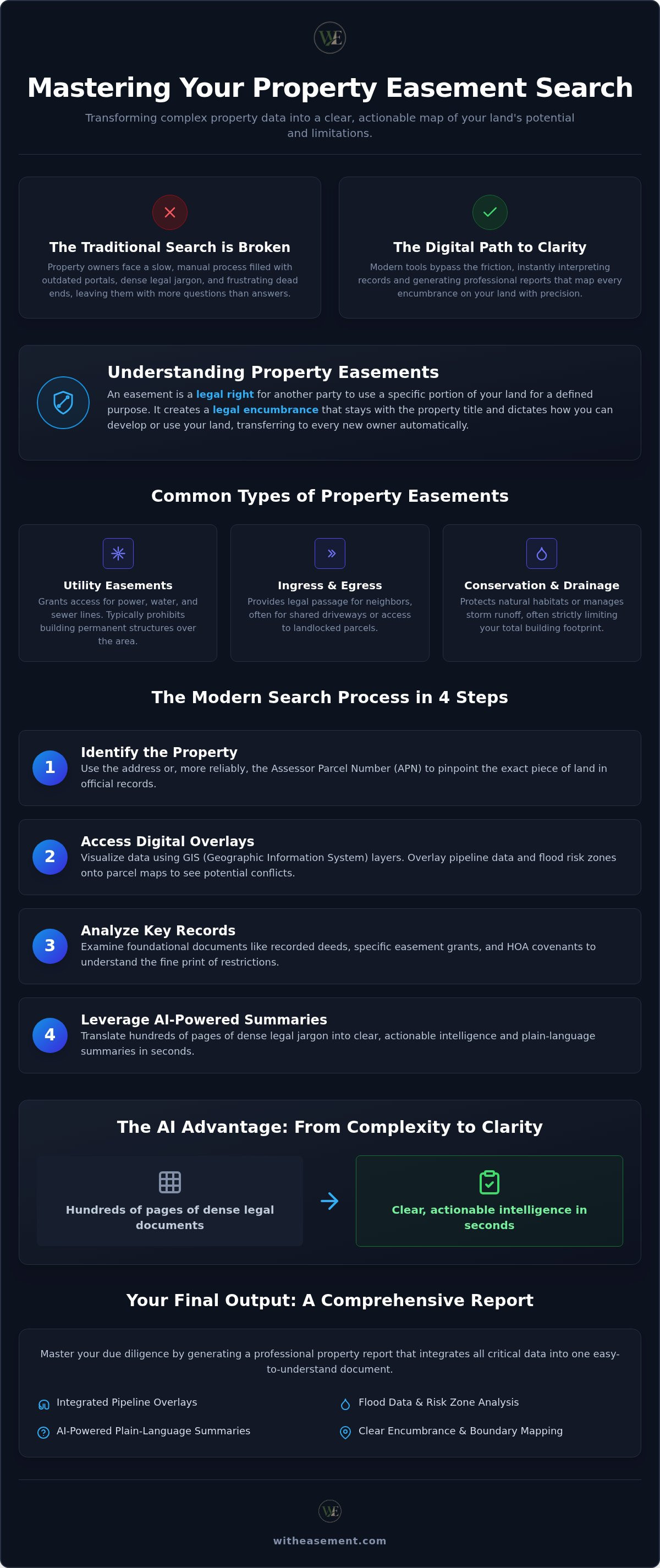
A recorded easement is a legal right for another party to use a specific portion of your land for a defined purpose. It creates what professionals call a legal encumbrance. This burden stays on the title and dictates how you can develop or enjoy your property. Understanding Property Easements is the first step in realizing that ownership doesn't always equal exclusive control. While public utility easements for power or water are standard, private access agreements between neighbors can be far more restrictive and complex.
Many owners assume title insurance covers every possible scenario. It doesn't. Title reports can sometimes miss nuances or historical records that haven't been updated in decades. Conducting a proactive San Diego property easement search online allows you to see the full picture before you sign a contract. Hidden easements for old drainage pipes or forgotten pathways can derail a construction project or cause a property sale to collapse at the last minute. Getting ahead of these issues saves time and protects your investment.
Common Types of Property Easements
Easements come in various forms, each with unique restrictions on your land use:
- Utility Easements: These grant access for power, water, and sewer lines. They typically prohibit building permanent structures like pools or guest houses over the designated area.
- In-gress and E-gress: These provide legal passage for neighbors, often for shared driveways or access to landlocked parcels.
- Conservation and Drainage: These protect natural habitats or manage storm runoff. They often strictly limit your total building footprint to prevent environmental impact.
The Legal Weight of Recorded Documents
Most easements run with the land. This means the legal obligation transfers to every new owner automatically. It stays in effect regardless of who originally signed the document. When you perform a San Diego property easement search online, you are looking into the permanent history of the parcel. There is a clear hierarchy in these records. Recorded deeds provide the foundation, while specific easement grants and HOA documents offer the fine print.
Distinguishing between active and abandoned easements is a critical part of your due diligence. An old utility line might look inactive, but the legal right to access it remains unless a formal quitclaim or abandonment is recorded. Accurate research helps you identify these dormant rights before they become active problems during a renovation or sale.
How to Search for Property Easements Online
Modern property research starts with digital records. While traditional methods once involved physical trips to a recorder's office, a San Diego property easement search online is now the standard for realtors, developers, and homeowners. You need to gather the right identifiers before diving into databases. Most government systems rely on specific legal markers rather than just a street address to pull accurate documents. Starting with the right data ensures you don't waste time on irrelevant records.
Step 1: Identifying the Property by Address or APN
The Assessor Parcel Number (APN) is your most reliable tool. It acts as a unique ID for the land. As of December 2024, Assembly Bill 1785 changed how some online portals function, often restricting direct searches by APN in public indices to protect owner privacy. You can still use address-to-parcel conversion tools to find your number. Once you have it, you'll often need to search official records by the owner's name or document number if the APN index isn't available online. If you're working on a large development site, cross-reference multiple parcels to ensure no overlapping easements exist between adjacent lots.
Step 2: Accessing Digital Map Overlays
Visualizing the data is where high-level research truly begins. County plat maps provide a flat view, but GIS (Geographic Information System) layers offer a deeper look into the terrain. You can layer pipeline data and flood risk zones over standard parcel maps to see potential conflicts. This is critical because physical landmarks, like fences or walls, often don't align with recorded boundaries. Under California Government Code § 65871, easements can be created by recorded covenants, making it essential to see how these legal lines sit on the actual landscape.
Free government databases are a helpful starting point, but they have limits. They often provide raw, unorganized PDFs that are difficult to scan quickly. You might spend hours downloading individual pages at $2.00 for the first page and $0.05 for each additional one, only to find the document doesn't apply to your specific needs. For a more streamlined experience, using a dedicated property easement search platform can save you hours of manual labor by aggregating these disparate data points into one clear, interactive view. Performing a San Diego property easement search online this way allows you to move from raw data to actionable intelligence with minimal friction.
Key Records to Analyze During Property Due Diligence
Finding the right documents is only half the battle. To complete a thorough San Diego property easement search online, you must analyze how different records interact with each other. A recorded deed might show you own the land, but an HOA covenant or a pipeline overlay can dictate exactly what you can build on it. Professional due diligence requires a multi-layered approach that looks past the surface level of public indices to find every potential restriction.
Recorded deeds and easements form the foundation of your property rights. These documents are legally binding and transfer with every sale. They define the "standard" rights of way for utilities and neighbors. However, they don't always tell the whole story. You also need to look for CC&Rs (Covenants, Conditions, and Restrictions) that might not appear in a standard easement search but still carry significant legal weight. Missing these community-level rules can lead to expensive permit delays or legal disputes with neighbors.
Evaluating HOA and Community Restrictions
HOA data is often harder to locate than standard utility easements. These records are frequently managed by private companies rather than being centralized in a single county database. You need to verify the active management company and review the latest recorded bylaws to understand community-level restrictions. Linking these search results to a specific address ensures you aren't surprised by architectural rules or hidden land-use fees after the closing. This step is essential for properties in planned developments where the HOA might have more control over the land than the local municipality.
Environmental and Infrastructure Overlays
Physical risks can be just as restrictive as legal ones. Assessing flood risk using FEMA and local hazard maps is a non-negotiable step for any buyer or builder. Similarly, locating gas pipelines or sewer mains is vital for both safety and securing building permits. You can't always see these pipes from the surface, but their presence creates an invisible "no-build" zone that can shrink your usable land area significantly.
Using interactive property maps allows you to see all these risks in one consolidated view. This spatial intelligence helps you visualize where legal easements overlap with physical infrastructure. By combining environmental data with recorded legal documents, you gain a complete picture of the property's encumbrances. This integrated view is exactly what modern professionals use to avoid the "hidden" surprises that derail traditional real estate deals.
Leveraging AI and Technology for Faster Property Research
Traditional property research often feels like an archaeological dig. You download massive PDF files, scroll through hundreds of pages of scanned documents, and hope you didn't miss a critical clause tucked into the margins. Performing a San Diego property easement search online shouldn't require a law degree to understand. Modern technology now bridges the gap between raw public records and actionable insights. By moving away from manual, "City Hall" style research, you focus on making decisions instead of just hunting for data.
The shift toward digital intelligence platforms represents a major upgrade in real estate workflows. These systems don't just store information; they organize it. They take the disparate pieces of a property's history and weave them into a cohesive narrative. This speed is essential for realtors and investors who need to move quickly in competitive markets. You get the confidence of professional-grade data without the typical three-day wait for a title search or a surveyor's preliminary report.
Instant AI Summaries of Complex Records
Reading through legal descriptions and historical deeds is incredibly time-consuming. AI summaries act as a professional filter, translating dense legalese into plain English for you and your clients. These tools automatically identify key dates, restriction types, and the specific parties involved in an easement. Using AI for real estate due diligence allows you to process documents in seconds that would normally take hours to review. It's about getting to the "why" of a document without the manual slog.
Centralizing Disparate Data Sources
Efficiency dies when you have to toggle between five different government portals to find one answer. A centralized platform brings everything into one view. It integrates interactive map data with the actual text of recorded documents, ensuring data consistency across your property reports. You won't have to worry about a map layer contradicting a written deed. This unified workflow is what defines modern property intelligence. It empowers you to see the full scope of a San Diego property easement search online without the friction of fragmented systems.
Ready to stop wasting time on manual research? Unlock instant property intelligence with WithEasement and get the professional reports you need in minutes.
Creating Professional Property Reports with WithEasement
Raw data is only as good as your ability to present it. A successful San Diego property easement search online should result in a clear, professional deliverable that your clients can actually use. WithEasement transforms complex findings into comprehensive PDF property reports that serve as the definitive record for any parcel. These documents don't just list facts. They provide a visual and textual narrative of a property's potential and its limitations.
Customizing your reports allows you to highlight the most relevant data for your specific project. You can include detailed easement summaries, HOA contact information, and risk overlays like flood zones or pipeline locations. This level of detail is essential when you need to justify a property valuation to a lender or prove building feasibility to a skeptical investor. It streamlines the entire property easement search process by turning hours of investigation into a single, shareable file.
The Value of Downloadable PDF Reports
Providing a tangible report during the discovery phase offers immediate value to potential buyers. It builds trust by showing total transparency regarding land use restrictions. When you have a data-backed document in hand, you negotiate from a position of strength. If a report reveals a utility easement that limits a backyard expansion, you have the evidence needed to adjust deal terms accordingly. It turns a potential deal-breaker into a manageable point of negotiation.
Standardizing your due diligence is also a major benefit for real estate teams. When every member of your group uses the same reporting format, you eliminate confusion and ensure no one misses a critical encumbrance. It creates a consistent professional standard that reflects well on your brand. It protects your clients from unforeseen legal hurdles while keeping your workflow incredibly lean.
Getting Started with WithEasement Membership
Unlocking professional property intelligence shouldn't be a hurdle. A WithEasement membership provides unlimited access to a centralized platform designed for speed. You can use the simple address search to find records in seconds, bypassing the clunky interfaces of traditional government portals. This empowerment allows you to perform a high-level San Diego property easement search online from your office or while out in the field. It's about having the right answers exactly when you need them.
Empower your business with high-tech land use tools that do the heavy lifting for you. By integrating AI summaries, interactive maps, and professional PDF generation, you move faster and with more confidence. It's a no-nonsense approach to property intelligence that puts the most accurate data directly within your reach. Start your search today and see how simple professional due diligence can be when you have the right partner.
Take Control of Your Property Intelligence
Modern real estate moves too fast for physical record rooms and manual document scanning. You've learned that a successful San Diego property easement search online requires more than just finding a raw PDF; it demands interpretation and spatial context. By identifying key encumbrances and leveraging digital overlays, you protect your investment from hidden utility lines or restrictive HOA covenants. It's about moving from uncertainty to total clarity in a few clicks.
You don't have to navigate these legal complexities alone. WithEasement streamlines the entire due diligence process with AI-powered summaries of complex records and centralized HOA and easement data. You can generate a professional PDF property report in minutes, giving you the data-backed evidence needed to justify valuations or negotiate better terms. This technology puts high-level intelligence within reach for every professional without the traditional administrative friction.
Start your professional property search with WithEasement today and unlock the insights you need to move forward. Your next great development or purchase starts with the right data at your fingertips.
Frequently Asked Questions
Can I find all property easements online for free?
No, while many government portals allow you to search indices for free, accessing the actual recorded documents usually involves a fee. Most county offices charge a set rate per page for digital copies of deeds and easements. Using a specialized platform for a San Diego property easement search online provides a more efficient, centralized experience compared to navigating fragmented public databases that require individual payments for every document you need to review.
What is the difference between a plat map and a recorded easement?
A plat map is a visual representation of how land is divided into parcels, showing lot dimensions and boundaries. A recorded easement is a specific legal document that grants a third party the right to use a portion of that land for a defined purpose. While a plat map might indicate where an easement exists, the recorded document provides the legal fine print, including the duration, scope, and specific restrictions on the property.
How do I search for easements if I only have the property address?
You can start by using an address-to-parcel conversion tool to find the unique Assessor Parcel Number (APN). Most official record systems rely on this number or the owner's name rather than a street address to pull accurate data. A professional property intelligence platform simplifies this by allowing you to enter a street address directly to locate all associated recorded documents, saving you the step of manually cross-referencing multiple county databases.
What information is included in an AI property summary?
An AI property summary translates dense legal jargon into clear, actionable bullet points. It identifies critical information such as the type of easement, the parties involved, and any specific land-use restrictions. These summaries also highlight key dates and document numbers, allowing you to understand the impact on your property without reading through hundreds of pages of historical records. It's a tool designed to turn raw data into immediate professional intelligence.
How often are online property records and map overlays updated?
Online property records typically update as soon as new documents are filed and processed by the county recorder. Map overlays, such as flood zones or pipeline data, are updated according to the schedules of the agencies that manage them, like FEMA. Using a centralized platform ensures you are viewing the most current integrated data available. This consistency is vital for maintaining accuracy during the fast-paced due diligence process required for modern real estate transactions.
Will an online easement search show utility lines on my property?
Yes, a comprehensive search will reveal recorded utility easements that grant companies the right to run lines through your land. While it identifies the legal right-of-way, it may not show the exact physical location of every underground pipe unless you use specific pipeline and infrastructure overlays. Combining recorded document research with interactive map layers provides the clearest picture of where these invisible utilities are legally permitted to exist on your parcel.
Do I still need a land surveyor if I find an easement online?
While an online search identifies the legal existence and location of easements, a land surveyor is necessary if you need to mark those boundaries physically on the ground. Digital research empowers you with the "what" and "where" of property encumbrances, but a professional surveyor provides the precision required for construction or resolving boundary disputes. Using these tools together ensures you have both the legal context and the physical confirmation needed for development.
Can realtors use these reports for listing presentations?
Realtors frequently use professional property reports to add transparency and authority to their listing presentations. These reports provide a clear map of all encumbrances, helping potential buyers understand exactly what they are purchasing. Including AI summaries and risk overlays demonstrates a high level of due diligence. It builds immediate trust with clients by presenting complex land-use data in an accessible, professional format that differentiates your services from the competition.


