

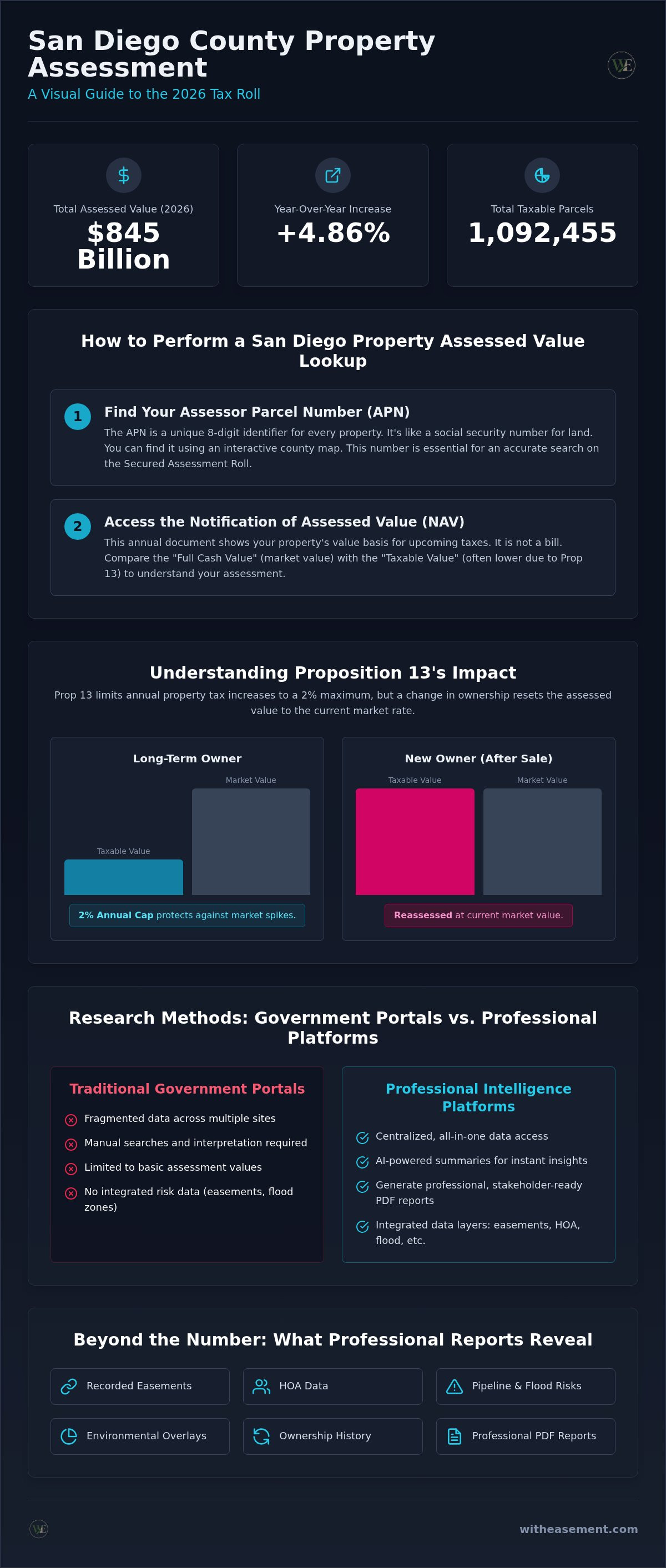
Did you know that the San Diego County assessment roll hit a record-breaking $845 billion in 2026? It's a staggering 4.86% increase from last year, yet most professionals still struggle to perform a quick San Diego property assessed value lookup without hitting a wall. You've likely spent hours clicking through fragmented government portals or squinting at technical records that don't make sense. It's frustrating to waste time on manual searches when your stakeholders expect fast, clear answers.
This guide changes that. Master the lookup process and transform raw county data into polished, professional land parcel reports in minutes. We'll show you how to bypass the friction of traditional research to get the exact insights you need. It's about turning complex data into a competitive advantage for your business and reducing the stress of property research.
We're covering everything from instant APN map access to integrated flood risk and HOA data. Discover how to use AI-powered summaries to visualize property intelligence and generate high-quality PDF reports that build trust with your clients. Let's unlock the full potential of San Diego's 2026 property data together and streamline your workflow for good.
Key Takeaways
- Master the San Diego property assessed value lookup by locating your APN and accessing the 2026 Secured Assessment Roll through streamlined digital tools.
- Understand the impact of Proposition 13 on 2026 valuations and how the San Diego County Assessor’s office manages record-breaking tax rolls.
- Compare manual government searches against professional intelligence platforms that centralize easements, HOA data, and environmental overlays.
- Learn to generate professional PDF property reports that transform raw data into clear, stakeholder-ready presentations.
- Use AI-powered summaries to instantly identify recorded easements or pipeline risks that could impact property development.
How to Perform a San Diego Property Assessed Value Lookup in 2026
Finding the value of a parcel in San Diego County requires a systematic approach. The process begins with the 2026 Secured Assessment Roll, which was officially certified on July 2, 2026. This roll documents a record $845 billion in taxable property across the region, reflecting a robust local market. When you perform a San Diego property assessed value lookup, you're accessing public records that break down value into two distinct categories: land and improvements. Land value represents the raw earth, while improvement value accounts for buildings, landscaping, or other structures on the site.
Always verify the current mailing address and ownership status on the record. This ensures you're looking at the most current data before making financial or development decisions. A property's tax assessment is the foundation for your annual bill, so accuracy is paramount for both buyers and sellers. By identifying these figures early, you can estimate future tax liabilities with precision.
Finding Your Assessor Parcel Number (APN)
Your search starts with the APN. In San Diego, this is a unique 8-digit identifier assigned to every piece of land. Think of it as a social security number for property. You can find this number by using an interactive county map; simply click on a parcel to reveal its identity and history. Don't confuse the standard APN with identification numbers found on supplemental or escape tax bills. These bills often appear after a change in ownership or the completion of new construction. They can lead to confusion if you're only looking for the base assessment. Using the correct 8-digit format ensures your San Diego property assessed value lookup returns the right results without delay.
Accessing the 2026 Notification of Assessed Value
Every year, the Assessor sends a Notification of Assessed Value (NAV) to property owners. This document isn't a tax bill, but it tells you what your upcoming bill will be based on. The 2026 roll reflects a 4.86% increase in total value countywide, a significant jump for the region's 1,092,455 parcels. When reviewing your NAV, look for the "Full Cash Value" versus the "Taxable Value." The taxable value is often lower due to Proposition 13 protections, which limit annual increases to 2% unless a change in ownership occurs. If the market's full cash value is actually lower than your taxable value, you may have grounds for an informal review or a formal appeal.
Understanding the San Diego County Assessor’s Role and Tax Rolls
The San Diego County Assessor, Recorder, and County Clerk office, led by Jordan Z. Marks, handles the monumental task of valuing over 1 million parcels. It's vital to distinguish between the Assessor and the Tax Collector. The Assessor determines the value of your property, while the Tax Collector handles the actual billing and payment processing. This valuation process creates the 2026 assessment roll, which recently reached a record $845 billion. For anyone conducting a San Diego property assessed value lookup, understanding this distinction helps you know who to contact for valuation disputes versus payment questions.
Property tax savings programs provide significant relief to eligible residents. In 2026, tax relief programs granted $346 million in savings across the county. This includes the Homeowners’ Exemption, which reduces the assessed value of a primary residence by $7,000. More specialized support exists for those who have served; currently, 22,564 disabled veterans benefit from specific tax relief programs in San Diego. These exemptions ensure that the tax burden remains manageable for vulnerable populations even as market values climb.
Proposition 13 and San Diego Property Taxes
Proposition 13 limits annual property tax increases to a maximum of 2% of the prior year's assessed value. This constitutional amendment is the reason why your San Diego property assessed value lookup might show a figure much lower than the current market price. While market values in neighborhoods like La Jolla or North County can skyrocket, the assessed value stays relatively stable for long-term owners. However, this stability resets upon a change in ownership. When a property sells, it's reassessed at its current market value, often resulting in a significant tax jump for the new buyer. Understanding California's Property Taxes is essential for predicting these long-term costs before you close a deal.
2026 San Diego Assessment Milestones
The 2026 tax roll provides the funding for essential local infrastructure, including schools, parks, and public safety. To protect your investment, the office offers an "Owner Alert" service that notifies you whenever a document is recorded against your property, helping prevent title fraud. If you disagree with your valuation, keep these dates in mind. The formal assessment appeal period runs from July 2 through November 30. There's no fee to file a formal appeal in San Diego County, making it an accessible option for homeowners seeking fairness. For a faster way to analyze these records and identify potential red flags, you can access centralized property intelligence that simplifies the research process.
Government Portals vs. Professional Property Intelligence Platforms
Navigating official county portals often feels like a digital scavenger hunt. To complete a comprehensive San Diego property assessed value lookup, you typically start at the Assessor's site for valuations. Then, you jump to the Tax Collector's portal for payment history. Finally, you might hunt through the Recorder's archives for easement documents. This fragmented process wastes valuable time and increases the risk of human error. Professional property intelligence platforms solve this by centralizing disparate data streams into a single, intuitive interface. You get an integrated view of easements, HOA data, and assessed values without clicking through five different tabs.
The goal isn't just to find a number; it's to understand the property's full context. While the county provides raw data, it lacks the analytical overlays that professionals need for due diligence. For a foundational look at the rules governing these offices, this California property tax overview explains the standard assessment cycle and the responsibilities of local officials. If you need a preliminary title report alternative San Diego, integrated platforms offer a significantly faster path to the same high-level insights.
The Hidden Cost of Manual Data Collection
Time is your most expensive resource. Jumping between different official county websites might seem free, but the minutes spent searching for a single APN across multiple databases add up quickly. Beyond the clock, there's the risk of missing critical details like recorded easements or flood zone overlays. Realtors and developers are moving toward integrated tools because they eliminate these blind spots. One search provides a complete picture, ensuring you don't overlook a pipeline easement or a pending special assessment that could derail a deal. Efficiency isn't just about speed; it's about the confidence that your data is complete.
Feature Comparison: WithEasement vs. County Kiosks
County kiosks and basic web portals are often tethered to rigid, outdated interfaces. They don't offer the mobile flexibility required for on-site research. A professional membership provides remote access, allowing you to pull up property intelligence from your phone while standing on the curb of a listing. AI summaries are the real game-changer here. Instead of manually reading through dense, technical property records, AI identifies key red flags and summarizes them in plain English. You also gain access to pipeline and utility overlay maps, which are essential for risk analysis but absent from basic public portals. When you're finished, you can generate a professional PDF report to share with stakeholders instantly.
Beyond the Number: What San Diego Land Parcel Reports Reveal
A San Diego property assessed value lookup provides a foundational figure, but that number is just one piece of a much larger puzzle. To truly understand a site's potential or limitations, you need to look at the specific data points that define its physical and legal boundaries. Professional land parcel reports synthesize this information, moving beyond tax valuations to reveal the hidden details that impact a property's marketability. A comprehensive property report San Diego offers a deep dive into these specifics, ensuring you aren't blindsided by restrictive covenants or environmental hazards after a deal is signed.
Modern reports utilize interactive map overlays to visualize critical risks. You can instantly see flood zone designations or identify if a high-pressure natural gas pipeline runs near the parcel boundary. This visual intelligence is vital for determining insurance requirements and ensuring the safety of future occupants. By analyzing these overlays alongside the assessed value, you gain a holistic view of the property's risk profile. It's about turning raw data into a narrative that helps stakeholders make informed, confident decisions without the guesswork.
Decoding Recorded Easements and Encumbrances
Easements are often the biggest surprise in real estate transactions. These recorded legal rights allow others to use a portion of the land for specific purposes, such as utility maintenance, sewer lines, or public access. If you plan to build a pool, an ADU, or an extension, a forgotten utility easement could result in a denied building permit. Identifying these encumbrances early is essential for accurate valuation and development planning. For a deeper look at how to find these records quickly, refer to our San Diego property easement search guide for pros. Understanding these restrictions ensures that your vision for the property is actually feasible under current county records.
HOA and Land Use Due Diligence
In San Diego's dense residential markets, Homeowners Association (HOA) data is a critical component of due diligence. A professional report identifies the governing HOA and provides management contact information, saving you hours of tracking down elusive board members. This is vital for verifying monthly dues, special assessments, and community rules that could impact a buyer's lifestyle or budget. Additionally, land use records help you verify the legal status of a parcel, ensuring it's zoned correctly for its intended use. Check out our San Diego HOA documents buyer’s guide for more specialized tips. Ready to streamline your research? You can generate a professional PDF property report in seconds and get all these insights in one place.
Streamlining Your Due Diligence with WithEasement Reports
Traditional research methods are too slow for the modern San Diego market. While a standard San Diego property assessed value lookup is a great starting point, the real value lies in how you synthesize that data for your clients. WithEasement streamlines this entire journey. It moves you from raw county data to a professional intelligence report in just a few clicks. Instead of manually cross-referencing maps and tax rolls, you get a unified view that highlights the most critical information instantly. It's about turning fragmented public records into a cohesive strategy for your business.
The platform's strength is its ability to handle the heavy lifting of data organization. You don't have to be a technical expert to understand complex land records. By centralizing values, easements, and environmental risks, you can focus on making deals rather than chasing paperwork. It's a tech-forward approach that respects your time and empowers you with high-level intelligence. You gain the clarity needed to navigate the $845 billion local tax roll with total confidence and professional precision.
AI-Powered Summaries: Research in Seconds
Reading through decades of recorded documents is a massive drain on your energy. Our platform uses advanced AI to summarize property records and flag potential issues like restrictive easements or pipeline proximity. The AI interprets dense legal descriptions and technical language, translating them into clear, actionable insights. This significantly reduces the cognitive load during high-volume research. You'll spend less time squinting at scanned PDFs and more time analyzing the actual risks. It ensures accuracy while dramatically speeding up your due diligence process, giving you a competitive edge in a fast-paced market.
Generating Client-Ready PDF Reports
Professionalism is built on the quality of information you provide. You can generate custom PDF property reports that include interactive map views, flood risk data, and the latest assessed values. These reports are designed to be shared with buyers, sellers, and other stakeholders to build immediate trust. You can customize the content to highlight specific concerns, such as HOA management details or pipeline overlays. Providing a clean, organized document shows you've done the work and understand the property's nuances. It's a simple way to elevate your brand and provide clear value to your clients without the manual effort.
Whether you're in the office or using our mobile-friendly San Diego interactive property map in the field, the data you need is always at your fingertips. Stop struggling with fragmented government portals and start using a platform built for professionals. Join WithEasement today to access the ultimate San Diego property intelligence platform and transform your workflow.
Master Your San Diego Property Intelligence
You now have the tools to navigate the record-setting $845 billion 2026 tax roll with precision. Performing a San Diego property assessed value lookup is just the first step. True due diligence requires a deeper look at easements, HOA encumbrances, and environmental risks that raw data often hides. By centralizing these disparate data points, you eliminate the friction of manual research and protect your deals from hidden red flags that could derail a closing.
It's time to stop jumping between fragmented government portals and start using a platform built for your success. WithEasement empowers you with AI-powered property summaries and interactive San Diego easement and flood maps that visualize risk instantly. You can generate professional PDF reports for your clients in seconds, ensuring every stakeholder has the clarity they need to move forward. Start Your San Diego Property Research with WithEasement today. Transform raw county data into your most valuable professional asset and lead the market with confidence.
Frequently Asked Questions
Where can I find the San Diego property assessed value lookup tool?
You can access the official tool via the San Diego County Assessor, Recorder, and County Clerk website. This portal allows you to search the 2026 Secured Assessment Roll using an address or APN. For a more integrated experience, professional platforms combine this data with environmental overlays and easement records. Having all this intelligence in one place saves you from navigating multiple government sites to find a single valuation for your due diligence.
How often are property assessed values updated in San Diego County?
Assessed values are updated annually on January 1, which serves as the lien date for the fiscal year. The Assessor certifies the roll each July, as seen with the record $845 billion total recorded in 2026. Values generally increase by a maximum of 2% per year under Proposition 13 protections. However, a change in ownership or new construction triggers a reassessment to the current market value, which often results in a supplemental tax bill.
Can I look up property records by address instead of APN?
Yes, you can perform a San Diego property assessed value lookup using a standard street address. Most online portals and professional intelligence tools allow you to enter the house number and street name to pull up the associated parcel. If the address search fails, you can use an interactive map to click on the specific lot and identify its 8-digit Assessor Parcel Number. This ensures you're viewing the correct records for the right property every time.
What is the difference between market value and assessed value in San Diego?
Market value is the price a buyer pays on the open market, while assessed value is the figure used to calculate property taxes. In San Diego, these numbers often diverge because Proposition 13 caps annual assessment increases. For example, the median estimated property value in 2026 is $956,085, but the median assessed value is only $518,158. The assessed value only resets to market levels when the property changes hands or undergoes major construction.
How do I find out if a San Diego property is in a flood zone?
You can check flood zone status by viewing FEMA’s Flood Insurance Rate Maps or using interactive property intelligence tools. Professional reports often include flood zone overlays directly on the parcel map, showing exactly where a property sits in relation to high-risk areas. This information is critical for determining insurance costs and development potential. Identifying these risks early helps you advise clients accurately and avoid expensive surprises during the escrow process or development phase.
Are San Diego County parcel maps available for public view online?
Yes, parcel maps are available through the Assessor’s online portal and interactive GIS maps. These maps show the boundaries and APNs for over 1 million parcels across the county. While the basic maps are free to view, obtaining a certified copy usually costs $2.00 per map. Professional platforms often integrate these maps with additional layers like pipeline locations and HOA boundaries to provide a more comprehensive view of the land without the administrative friction.
What is included in a WithEasement professional property report?
A WithEasement report centralizes critical data into a single PDF. You get the current result of your San Diego property assessed value lookup, APN maps, and interactive overlays for flood zones and pipelines. The report also includes HOA management contact information and AI-powered summaries of recorded documents. These summaries highlight red flags in plain English, making it easy to share high-level intelligence with stakeholders. It's a professional way to deliver due diligence quickly.
How do I check for recorded easements on a San Diego parcel?
You can check for easements by searching the Grantor and Grantee index at the County Recorder’s office or using a specialized property intelligence platform. These records reveal legal rights for utilities, sewer lines, or public access that could restrict building permits. Since manual searches through technical documents are time-consuming, many pros use AI summaries to quickly identify easement language. This ensures you don't overlook a restriction that could impact the property's development or total value.


