

A single unrecorded sewer line can turn a profitable San Diego real estate deal into a legal and financial quagmire. If you've ever spent hours clicking through broken links on government portals, you know that a sewer easement search San Diego is often anything but simple. You want to start construction or close a sale with confidence, not with the lingering fear of a hidden utility pipe waiting to be discovered by a backhoe.
It's frustrating when the data you need is buried under layers of complex plat maps and technical jargon. This guide changes that. You'll discover how to locate recorded sewer easements and navigate San Diego utility maps with professional efficiency. We'll walk through the exact steps to verify infrastructure, explain the latest 2026 fee structures for encroachment permits, and show you how to generate high-level property reports that protect your investment. By the end of this article, you'll have a clear path to finding the records you need without the headache of traditional research methods.
Key Takeaways
- Distinguish between public sewer mains and private laterals to clarify future maintenance and legal obligations.
- Use the Assessor Parcel Number (APN) to launch a targeted sewer easement search San Diego via official county records.
- Interpret complex GIS symbols to visualize active versus abandoned utility lines before breaking ground.
- Navigate San Diego City Council policies and the latest 2026 encroachment fees to avoid unexpected project costs.
- Access centralized pipeline overlays and professional PDF property reports to accelerate your due diligence process.
What is a Sewer Easement in San Diego?
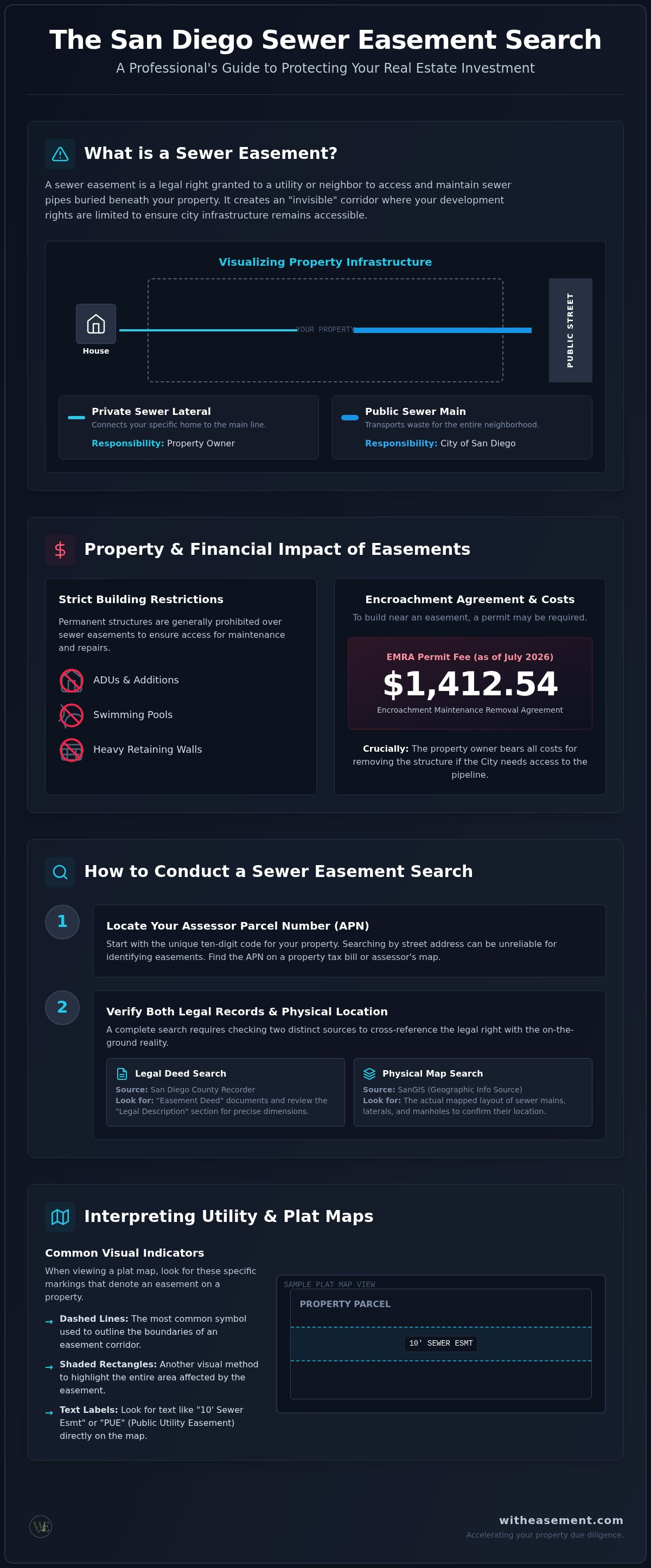
A sewer easement is a legal encumbrance that grants a utility provider or a neighbor the right to access and maintain pipes buried beneath your property. To understand What is a Sewer Easement in a practical sense, think of it as a designated corridor where your rights as a property owner are secondary to the city's infrastructure needs. Conducting a sewer easement search San Diego is the only way to visualize these "invisible" boundaries before you invest in a property or break ground on a project.
You'll typically encounter two types of infrastructure in these searches. Public sewer mains are the large, city-managed pipes that transport waste from entire blocks. In contrast, private sewer laterals are the smaller lines that connect your specific home to the main. While you own the lateral, the City of San Diego maintains the main. If that main runs through your backyard, an easement exists to ensure maintenance crews can reach it without delay.
Identifying these zones on a San Diego County plat map is a critical skill for any real estate professional. Easements usually appear as dashed lines or shaded rectangles cutting across a parcel. They often feature labels like "10' Sewer Esmt" or "PUE" (Public Utility Easement). If you see these markings, it means a portion of your land is effectively off-limits for permanent development.
The Difference Between Utility and Private Easements
Public Utility Easements (PUE) are the most common. These are recorded to allow the City of San Diego access to essential services like sewer, water, and power lines. Private sewer easements are different; they're contracts between two private property owners. For example, if a neighbor's sewer line must cross your lot to reach the street's main, a private agreement is recorded on your deed. You can find these specific details by pulling the recorded documents from the County Recorder's office using the property's legal description.
Why Sewer Easements Impact Property Value
Easements create strict limitations on how you use your land. You generally cannot build permanent structures like ADUs, pools, or heavy retaining walls over a sewer easement. If you must build near one, the City of San Diego often requires an Encroachment Maintenance Removal Agreement (EMRA). As of July 2026, the fee for an EMRA is $1,412.54. Even with this permit, you're responsible for the cost of removing the structure if the City needs to dig up the pipe. These restrictions can limit the future development potential of a lot, making a sewer easement search San Diego a vital part of your financial due diligence.
How to Conduct a Sewer Easement Search in San Diego
Finding accurate records requires a two-pronged strategy. You must verify the legal right recorded on the deed and the physical location of the pipes in the ground. A successful sewer easement search San Diego starts by identifying the correct jurisdiction. Records for properties within the City of San Diego are managed differently than those in unincorporated areas like Fallbrook or Lakeside. While the City's Development Services Department oversees urban utility maps, the County Recorder holds the legal authority on recorded encumbrances for the entire region.
Step 1: Locating Your San Diego APN
Your search begins with the Assessor Parcel Number (APN). This ten-digit code is the only way to ensure you're looking at the correct piece of land. Searching by street address often fails because property boundaries and utility corridors don't always align with mailing addresses. You can find your APN on a recent property tax bill or an assessor's parcel map. If you're handling multiple properties, using professional San Diego property easement search tools can help you pull this data instantly without manual lookup errors.
Step 2: Accessing the San Diego County Recorder
Once you have the APN, you must check the San Diego County Recorder's Grantor/Grantee index. You aren't just looking for a "sewer map." You're looking for an Easement Deed. Unlike a standard Grant Deed, which transfers ownership, an Easement Deed specifically carves out rights for a third party. Pay close attention to the "Legal Description" section. It defines the exact dimensions of the easement area, often referencing specific distances from property corners. If the description is vague, you'll need to cross-reference it with a recorded subdivision map or plat.
Physical infrastructure data is best found through SanGIS (San Diego Geographic Information Source). This interactive tool shows the actual layout of sewer mains, manholes, and laterals. It's an excellent way to see if a pipe physically exists where the deed says it should. For realtors who need to present this data clearly to clients, a WithEasement membership provides a centralized way to pull these disparate records into a single, professional PDF report.
Interpreting Pipeline Overlays and GIS Maps
A successful sewer easement search San Diego yields more than just a stack of paper deeds. It provides the geographic data needed to visualize underground risks. While the County Recorder’s office tells you that a right-of-way exists, a San Diego interactive property map shows you exactly where the pipes lie. Modern GIS (Geographic Information System) tools allow you to layer infrastructure data over satellite imagery, revealing the physical path of sewer mains across a parcel.
Interpretation is key. GIS maps use specific symbology to denote different types of infrastructure. Active lines are usually represented by solid, color-coded lines, while abandoned lines might appear as dashed or grayed-out segments. Don't assume an abandoned line is a green light for construction. Even if a pipe is no longer in use, the legal easement may still be active on the deed. You must also account for pipeline material and depth. Older clay pipes are more prone to collapse under the weight of new structures compared to modern PVC or ductile iron alternatives.
Remember that GIS data is for reference only. It's a digital representation of field surveys and city records, but it isn't a legal document. Discrepancies between a GIS overlay and the physical location of a pipe are common. Always verify digital findings with a physical locate service or a recorded plat map before finalizing any site plans.
Reading Sewer Main and Manhole Data
Sewer mains are the backbone of the city’s waste system. On a professional pipeline overlay, these appear as thick lines, often accompanied by labels indicating the pipe’s diameter. Manholes and cleanouts are marked by circular icons. If a manhole is located on your property, it indicates a high-priority access point for city crews. Obstruction of these points can lead to immediate code enforcement actions. Understanding these symbols helps you identify "exclusion zones" where permanent structures are strictly prohibited.
Sewer Lateral Locations vs. Main Lines
It's vital to distinguish between the city-managed main and your private sewer lateral. The lateral is the pipe connecting your building to the main line. In San Diego, the property owner is responsible for the maintenance of this lateral, even the portion located under the sidewalk or street. You can often find lateral connection points on city "as-built" drawings or lateral cards. If your lateral crosses a neighbor’s lot to reach the main, you'll need a private easement recorded on their deed to ensure your right to repair that line remains protected.
Risks and Due Diligence: Building Over Sewer Lines
Starting a renovation without a thorough sewer easement search San Diego is a gamble with your property's equity. While most easements are recorded clearly, "hidden" encumbrances exist. These often stem from old subdivision maps or unindexed utility grants that a standard title search might overlook. If you build a structure over an active sewer main, the City of San Diego has the legal authority to halt your project or demand the immediate removal of the obstruction.
San Diego City Council policies prioritize infrastructure access over private development. You generally cannot place permanent footings, ADUs, or swimming pools within an easement corridor. If you must build, relocating a sewer main is a complex engineering feat. The process involves high-level city approvals, environmental reviews, and significant construction costs that can easily exceed the value of the planned improvement. For realtors, these easements are material facts. Failing to disclose a sewer easement during a sale can lead to legal disputes and rescinded contracts, making diligent research a non-negotiable step in every transaction.
Encroachment Maintenance and Removal Agreements (EMRA)
If you want to install minor improvements like a fence, pavers, or landscaping over an easement, you'll likely need an Encroachment Maintenance and Removal Agreement (EMRA). This is a formal contract with the City of San Diego. As of July 2026, the fee for an EMRA when an encroachment already exists is $1,412.54. It's vital to understand that an EMRA is a "removal" agreement. If the Public Utilities Department needs to access the pipe for emergency repairs, they can remove your improvements at your expense. The city does not guarantee the preservation of any structure placed within these zones.
The Role of AI in Property Record Research
Modern technology has simplified the way we scan dense legal documents for red flags. Utilizing AI for real estate due diligence allows you to process hundreds of pages of recorded deeds in seconds. These tools identify critical "subject to" clauses and specific keywords that signal a sewer easement. Instead of manually reading every line of a Grant Deed, AI summarizes the legal jargon into actionable insights. This reduces the risk of missing a small, handwritten note on an old plat map that could otherwise derail a development project.
Don't leave your project to chance. You can start your property search today and generate a professional PDF report that highlights every recorded risk on your parcel.
Streamlining Research with WithEasement Membership
Conducting a sewer easement search San Diego manually involves toggling between the County Recorder’s index and city GIS portals. It’s a fragmented process that invites human error and wastes valuable billable hours. A WithEasement Membership fixes this by consolidating disparate data sources into a single, high-tech interface. You gain instant access to recorded easements, HOA data, and critical pipeline overlays specifically for San Diego County.
Our platform acts as a transparent facilitator between dense public records and your specific property needs. By integrating interactive maps with flood risk data and infrastructure locations, we perform the heavy lifting of organizing information. This allows you to focus on the results rather than the research. You’ll find that high-level property intelligence is finally within reach without the need for specialized training or expensive intermediaries.
Why Realtors Choose WithEasement
Speed is the primary competitive edge in the San Diego market. Realtors use our platform to eliminate time-consuming trips to the County Operations Center or the Development Services Department. Instead of waiting days for a clerk to pull records, you can perform deep due diligence during your initial listing presentation or buyer consultation. This immediacy builds trust and positions you as a knowledgeable local specialist.
Professionalism matters when presenting risks to clients. Our platform generates sleek, professional PDF Property Reports that summarize complex findings into digestible fragments. These reports include:
- AI Summaries that translate legal jargon into clear, actionable insights.
- Pipeline Overlays showing the exact path of sewer mains and laterals.
- Flood Zone Data to identify environmental risks before they become liabilities.
Getting Started with Your San Diego Property Search
Launching a search is simple and takes only seconds. You can enter an address or an APN to unlock comprehensive property intelligence instantly. Once you’ve identified a parcel, the interactive map displays all recorded maps and pipeline data in one unified view. There’s no need to guess which city bulletin applies or which GIS layer you need to activate. Everything is pre-configured for the San Diego market.
Our AI-powered summaries interpret recorded documents the moment you open them. This feature is essential for identifying "subject to" clauses that might be buried in a hundred-page deed. By streamlining your sewer easement search San Diego, you reduce the friction of property research and move toward closing with total confidence.
Secure Your San Diego Property Development Today
Navigating underground infrastructure doesn't have to be a manual struggle. By combining legal deed verification with modern GIS pipeline overlays, you protect your investment from the risks of hidden sewer mains. Whether you're managing a new construction project or facilitating a real estate sale, having the right data at your fingertips ensures you avoid costly encroachment fees and potential legal disputes. A professional sewer easement search San Diego is now faster and more accurate than ever before.
You don't have to spend hours at the County Operations Center or decoding complex city bulletins. Start your San Diego sewer easement search with WithEasement to access centralized county and city data instantly. Our platform is trusted by San Diego Realtors to deliver AI-powered property summaries and professional reports that simplify complex due diligence. Take control of your property research and build with total confidence.
Frequently Asked Questions
How do I find a sewer easement on my property in San Diego?
You can find a sewer easement by searching the San Diego County Recorder’s index using your Assessor Parcel Number (APN). Look for recorded documents like Easement Deeds or Grant Deeds that specify utility rights. For a visual check, use SanGIS to view interactive pipeline overlays. Professionals often use centralized platforms to pull both legal records and infrastructure maps into a single report; this saves time and reduces the risk of missing hidden encumbrances.
Can I build a fence or ADU over a sewer easement?
Building permanent structures like ADUs or pools over an easement is typically prohibited by city policy. You might get approval for minor improvements, like a fence or pavers, by obtaining an Encroachment Maintenance Removal Agreement (EMRA). As of July 2026, the EMRA fee is $1,412.54. Even with this permit, the City can remove your structure if they need to access the sewer line for emergency repairs or essential maintenance.
What is the difference between a sewer lateral and a sewer main?
A sewer main is a large, public pipe that services multiple properties and is maintained by the City of San Diego. A sewer lateral is the private line connecting your home’s plumbing to that main. Property owners are responsible for the maintenance and repair of their laterals, even the portion under the sidewalk. Identifying these lines during a sewer easement search San Diego helps clarify where your financial liability ends and the city's begins.
Are all sewer easements recorded with San Diego County?
Most legal easements are recorded with the County Recorder, but some "hidden" ones might only appear on old subdivision maps or unindexed utility grants. These older records can be difficult to find through a standard title search. It’s important to check both the physical infrastructure on GIS maps and the legal descriptions on recorded deeds. Missing an unrecorded easement can lead to significant legal and construction delays during your next property development project.
How much does it cost to search for sewer records in San Diego?
The cost depends on the depth of your research. The San Diego County Recorder charges small fees for document copies, while the City’s Development Services Department has specific fees for project submittals. For instance, a mapping fee of $12.16 is charged when plans or drawings are used for review. Many professionals prefer membership-based platforms to access these records efficiently, avoiding the logistical costs of multiple individual document requests and manual site visits.
What happens if a sewer line breaks under my house?
If a sewer main breaks within an easement on your property, the City of San Diego is responsible for the repairs. However, if the break occurs in your private sewer lateral, you are responsible for the costs. If you built a structure over the main with an EMRA, you must pay to remove and replace that structure so the city can reach the pipe. This is why verifying pipe locations before building is critical.
Who is responsible for maintaining a sewer easement?
The utility provider, such as the City of San Diego, is responsible for maintaining the sewer main and the infrastructure within the easement. As the property owner, you're responsible for maintaining the surface of the land, such as keeping it clear of large trees or permanent buildings that would block access. You must also ensure that city crews can reach manholes or cleanouts located within the easement area without obstruction.
How do I read a SanGIS sewer map?
To read a SanGIS map, look for color-coded lines representing sewer pipes. Solid lines usually indicate active mains, while dashed lines might represent abandoned infrastructure or easements. Circular icons typically denote manholes or cleanouts. When performing a sewer easement search San Diego, cross-reference these digital symbols with your recorded plat map. This ensures the physical pipes align with the legal boundaries described in your property’s deed or subdivision map.


