

Imagine pouring a concrete foundation only to have a utility company demand you tear it up because of a hidden pipe you never knew existed. It's a nightmare scenario that happens more often than most property owners realize. You shouldn't have to spend weeks at a county office just to check for easements before building. It's frustrating to deal with manual record searches and legal jargon that feels designed to confuse you.
You deserve a clear path forward for your construction project. In this guide, you'll discover how to identify hidden land restrictions and protect your project from costly legal delays. We'll show you how to use modern tools that turn complex data into a clear map of your buildable area. We'll explore how to use AI-powered summaries and professional property reports to verify HOA and utility restrictions in minutes instead of days. By the end, you'll have the intelligence you need to show contractors and lenders exactly where it's safe to break ground.
Key Takeaways
- Identify legal "no-fly zones" on your land to prevent forced demolition and protect your construction investment.
- Master a professional workflow to check for easements before building by searching recorded deeds and title report exceptions.
- Distinguish between utility and private restrictions that dictate exactly where you can and cannot safely break ground.
- Calculate property setbacks correctly to ensure your foundation stays a safe distance from hidden underground pipelines.
- Leverage AI-powered summaries and PDF reports to streamline communication with your contractors and lenders.
Why You Must Check for Easements Before Building
An easement is a legal right that allows a specific party to use a portion of your land for a designated purpose without owning it. You can find a comprehensive definition of easements to better understand the various legal frameworks involved. Building over these zones is a high stakes gamble. If you obstruct a utility line or a neighbor's access path, you face the risk of forced demolition. The easement holder has the legal authority to clear their path, and they usually do so at your expense.
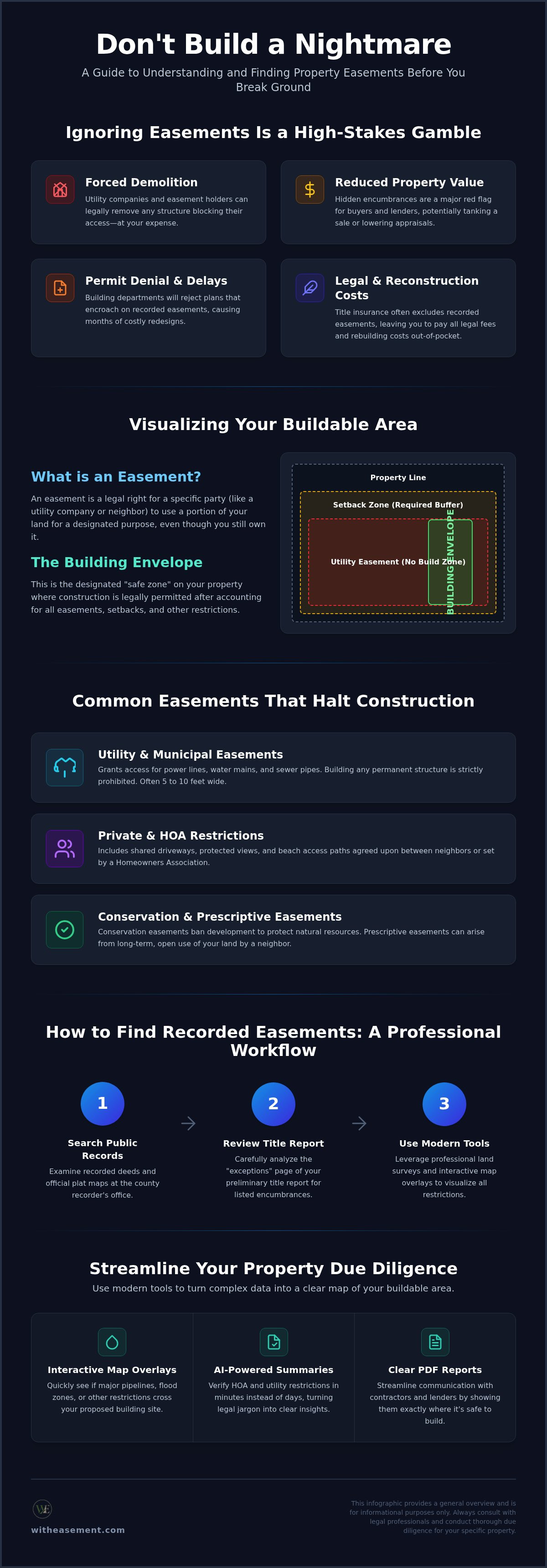
These restrictions also dictate your property's long term marketability. A home with a patio built over a sewer main is a liability, not an asset. Buyers and lenders look for clean titles. Hidden encumbrances can tank a sale or lead to significantly lower appraisals during the resale process. Your building envelope is the designated area on a property where construction is legally permitted after accounting for all setbacks, easements, and environmental restrictions.
The Legal Consequences of Building Encroachments
Understand the two primary categories of land use rights. Affirmative easements allow someone to perform an action on your land, such as driving across a shared path. Negative easements prevent you from doing something, like building a structure that blocks a neighbor's protected view. You must check for easements before building to ensure your project doesn't violate either type.
If you encroach on a utility zone, the consequences are swift. Utility companies require 24/7 access to maintain power lines or water mains. They can, and will, remove any shed, deck, or fence that blocks their equipment. Title insurance often won't protect you in these cases. If an easement was already recorded in public records when you bought the property, your policy likely excludes it. You are left footing the bill for legal fees and reconstruction costs.
Impact on Project Timelines and Permitting
Your local building department cross references your site plans with recorded maps before issuing any permits. If your proposed structure sits on a restricted zone, your application will be denied immediately. This triggers a cycle of redesigns and resubmissions that can stall your project for months. Setback requirements often extend beyond the easement itself. You can't simply build right up to the line; you must maintain a specific buffer zone for safety and maintenance access.
Preliminary research saves weeks of administrative headache. Identifying these "no-fly zones" early allows you to adjust your designs before you've spent thousands on architectural drawings. It turns a potential permit rejection into a predictable approval process. When you check for easements before building, you move from guesswork to professional certainty.
Common Types of Easements That Halt Construction
Not all easements appear as clear lines on a map. Some exist as hidden underground infrastructure, while others are invisible legal boundaries that restrict where you can place a fence or a garage. You must check for easements before building to avoid hitting high-pressure gas mains or blocking a neighbor's long-established access path. Understanding these specific categories helps you visualize the true buildable area of your lot.
Utility and Municipal Access Rights
Utility easements are the most frequent obstacles for new construction. These grant companies the right to run power lines, water mains, or sewer pipes through your land. Research indicates that utility easements shown on plats are often 5 to 10 feet wide. Building a permanent structure like a guest house or a pool within this zone is strictly prohibited. You must also distinguish between a standard easement and a "right of way." A right of way typically grants the public or a municipality the right to travel across a specific portion of your land, which can significantly impact where you place your driveway or front gate.
Locating underground gas pipelines is a safety priority. Building near high-pressure mains requires specific clearances that go beyond standard property setbacks. For projects requiring high precision, professionals rely on professional land survey standards to map these zones accurately. You can use interactive map overlays to quickly see if a major pipeline or flood zone crosses your proposed building site.
Private and Homeowners Association (HOA) Restrictions
Private easements often involve legal agreements between neighbors, such as shared driveways or protected beach access. If your project blocks these paths, you could face a lawsuit or a court order to remove the structure. Prescriptive easements are even more complex. These can "appear" over time if a neighbor uses a portion of your land openly and continuously for a period defined by state law. Conservation easements are another major hurdle. These are designed to protect natural resources and often ban all residential development on specific parts of a property to preserve the environment.
If you are in a managed community, your Homeowners Association (HOA) adds another layer of rules. CC&Rs can create "de facto" easements for common area maintenance or utility repairs that aren't listed on the general deed. It is vital to know what to look for in HOA documents to ensure your new construction doesn't violate architectural guidelines. Always check for easements before building to ensure your project remains compliant with both local laws and community standards.
How to Find Recorded Easements: A Professional Workflow
Identifying every encumbrance on a lot requires a systematic approach. You shouldn't rely on a single document to tell the whole story. A professional workflow combines legal document review with modern digital mapping to ensure no restriction is missed. To effectively check for easements before building, you must look beyond the standard deed and examine the full history of the land.
Start by reviewing your preliminary title report. Focus specifically on the "exceptions" schedule. This section lists every legal restriction the title company won't cover, which almost always includes recorded easements. Next, examine historical plat maps. These documents show original land divisions and often reveal access rights or utility corridors that don't appear in modern descriptions. For localized data, a comprehensive property easement search provides a baseline for understanding how regional records are structured.
Modern Digital Search vs. Traditional County Records
Traditional property research is notoriously slow. It often involves a physical trip to the County Recorder’s office, paying for parking, and waiting for staff to pull paper files. This manual process creates friction that can stall a project before it starts. Modern property intelligence platforms eliminate these barriers by providing instant access to digitized records from your desk. You can utilize interactive GIS maps to visualize pipeline and flood overlays, helping you spot potential overlaps with utility infrastructure immediately. This speed allows you to perform due diligence on multiple lots in the time it used to take to research one by using an interactive property map.
Generating Professional Reports for Stakeholders
Due diligence isn't just for your own peace of mind; it's a requirement for your project partners. Lenders and contractors need clear, documented proof of where they can safely work. PDF property reports provide a standardized format that makes this information easy to share. Instead of handing a contractor a 100-page stack of legal deeds, you can provide a concise summary that highlights the critical "no-build" zones. AI-powered summaries further streamline this by digesting complex legal jargon into actionable insights. This ensures that every stakeholder, from the architect to the lender, understands the land's limitations. When you check for easements before building using these professional tools, you build trust and reduce the risk of costly miscommunications on the job site.
Analyzing the Impact: Setbacks, Pipelines, and Risks
Identifying an easement is only the first step. You must analyze how these legal zones shrink your actual building footprint. A common mistake is assuming you can build right up to the edge of a restricted area. In reality, local building codes often require additional setbacks from the easement line itself to allow for safe maintenance and emergency access. You must check for easements before building to determine the exact boundary of your usable land.
| Easement Type | Typical Restriction | Building Impact |
|---|---|---|
| Utility | No permanent structures | Foundations must be clear of pipes/wires. |
| Drainage | No grading or fencing | Water flow must remain completely unimpeded. |
| Private Access | No barriers or gates | Shared paths must stay open for neighbors. |
| Pipeline | High safety clearances | Large "no-build" buffers for high-pressure lines. |
Some easements are no longer in use, such as old telegraph lines or abandoned access roads. These are known as "abandoned" easements, but they don't disappear automatically. You must go through a formal legal process called "vacating" to remove the encumbrance from your title. This requires coordinating with the easement holder and the local municipality to sign off on the release of their rights.
Visualizing Pipeline and Flood Overlays
Modern property intelligence requires looking at multiple data layers simultaneously. A utility easement might overlap with a flood zone, creating a complex set of construction requirements. For example, building near a high-pressure gas pipeline requires specific safety clearances that can exceed standard setbacks. Flood zone designations also dictate your foundation height and insurance costs. You can access interactive pipeline and flood overlays to see exactly how these environmental risks intersect with your property's legal restrictions.
When to Call a Professional Surveyor
Digital research is your best starting point, but it doesn't replace a physical "staked" survey for final construction. Use digital intelligence tools to create a roadmap for your surveyor. By identifying recorded easements and pipeline zones beforehand, you save the surveyor hours of manual research time. This preliminary work ensures that when they arrive on-site, they know exactly which corners to mark and which underground assets to verify. Digital data provides the "where," while the surveyor provides the legally binding "exactly here" for your foundation pour.
WithEasement: Streamlining Your Property Due Diligence
Manual property research is a relic of the past. You don't need to spend hours at a county office or wait weeks for a clerk to return your call. The WithEasement Membership provides a high-tech bridge between dense public records and your construction goals. It acts as a professional facilitator, performing the heavy lifting of organizing land data so you can focus on building. By simply entering an address or APN, you unlock recorded easements instantly, ensuring your project starts on solid legal ground.
Speed is your greatest asset in a competitive real estate market. You can check for easements before building across multiple potential sites in a single afternoon. This efficiency allows you to spot "no-build" zones early, preventing you from investing in architectural plans for a site that is legally restricted. Professional clarity replaces the friction of traditional due diligence, giving you the confidence to move forward with your project without the fear of hidden legal delays.
The Power of AI-Powered Property Summaries
Legal jargon in deeds can be intentionally confusing. Our platform utilizes advanced AI for real estate due diligence to digest hundreds of pages of land records into clear, actionable bullet points. This tool identifies specific "fine print" encumbrances that a human eye might miss during a rushed search. It turns complex legal descriptions into a simple list of restrictions, saving developers and realtors hours of manual reading. You get the facts you need to make a decision without needing a law degree to interpret the results.
Centralized Data for Faster Decision Making
Scattered data is the enemy of a successful build. WithEasement brings everything together into one single, intuitive dashboard. You can view recorded easements, HOA data, and flood risk overlays in a single map view. This centralized approach allows you to see how different restrictions overlap and impact your total buildable area. Having this data at your fingertips provides a significant competitive advantage, allowing you to secure permits and satisfy lenders faster than those relying on manual methods.
Communication is the final piece of the puzzle. Our platform generates professional PDF property reports that you can share directly with contractors, architects, and lenders. These reports build immediate trust by providing a standardized, authoritative view of the property's limitations. They serve as a clear roadmap for your team, ensuring everyone stays away from restricted utility lines or protected access paths. When you use these tools to check for easements before building, you eliminate the risk of miscommunication on the job site. Start your search today with a WithEasement Membership and take the guesswork out of your property due diligence.
Secure Your Build with Professional Property Intelligence
Breaking ground without full property intelligence is a risk you don't need to take. You've seen how hidden utility lines and private access rights can stall permits or lead to forced demolition. It's essential to check for easements before building to define your true construction envelope. By identifying these legal restrictions early, you protect your investment and save months of redesign work.
You can now move from manual record searches to instantaneous data visualization. Use an interactive map with pipeline overlays to spot environmental and infrastructure risks in seconds. AI-powered easement summaries and professional PDF property reports ensure that every stakeholder has the same clear roadmap. You have the power to unlock these insights without specialized training or expensive intermediaries. Take control of your due diligence and ensure your foundation is built on certain data.
Unlock instant property insights with a WithEasement Membership and start your next project with total confidence.
Frequently Asked Questions
How do I check for easements on my property for free?
You can visit your local County Recorder's office or search their online public records portal. Most counties allow you to view index records for free, though they often charge a fee to download or print the actual deed documents. This manual process is time-consuming and requires you to interpret complex legal descriptions yourself. For a more efficient alternative, professional platforms consolidate these records into a single, searchable dashboard for faster results.
Can a property owner build on a utility easement?
Generally, no. You cannot build permanent structures like houses, garages, or pools on a utility easement. These zones must remain clear so utility companies can access underground pipes or overhead lines for maintenance. While you might be allowed to install removable items like fences or gardens, you do so at your own risk. If the utility company needs access, they can remove your property without compensation or repair.
What happens if I build over an easement without knowing?
Building over a restricted zone can lead to forced demolition and significant financial loss. If you fail to check for easements before building, the easement holder has the legal right to remove any obstruction at your expense. You may also face permit denials or trouble selling the property later. Title insurance often excludes coverage for recorded easements, meaning you'll be personally liable for all legal and reconstruction costs.
Do all easements show up on a property survey?
Most recorded easements appear on a professional boundary survey, but not all of them. Prescriptive easements or easements by necessity might not be documented until a court ruling occurs. A standard survey typically focuses on recorded plats and deeds. To ensure full coverage, you should cross-reference survey data with a comprehensive property intelligence report that includes pipeline overlays and historical land records to identify potential unrecorded usage.
How long does a typical easement search take online?
A manual search through county databases can take several hours or even days if records aren't fully digitized. You have to navigate clunky interfaces and search by document numbers or grantor names. In contrast, using a centralized property intelligence platform allows you to find results in seconds. By searching by address or APN, you get instant access to recorded easements, HOA data, and environmental risk overlays in one view.
Can an easement be removed from a property title?
Yes, but it requires a formal legal process. An easement can be removed through a release signed by the easement holder or by vacating the easement via a government petition. This usually happens if the easement is abandoned or no longer serves its original purpose, such as an old telegraph line. You must record the termination document with the county to officially clear the restriction from your property title records.
What is the difference between a setback and an easement?
A setback is a local zoning rule that dictates how far a building must be from the property line. An easement is a specific legal right granted to another party to use a portion of your land. While setbacks apply to the entire perimeter of your lot, easements are often localized to a specific strip or area. You must account for both when planning your build, as they combine to define your buildable area.
How do I find out who owns a specific easement on my land?
You can find the owner by reviewing the recorded easement deed or the exceptions section of your title report. These documents specify the grantee, which is the person or company that holds the right to use your land. Common owners include municipal utility departments, private neighbors, or telecommunications companies. Professional property reports can help you quickly identify these parties and provide AI-powered summaries of the specific rights they hold.


