

What if your $350,000 ADU investment was blocked by a hidden line on a map you never even saw? In San Diego's 2026 housing market, an easement check for ADU San Diego projects is the ultimate kill-switch that most homeowners overlook until it is too late. You might have the perfect backyard and a generous budget, but a forgotten utility line or a neighbor's right-of-way can instantly halt your plans before the first shovel hits the dirt.
It's frustrating to feel like you're gambling with permit fees and architect costs while waiting for slow, manual record searches at City Hall. We know that navigating complex land records feels like an intimidating hurdle that slows your momentum. This guide will show you how to identify hidden property easements that could block your project and how to conduct a professional-grade search in minutes. You'll gain instant clarity on building setbacks and the certainty that your project is feasible before you invest in expensive construction plans.
Key Takeaways
- Performing an easement check for ADU San Diego projects is the only way to identify "no-build" zones that standard setbacks don't cover.
- Distinguish between utility easements and neighbor access rights to understand how they impact your ADU's footprint and utility connections.
- Replace slow manual searches at the County Assessor with instant digital lookups to get property intelligence in seconds.
- Use an Assessor Parcel Number (APN) to pull recorded documents and verify feasibility before paying for expensive architectural plans.
- Generate professional PDF property reports that streamline your permit application process and provide certainty to developers and realtors.
Why an Easement Check is the First Step for Any San Diego ADU Project
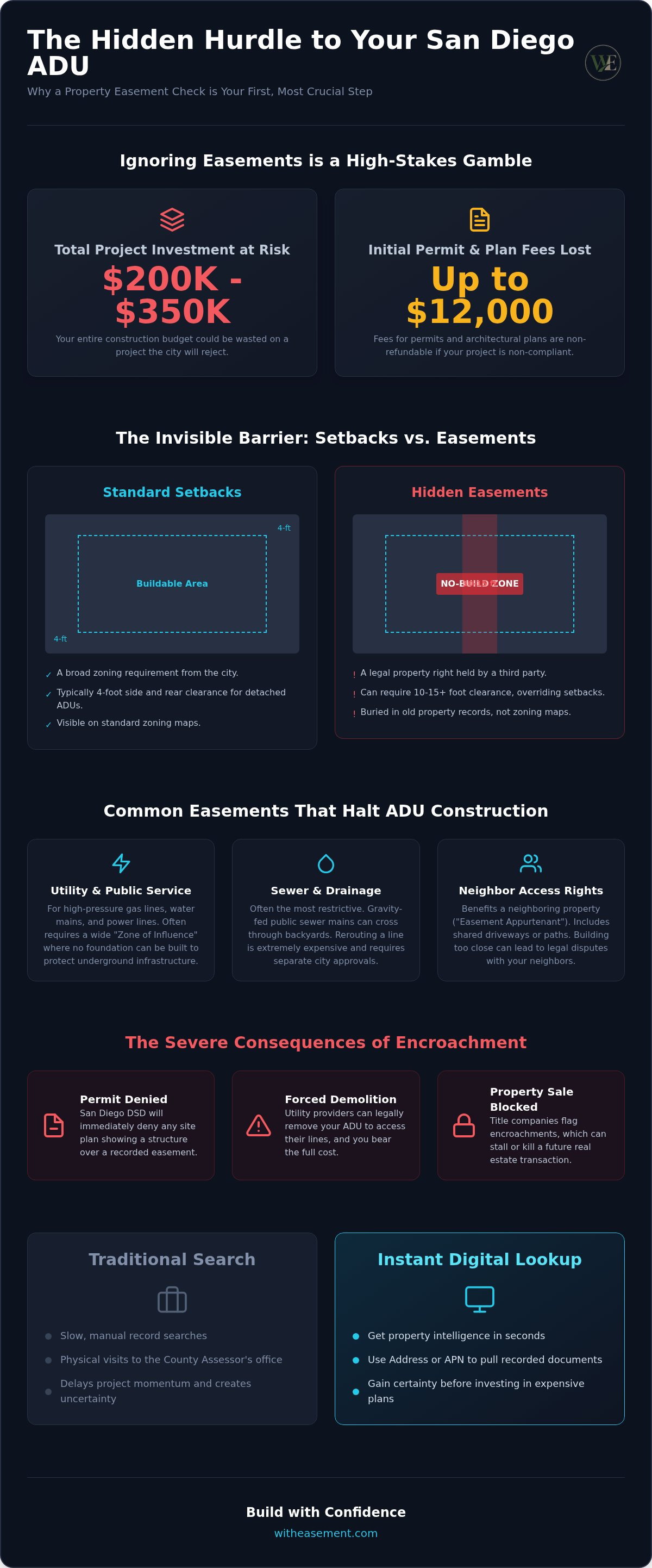
San Diego's ADU market reached a fever pitch in 2026. With thousands of units permitted in recent years, homeowners are squeezing structures into tighter spaces than ever before. An easement check for ADU San Diego projects is now the primary feasibility gate. You cannot rely on general zoning maps alone. Easements act as invisible barriers that can shrink your buildable lot in an instant. Skipping this search means you're gambling with a construction investment that often ranges between $200,000 and $350,000. Start with the data so you don't waste money on plans that the city will eventually reject.
The Difference Between Setbacks and Easements
Setbacks are broad zoning requirements. In San Diego, detached ADUs generally require 4-foot side and rear setbacks. Understanding property easements is more complex because these are specific rights tied to the land itself. A setback is a city rule; an easement is a legal property interest held by a third party. If a utility company has a recorded easement for a high-pressure gas line running through your backyard, that 4-foot setback is irrelevant. The easement might require a 10-foot or 15-foot clearance. These details are often buried in old recorded documents rather than modern zoning maps.
The Consequences of ADU Encroachment
Encroaching on an easement is a high-stakes mistake. If you build over a utility line, the service provider can legally remove your ADU to perform repairs. You'll be responsible for the demolition costs and the loss of the structure. Additionally, the San Diego Development Services Department (DSD) uses easement records as a checklist for permit approval. If your site plan shows a structure over a recorded easement, your application will be denied immediately. This results in the loss of your initial permit fees, which can reach $12,000 for larger units. It also complicates future property sales. Title companies will identify the encroachment during a search, which can stall or kill a real estate transaction until the structure is removed or the title is cleared.
Understanding the Types of Recorded Easements That Limit ADU Construction
Identifying every legal restriction on your parcel is the core of a successful easement check for ADU San Diego projects. Most residential lots in the county contain at least one Public Utility Easement (PUE). These are typically "Easements in Gross," which means they belong to an entity like SDG&E or the City of San Diego rather than a specific neighbor. In contrast, "Easements Appurtenant" benefit a neighboring property, such as a shared driveway or a path to a canyon. While you might see a physical power pole, many easements are for underground infrastructure that remains invisible until you start digging.
You must also distinguish between recorded and implied easements. A recorded easement is documented in the county's official records and appears in your title report. An implied easement might exist based on decades of historical use, even if the paperwork is missing. Identifying these early protects you from legal challenges after your ADU is built. To see these layers clearly, you can use a Property Easement Search to pull recorded documents instantly and verify exactly where these rights exist.
Utility and Public Service Easements
Building over a high-pressure gas line or a main water trunk is strictly prohibited. Beyond the physical pipe, you must respect the "Zone of Influence." This is a structural buffer where the weight of your ADU foundation could potentially damage underground utilities. San Diego inspectors require specific clearances to ensure maintenance crews can access lines without undermining your new unit. Use modern pipeline overlays to visualize these "no-build" zones before you finalize your site plan. This step prevents the city from flagging your project during the initial design review.
Sewer and Drainage Easements
Sewer lines are often the most restrictive factor for ADU placement in San Diego's varied topography. Many systems rely on gravity-fed lines that run through private backyards to reach the main street connection. A dedicated search identifies whether a public main crosses your property. If an ADU footprint overlaps a sewer easement, you face a choice. You can either move the ADU to a clear area or pay to reroute the line. Rerouting is often expensive and requires additional city approvals; therefore, early detection is the best way to keep your project on budget.
Comparing Traditional Title Searches vs. Instant Digital Easement Lookups
The traditional easement check for ADU San Diego projects is a relic of the past. For decades, homeowners had to visit the County Assessor in person or wait weeks for a title company to return a preliminary report. These manual methods are slow, expensive, and prone to human error. In 2026, the San Diego real estate market moves too fast for mail-in requests or physical office visits. Modern professionals now use digital-first platforms to access recorded data instantly. This shift replaces dense, 40-page legal documents with clear, actionable summaries. Instead of deciphering 1950s legalese, you get immediate insights into whether your ADU footprint is clear of obstructions.
Realtors and developers are rapidly moving toward property intelligence platforms for faster due diligence. Speed is the new currency in local construction. Performing a comprehensive easement check for ADU San Diego properties shouldn't take weeks of back-and-forth communication. AI-powered summaries act as a bridge between raw data and decision-making. These tools extract essential "no-build" clauses for you, allowing you to move from curiosity to construction certainty in a single afternoon. This efficiency empowers you to make offers or sign contracts with total confidence in the land's potential.
The Limitations of Preliminary Title Reports
Preliminary title reports are often incomplete snapshots in time. They typically reflect the state of the property on the day it last changed hands. If a utility company recorded a new easement last month, an older report won't show it. Furthermore, interpreting these records is difficult without a visual reference. You're often left guessing where a "line 10 feet from the western boundary" actually sits on your lawn. This lack of precision can lead to costly design errors. For a more reliable and updated approach, follow a San Diego property easement search that utilizes live county data to verify current restrictions.
The Power of Interactive Map Overlays
Interactive maps change the game for ADU feasibility by merging disparate data sets into one view. You can toggle layers for pipeline overlays, flood zones, and assessed values simultaneously. This allows you to run "what-if" ADU placement scenarios without hiring a surveyor first. If you move the ADU five feet to the left, does it clear the sewer line? This level of visualization is impossible with a flat PDF or a paper parcel map. Use a San Diego interactive property map to see exactly how these physical and legal constraints overlap in real-time. This visual clarity ensures your site plan is accurate before it ever reaches the city's desk.
Step-by-Step: How to Perform a Professional Easement Search by Address or APN
Executing a professional easement check for ADU San Diego properties requires a shift from general search engines to specialized data tools. Accuracy starts with identifying your property with precision. While a street address works, using the Assessor Parcel Number (APN) is the gold standard for verifying legal boundaries. This unique identifier ensures you are pulling records for the specific parcel rather than a general neighborhood area. It is the most reliable way to begin your feasibility study.
Once you have your identifier, use a dedicated property intelligence platform to pull all recorded documents. These platforms link your APN directly to digital archives. You can then apply specific overlays to visualize physical and legal constraints. Toggling layers for high-pressure pipelines, flood zones, and HOA boundaries allows you to see the full picture of your buildable area. This layered approach to an easement check for ADU San Diego reveals obstacles that a standard site survey might miss.
Locating Your APN in San Diego County
The APN is the "social security number" for your land. It tracks every legal event, grant, and restriction tied to your property over time. Using an APN lookup tool allows you to find parcel boundaries instantly. This precision is essential for properties with irregular shapes common in San Diego's hills. Check this guide to Find easements by APN San Diego to get started with your search.
Interpreting AI Property Summaries
Historical deeds are often filled with dense legalese that is difficult to parse. Using AI for real estate due diligence San Diego allows you to scan documents for keywords like "easement" or "restriction" instantly. The AI extracts building restrictions into a clear format, highlighting exactly who holds the rights to your land. Always verify these findings against the original PDF to ensure total accuracy before you begin construction.
After verifying the data, generate a professional PDF report to share with your project team. This document consolidates parcel maps, AI summaries, and recorded deeds into a single file. Sharing this with your architect or contractor during the initial consultation prevents expensive redesigns later. It provides the proof of feasibility needed to move forward with your project with total confidence. To get your report today, start your property easement search on our platform and unlock your land's potential.
Streamlining Your ADU Due Diligence with WithEasement Property Intelligence
WithEasement serves as the centralized hub for San Diego property data, removing the friction from complex land research. A WithEasement Membership provides realtors and developers with the professional-grade tools needed to verify land use in seconds. Instead of chasing records across multiple government departments, you access recorded easements, pipeline overlays, and HOA data in one interface. This approach eliminates the guesswork that often stalls ADU projects. It empowers you to provide immediate, accurate answers to clients and contractors without waiting for traditional title reports.
Our platform values your time by focusing on effortless efficiency. Performing an easement check for ADU San Diego projects shouldn't be a multi-week ordeal. By organizing dense public records into a user-friendly register, we've done the heavy lifting for you. You get the technical accuracy of a title search with the speed of a modern high-tech utility tool. This certainty allows you to move forward with construction plans or property offers with total confidence in the project's feasibility.
Professional PDF Property Reports
Generating a PDF Property Report is the final step in a professional easement check for ADU San Diego projects. These reports consolidate every critical data point into a single, downloadable document. You get a clear view of recorded easement details, pipeline overlays, and flood risk zones. Having this data in a professional format builds immediate trust with buyers, lenders, and city inspectors. It proves that you've conducted thorough due diligence and identified any potential "no-build" zones. This documentation is an essential part of any permit application package, ensuring your architect has the most accurate site information from day one.
Beyond Easements: HOA and Flood Risk
An easement check is only the beginning of your due diligence. Accessing San Diego HOA documents is the second most important step for any ADU project. While state laws have limited HOA power over ADUs, specific community architectural guidelines still impact your design and placement. Ignoring these rules can lead to expensive legal disputes or required modifications after construction begins.
Assessing flood risk is equally vital for your budget. If your property sits within a designated flood zone, you may face "substantial improvement" requirements. These regulations can trigger mandatory upgrades to the primary dwelling if the ADU cost exceeds a certain percentage of the home's value. Our interactive map includes flood zone overlays, allowing you to visualize these risks instantly. Identifying these constraints early prevents the hidden costs that often derail San Diego ADU projects.
Protect Your ADU Investment with Instant Property Intelligence
Securing your property's future starts with understanding its legal boundaries. An easement check for ADU San Diego projects is no longer a luxury; it's a necessity in a crowded 2026 market where buildable space is at a premium. You've learned how recorded easements can override standard setbacks and why digital lookups are the only way to keep pace with modern construction timelines. Relying on outdated title reports or slow manual searches at the County Recorder puts your project at risk of costly redesigns or permit denials.
WithEasement acts as your knowledgeable local specialist, providing a centralized hub for San Diego County recorded easements and HOA data. Our platform offers AI-powered property summaries for instant clarity and interactive pipeline and flood risk overlays to help you visualize every constraint. Don't let a hidden utility line or a forgotten property right stall your progress.
Start your San Diego easement search today with WithEasement to generate professional PDF reports that build trust with lenders and architects alike. Your ADU project is a significant investment; starting with the right data ensures you build with total certainty.
Frequently Asked Questions
Can I build an ADU over a utility easement in San Diego?
No, you cannot build a permanent structure over a utility easement. These zones must remain clear for service providers like SDG&E to access, maintain, or repair underground lines. If your site plan shows an ADU encroaching on a recorded utility easement, the San Diego Development Services Department will deny your permit application. Building over these lines also risks future demolition if emergency repairs become necessary.
How do I find easements on my property by address?
You can find easements by entering your address into a specialized property intelligence platform. These tools link your physical location to the San Diego County Assessor records instantly. This allows you to view interactive maps with pipeline and flood risk overlays. Conducting a digital easement check for ADU San Diego projects is significantly faster than visiting the County Recorder office or waiting for a title company to mail documents.
What is the difference between a setback and an easement for an ADU?
Setbacks are general zoning requirements that apply to all properties in a specific zone, while easements are legal rights tied to your specific parcel. For example, San Diego detached ADUs usually require 4-foot setbacks. However, if a utility company holds a 10-foot easement on your property line, that easement overrides the standard setback. You must respect the larger "no-build" zone to ensure legal and structural compliance.
Will a sewer easement prevent me from building a detached ADU?
A sewer easement will prevent construction if the ADU footprint overlaps the recorded line or its required structural buffer. Gravity-fed sewer lines often run through private backyards to reach the main street connection. If your proposed building site sits on top of these pipes, you must either relocate the ADU or pay for a costly line reroute. Identifying this early prevents expensive delays during the permit review process.
How much does a professional easement search cost in 2026?
The cost of an easement search depends on the method you choose for your research. Accessing your existing preliminary title report from your home purchase is free, but it may be outdated. Searching the San Diego County official records manually often involves fees for downloading individual documents. Modern property intelligence platforms typically provide access through membership models that consolidate recorded easements, HOA data, and flood risk overlays into one professional report.
Does an easement show up on a property survey?
An easement should appear on a professional property survey if the surveyor researched the title records before mapping the land. However, a physical survey only shows visible markers. A comprehensive easement check for ADU San Diego projects is necessary to identify underground utilities or legal access rights that aren't physically marked on the ground. Combining a legal record search with a physical survey provides the most accurate feasibility data.
Can I terminate an easement to build my ADU?
Terminating an easement is possible but difficult and requires the formal consent of the easement holder. You would need to negotiate a "quitclaim deed" or an "abandonment" with the utility company or neighbor who holds the rights. This process is often slow, requires legal assistance, and is rarely successful if the easement still serves a functional purpose. It's usually faster to design your ADU around the existing restriction.
How do I find my San Diego Assessor Parcel Number (APN)?
You can find your Assessor Parcel Number (APN) on your annual property tax bill or your preliminary title report. If you don't have those documents, use an online APN lookup tool by entering your property address. The APN is a unique identifier that acts as the "social security number" for your land. It's the most accurate way to pull recorded deeds and verify building restrictions on our platform.


