

How much of your week is lost to the "paperwork abyss" of dense legal descriptions and handwritten deed notes? For most real estate professionals, manual document review isn't just tedious; it's a bottleneck that risks missing critical flood zones or hidden utility easements. You can now summarize property records AI-style to transform dense data into actionable intelligence in seconds. What used to take a full afternoon of squinting at scanned PDFs can now be handled in moments.
We know the pressure of needing to be 100% accurate while moving at the speed of the market. It's frustrating when a simple due diligence task turns into a multi-hour deep dive. This guide explores how AI-powered summarization transforms messy data into professional reports. You'll learn how to reduce your research time from hours to minutes, identify land use constraints with precision, and generate polished PDF reports that keep your clients informed and impressed. We will walk through the tools and strategies that turn complex public records into your greatest competitive advantage.
Key Takeaways
- Learn how to summarize property records AI tools to transform dense legal descriptions into actionable intelligence in seconds.
- Discover how to identify "hidden" easements and land use constraints that manual reviews often overlook.
- Shift from fragmented county portals to a centralized intelligence platform for one-click fact extraction across all recorded documents.
- Reduce your due diligence time from hours to minutes while maintaining absolute professional accuracy.
- Master the creation of professional PDF reports and interactive map overlays to provide clients with immediate, high-level property insights.
What is AI Property Record Summarization?
Property records are notoriously difficult to navigate. They often consist of hundreds of pages of scanned documents, legal jargon, and fragmented notes. AI property record summarization uses Large Language Models (LLMs) to extract and condense the material terms from these files instantly. This technology matters because traditional Land registration systems focus on archiving data rather than making it searchable or readable. Without AI, you're forced to hunt for critical risks like hidden encumbrances or restrictive legal descriptions manually. This process is slow, expensive, and prone to human error.
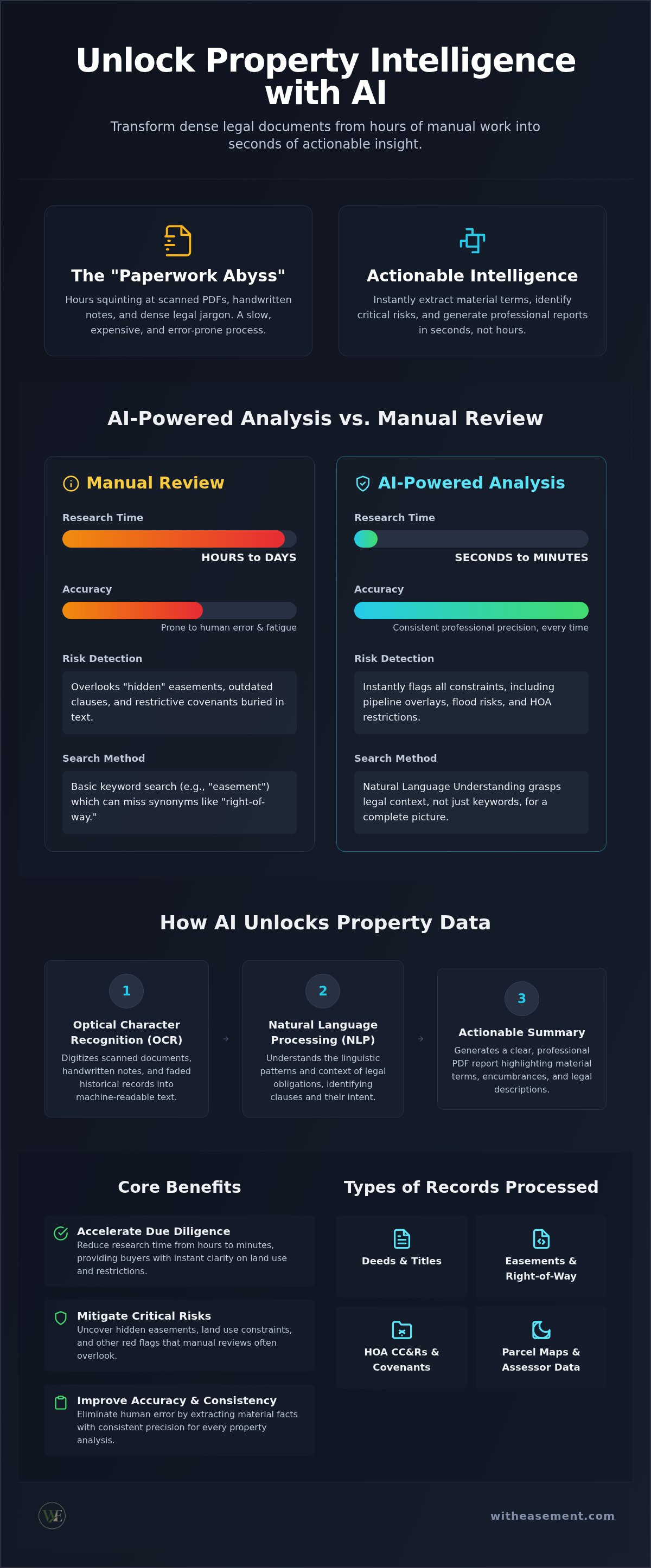
The industry is currently moving away from basic keyword searches toward true natural language understanding. In the past, you might search a PDF for the word "easement" and hope you didn't miss a synonym like "right-of-way." Modern AI doesn't just look for specific words; it understands the context of the entire document. It can distinguish between a utility easement that ended ten years ago and a permanent restriction that limits where a client can build. This shift allows real estate professionals to gain a deep understanding of a property without spending hours in the "paperwork abyss."
The Technology Behind the Summary
Natural Language Processing (NLP) identifies specific clauses in a deed by recognizing the linguistic patterns of legal obligations. It understands the intent behind a sentence rather than just matching characters. Optical Character Recognition (OCR) performs the heavy lifting for historical documents, digitizing handwritten notes or faded scans so they can be analyzed by the LLM. AI property summarization is a professional-grade utility that translates complex land records into clear, actionable intelligence.
Types of Records AI Can Process
The scope of this technology covers every document that impacts a property's title or use. It handles recorded easements and right-of-way agreements that could prevent future development. It also parses HOA CC&Rs, extracting fee schedules and restrictive covenants that might deter a potential buyer. Beyond text, it integrates assessor data and parcel maps to provide a holistic view of the land. When you use a tool to summarize property records AI models can now surface encumbrances and legal descriptions that previously required a title officer's specialized expertise. This ensures that no "hidden" risk goes unnoticed during the due diligence phase.
The Benefits of Using AI to Summarize Property Records
Efficiency is the lifeblood of real estate. When you choose to summarize property records AI tools, you turn a three-hour manual research task into a thirty-second summary. This isn't just about saving time; it's about gaining a competitive edge. Most professionals still dig through fragmented county portals or wait days for third-party title searches. You can bypass that friction entirely. By automating the extraction of material terms, you focus on closing deals rather than deciphering legalese.
Risk mitigation is the second major pillar of this technology. Manual reviews often overlook "hidden" easements buried on page fifty of a complex title report. These oversights lead to expensive legal disputes or cancelled contracts. AI identifies these constraints instantly. It flags pipeline overlays, flood risks, and HOA restrictions in one centralized view. This allows you to spot red flags before they become liabilities. Accessing diverse data types in a single dashboard ensures that no critical detail is left to chance.
Accelerating Professional Due Diligence
Realtors use these tools to prepare for listings with unprecedented speed. By integrating AI for real estate due diligence, you provide buyers with instant clarity on land use. They don't have to wait for a title officer to explain a right-of-way agreement. You deliver that value during the first showing. This transparency builds trust and empowers buyers to make confident decisions. It transforms you from a simple facilitator into a tech-forward innovator who values the client's time.
Improving Accuracy and Consistency
Standardization protects your brokerage from liability. Human error is inevitable when reading complex legal descriptions under a tight deadline. AI eliminates that variance by extracting material facts with consistent precision every time. This level of detail is supported by academic research on AI in property valuation, which highlights how automated systems reduce bias and improve data reliability. Generating professional PDF property reports ensures that every client receives the same high standard of intelligence. You can start building these reports today with a WithEasement Membership to streamline your entire research workflow and deliver professional results in seconds.
AI vs. Manual Property Record Search
Traditional property research is a fragmented, time-consuming slog. You often start by navigating outdated government websites or visiting a county recorder's office in person. This manual approach is slow and inherently restrictive. When you choose to summarize property records AI technology performs the heavy lifting by pulling material facts from every recorded document simultaneously. This eliminates the need to cross-reference disparate files yourself. It turns a chaotic stack of paperwork into a structured, readable format that highlights only what matters most to your transaction.
Manual searches carry a high risk of oversight. A researcher might catch the primary utility easement but miss a secondary access right-of-way buried in an old deed. These "hidden risks" create significant liability for realtors and buyers. Human eyes get tired after reading fifty pages of legalese; AI does not. From a financial perspective, the math is simple. Paying for a professional researcher's hourly rate for every listing is unsustainable for a growing business. A tech-forward membership provides predictable costs and instant results, ensuring you never miss a critical land use constraint again.
The Workflow Comparison
The difference in efficiency is stark. A manual workflow involves searching for a parcel, downloading multiple PDFs, reading through complex language, and manually highlighting key sections. This process typically takes two to four hours per property. With an automated system, you search the address and receive a summary and a PDF report in two to four minutes. You can also visualize these constraints through interactive property maps that overlay legal data onto a physical view of the land. This allows you to see exactly how an easement or pipeline impacts the buildable area of a lot.
Data Depth and Reliability
Reliability comes from the ability to cross-reference multiple data sources simultaneously. A human researcher might focus on the deed but forget to check the latest flood maps or pipeline locations. Using a tool to summarize property records AI ensures you don't have these blind spots. It parses everything from historical easements to modern HOA documents to ensure total transparency. It identifies material facts like capital improvement assessments or rental restrictions that are often buried in fine print. This level of automated intelligence is why professional realtors are shifting toward these platforms to protect their clients and their reputation.
How to Implement AI Summaries in Your Real Estate Business
Adopting new technology shouldn't be a hurdle. Integrating automated intelligence into your workflow is a straightforward process that yields immediate results. You don't need a background in data science to get started. Follow these five steps to modernize your due diligence and provide better service to your clients.
- Step 1: Identify the property. Use a standard street address or an APN (Assessor Parcel Number) to locate the specific land area.
- Step 2: Access recorded documents. Use a centralized intelligence platform to pull all historical deeds, maps, and agreements related to that parcel.
- Step 3: Run the summarization. When you summarize property records AI tools extract the material terms and land use constraints instantly.
- Step 4: Verify the findings. Use the provided source links to cross-reference the summary against the original recorded deed or map.
- Step 5: Export your report. Generate a professional PDF report to share with stakeholders, buyers, or listing clients.
This workflow replaces hours of manual research with a repeatable, high-speed system. It allows you to move from initial curiosity to deep property insight in a single sitting. You'll spend less time in the "paperwork abyss" and more time closing deals. To start optimizing your workflow, you can join the WithEasement Membership and access these tools today.
Best Practices for AI Verification
Think of AI as your "first pass" specialist. It's designed to flag critical issues like utility easements or pipeline overlays that might otherwise go unnoticed. Professional oversight remains essential. Always link the summary back to the original recorded document to ensure absolute accuracy. This hybrid approach combines the speed of machine learning with your professional expertise, creating a due diligence process that is both fast and bulletproof.
Integrating Summaries into Client Presentations
Property intelligence is a powerful tool for building trust. If a buyer is nervous about a "right-of-way" mentioned in a title report, you can use an AI summary to explain exactly what it means for their future home. You can also add value to listing presentations by providing a comprehensive property report before the first showing. This level of transparency creates a massive competitive advantage. You aren't just selling a house; you're providing the clarity and confidence that today's buyers demand.
WithEasement: The Future of AI Property Intelligence
WithEasement serves as the professional bridge between raw, intimidating public records and the actionable intelligence you need to close deals. Our platform doesn't just provide a wall of text. It combines the power to summarize property records AI technology with interactive map overlays to create a complete picture of any parcel. This dual approach gives you both the legal context and the physical reality of a property in one view. You can visualize flood zones, pipeline locations, and market values layered directly over the land while reading a concise breakdown of recorded deeds.
We designed this platform to be an indispensable partner for real estate professionals who value their time. Instead of juggling multiple browser tabs for county records, FEMA maps, and HOA portals, you access everything through a single, streamlined interface. This centralization reduces the friction of due diligence and ensures that high-level data is now within reach for every user. You gain the confidence to speak authoritatively about land use constraints without requiring specialized legal training or professional intermediaries.
The Power of the WithEasement Membership
Realtors trust the WithEasement Membership because it provides a professional-grade toolkit for modern property research. The value lies in the centralization of disparate data sets. Having HOA data, recorded easements, and pipeline overlays in one location eliminates the risk of missing a critical "hidden" constraint. Our platform simplifies complex land use data by translating technical jargon into clear, functional insights. This allows you to identify potential deal-breakers early in the process, protecting both your reputation and your client's interests.
The membership also empowers you to generate professional PDF property reports with a single click. These reports are designed to be client-ready, offering a polished presentation of easements, encumbrances, and environmental risks. By delivering this level of detail instantly, you position yourself as a tech-forward innovator who provides more value than a traditional agent. It's about moving from curiosity to deep, specific insight with minimal effort.
Getting Started with AI Property Summaries
Joining the platform is a simple step toward total property clarity. Once you log in, you can start searching for any parcel using a standard street address or an APN (Assessor Parcel Number). The system immediately pulls the relevant records and applies our AI-powered reporting tools to generate a summary. This immediacy is what sets us apart from traditional research methods. You don't have to wait days for a title search to understand the basic constraints of a lot. For those just beginning their journey, we even offer three free HOA intelligence lookups to demonstrate the speed and accuracy of our data. Unlock professional property intelligence with WithEasement today and transform how you handle due diligence.
Upgrade Your Due Diligence Workflow Today
The shift from manual document review to automated intelligence is a necessity for staying competitive. You now understand how the ability to summarize property records AI technology reduces research time from hours to minutes while eliminating the risk of missing hidden easements. By centralizing recorded documents, HOA data, and interactive map overlays for flood and pipeline risk, you gain a level of property clarity that was previously impossible without professional intermediaries.
Efficiency builds trust with your clients. Delivering a professional PDF property report during a first showing positions you as a tech-forward innovator who values transparency. You have the tools to unlock deep property insights with a single click. It's time to stop digging through fragmented portals and start using a toolkit designed for your success.
Start your WithEasement Membership for instant AI property summaries and take control of your due diligence process. We've done the heavy lifting of organizing the data so you can focus on closing deals with absolute confidence.
Frequently Asked Questions
How accurate are AI property record summaries?
AI property summaries are highly reliable because they extract data directly from recorded legal documents. While human researchers might experience fatigue after reading dozens of pages, AI maintains consistent precision. It identifies material terms like specific square footage or setback requirements without bias. However, it's best used as a high-speed "first pass" tool. You should always use the provided source links to verify critical findings against the original recorded deed.
Can AI identify hidden easements on a property?
Yes, AI is specifically designed to uncover "hidden" easements that manual searches often miss. Traditional keyword searches might fail if a document uses synonyms like "right-of-way" or "ingress and egress." When you summarize property records AI models analyze the context of the entire document to flag these encumbrances. This ensures that a secondary utility line or a shared driveway agreement buried on page thirty is brought to your attention instantly.
Do I still need a title company if I use AI property summaries?
AI summaries are a powerful due diligence tool, but they don't replace the legal protection of a title company. Title companies provide insurance and a formal guarantee of ownership. Use AI property summaries to identify risks early in the listing or buying process. This allows you to address easements or HOA restrictions weeks before the title report even arrives. It's about gaining an immediate competitive advantage and protecting your professional reputation.
How much time does AI save in property due diligence?
AI typically reduces the due diligence process from several hours to just a few minutes. A manual search involves visiting county portals, downloading multiple PDFs, and highlighting material facts; this often takes two to four hours. With an automated platform, you simply enter an address or APN. The system generates a comprehensive summary and a professional PDF report in under four minutes, allowing you to focus on building client relationships.
What documents are required for an AI property summary?
You don't need to provide any physical documents to get started. The platform only requires a property address or an Assessor Parcel Number (APN). Once you enter this information, the system automatically retrieves recorded deeds, easement agreements, and HOA CC&Rs from centralized databases. The tool then processes these files to summarize property records AI-style, delivering a clear breakdown of land use constraints and environmental risks without any manual uploads.
Is AI summarization available for all property types?
AI summarization works across all property categories, including residential homes, commercial buildings, and vacant land. It is particularly effective for large parcels where complex legal descriptions and multiple easements are common. Whether you're researching a single-family residence with strict HOA rules or a commercial lot with pipeline overlays, the technology adapts to the specific document types involved. This versatility makes it an essential tool for realtors handling diverse portfolios.
Can I export AI property summaries into a PDF report?
Yes, generating professional PDF property reports is a core feature of the platform. Once the AI has analyzed the recorded documents, you can export the findings with a single click. These reports are designed for stakeholders and include summaries of easements, HOA data, and map overlays. They provide a polished, authoritative presentation that you can share with buyers or sellers to prove you've conducted thorough, modern due diligence.


