

What if the most expensive mistake on your property is currently invisible to the naked eye? Many San Diego homeowners start a renovation only to find a main sewer line right where they planned a new ADU or pool. If you're conducting a sewer easement search in San Diego, you likely already know how confusing plat maps and legal jargon can be. It's frustrating to wait weeks for a government office to return your call while your contractor is on standby.
We believe property data should be accessible and easy to understand. You don't need a law degree to protect your investment. In this guide, you'll discover how to identify sewer easements on any San Diego property using modern digital tools and public records. We'll show you how to get instant visual confirmation of underground lines so you can build with confidence. From pipeline overlays to professional PDF reports, you're about to learn how to unlock the data you need in minutes, not months.
Key Takeaways
- Identify the legal restrictions of sewer easements to ensure your next building project complies with City of San Diego infrastructure requirements.
- Simplify your driveway easement search San Diego by moving beyond slow government kiosks and utilizing centralized digital records.
- Visualize underground lines instantly using interactive pipeline overlays to prevent accidental damage during excavation.
- Generate professional PDF property reports that provide clear documentation for realtors, buyers, or contractors.
- Leverage AI-powered summaries to quickly interpret dense plat maps and legal descriptions without needing specialized training.
Understanding Sewer Easements in San Diego County
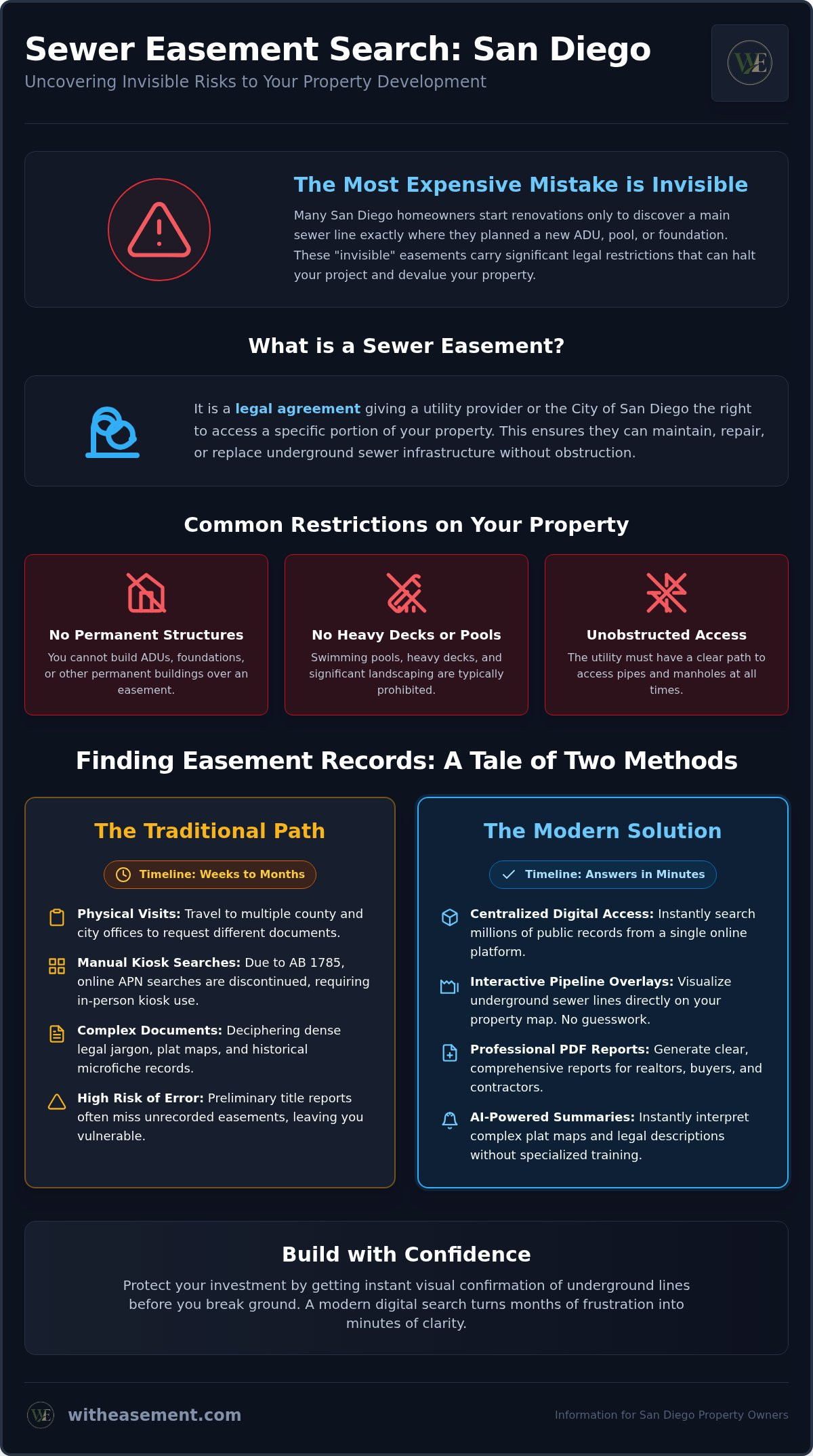
A sewer easement is a legal agreement that gives a utility provider or the City of San Diego the right to use a specific portion of your land. This access is strictly for maintaining, repairing, or replacing underground sewer infrastructure. If you're wondering, What is a Sewer Easement?, it's essentially a shared space where your ownership meets public utility needs. These exist to ensure that the city can service main lines without having to demolish structures or navigate around permanent obstacles.
One common frustration for homeowners is that these easements aren't always listed on a standard grant deed. They often live in the fine print of plat maps or within historical documents at the Assessor's office. This is why a thorough driveway easement search San Diego is so critical during the due diligence phase of a home purchase. Missing an easement could mean buying land you can't actually build on. It directly impacts your property's development potential and, by extension, its market value.
Public vs. Private Sewer Easements
In San Diego, you'll encounter two main types of sewer easements. Public Utility Easements (PUE) are the most common; these are managed by the City or County for large-scale main lines. Private easements, however, are shared agreements between neighbors. You'll often find these in older San Diego suburbs where one neighbor's line runs through another's yard to reach the street. When you run a driveway easement search San Diego, your results will typically specify the grantee. This tells you if you're dealing with the municipality or a private party.
Common Restrictions for San Diego Homeowners
Living with a sewer easement means accepting certain limitations on your backyard dreams. The most significant restriction is the prohibition of permanent structures. You cannot build ADUs, swimming pools, or heavy decks over an easement area. The City requires a clear, unobstructed path to reach manholes and pipes at a moment's notice. If you build without a recorded encroachment permit, you face the very real risk of mandatory removal at your own expense. Always verify the exact boundaries before you break ground to avoid these costly legal entanglements.
Where Sewer Easement Records are Stored in San Diego
Finding easement data in San Diego requires knowing which government department to approach. Records aren't stored in a single, convenient folder; instead, they're distributed across multiple departments. The county's official record-keeping office serves as the primary repository for recorded legal documents. If an easement was officially granted and signed, it lives here. However, for technical details like pipe depth or specific material, you often need to consult the City of San Diego Development Services Department (DSD).
Don't rely solely on a preliminary title report from your escrow company. These reports focus primarily on financial liens and clear ownership. They frequently miss unrecorded easements or utility rights established through historical use. To get a true visual of your property's constraints, you need a Plat Map. This map provides the spatial context that a text-heavy deed lacks. It's the difference between reading a legal description and actually seeing where the line cuts across your yard.
Leveraging Property Parcel Numbers
The local property assessment office uses Assessor Parcel Numbers (APNs) to catalog every square inch of the county. While these maps are excellent for identifying property boundaries, they have significant limits. They show where an easement exists but rarely pinpoint the precise location of the pipe underground. As of December 9, 2024, online APN searches in the publicly accessible recorded documents have been discontinued due to Assembly Bill 1785. You now need to visit in-person kiosks at designated county record-keeping office locations to perform these manual searches. This shift makes a digital driveway easement search San Diego even more valuable for homeowners who want to skip the commute.
Digital vs. Physical Records
San Diego's record-keeping history creates a digital divide. For properties built after 2003, tools like OpenDSD and Accela offer relatively easy access to permit maps. However, older neighborhoods often fall under the 1955 Rule. Records from the mid-20th century or earlier may only exist as physical microfiche or hand-drawn as-built plans stored at City Hall. If you're performing a driveway easement search San Diego for a historic property, expect to spend more time digging through these analog archives. There's often a gap between what was recorded in a deed and the as-built infrastructure, as pipes may have shifted during installation decades ago.
The Traditional vs. Modern Search Method
The speed of a San Diego real estate transaction often hinges on the accessibility of data. Missing a sewer easement can stall a closing or kill a development deal entirely. A comprehensive driveway easement search San Diego is no longer just about finding a piece of paper; it's about speed and precision. Choosing between traditional manual research and modern digital tools determines how quickly you can move from curiosity to construction. While government offices provide the raw data, the method you use to access it impacts both your timeline and your accuracy. In a fast-moving market, waiting for a records clerk is a luxury most professionals can't afford.
Manual research is notoriously prone to human error. Interpreting a text-based legal description without a visual reference is difficult even for seasoned engineers. If you misread a single coordinate or skip a line in a 70-year-old deed, you might miss a critical encumbrance. This oversight can lead to building over a main line, resulting in expensive mandatory removals later. A modern driveway easement search San Diego eliminates this guesswork by translating dense text into clear, visual data points on a map. It replaces "best guesses" with verified, visual intelligence that anyone can understand.
The 'Old Way' of Easement Research
The traditional method involves significant friction and logistical hurdles. You must often schedule an appointment with the City of San Diego Development Services Department or visit an ARCC kiosk in person. Since online APN searches were discontinued in December 2024, the "old way" now requires a physical commute for many property lookups. You'll spend hours navigating complex record indexes and paying $0.30 per page for physical copies of public records. This process is slow, expensive, and often leaves you with more questions than answers as you try to decipher hand-drawn maps from the mid-century era.
The 'New Way': Instant Map Overlays
Technology has transformed property intelligence into an instantaneous, user-friendly experience. Instead of waiting days for a records clerk to return your call, you can now use San Diego interactive property maps to see exactly where sewer lines and easements sit. Platforms like WithEasement centralize data from city, county, and state sources into a single, intuitive interface. You get immediate visual confirmation through pipeline overlays, allowing you to identify building restrictions before they become legal nightmares. For realtors and contractors, the ability to generate a professional PDF report in minutes builds immediate trust. It turns a complex legal hurdle into a simple, shareable insight that keeps projects moving forward without delay.
Step-by-Step: Conducting a Sewer Easement Search in San Diego
Successful property research starts with the right identification. You must first secure the property’s Assessor Parcel Number (APN) or full street address. Once identified, you can access the County Recorder’s index to pull specific "Easement" or "Right of Way" deeds. Even if your primary goal is a driveway easement search San Diego, you must specifically look for sewer-related encumbrances to avoid catastrophic utility damage. These documents provide the legal framework for who can access your land and for what purpose.
Finding Your APN Fast
Your annual property tax bill is the most direct source for your APN. If that isn't available, using a dedicated San Diego property easement search platform allows you to find this "key" using just a street address. Accuracy is vital here. San Diego uses a specific 10-digit format for parcel numbers. Common mistakes, such as omitting the hyphens or the final two zeros, often trigger "no record found" errors in government databases.
Interpreting the Plat Map
The Plat Map is where legal text becomes a visual guide. Look for dashed lines and specific abbreviations like "S.E." (Sewer Easement) or "M.B." (Map Book references). The map will often list a "width" in feet, which dictates your building setbacks. It's important to recognize the distinction between an easement search vs land survey in San Diego. A search tells you what is recorded in the halls of records, while a survey involves a professional physically staking the boundaries on your property.
After pulling the maps, verify the data against the City’s "as-built" records. These documents reveal the exact depth and diameter of the sewer pipes. This technical step is necessary because the legal easement width doesn't always account for the physical space required for heavy machinery to perform repairs. Analyze these results to ensure your project doesn't violate encroachment limitations or access requirements. To simplify this complex process and get a professional report in seconds, access our San Diego easement search tools today.
Why Professionals Use WithEasement for San Diego Research
Real estate professionals in San Diego can't afford to lose days to bureaucratic bottlenecks. Navigating fragmented government portals is a significant time-sink that stalls deals and delays construction. WithEasement solves this by centralizing City, County, and State data into one intuitive interface. You can perform a driveway easement search San Diego and get visual results in seconds. This eliminates the need to cross-reference disparate maps and deeds manually. It turns a week-long research project into a few simple clicks.
Speed is your ultimate competitive advantage in the San Diego market. While competitors are still trying to secure a records appointment at the DSD, you’ve already completed your risk analysis. Our platform lets you see sewer easements layered directly over flood zones and pipeline overlays. This multi-layered view reveals environmental and infrastructure risks that standard deeds often miss. Use a thorough driveway easement search San Diego to protect your investment and move projects forward with confidence. You’ll have the intelligence you need to make fast, accurate decisions every time.
AI-Powered Property Insights
Dense legal documents are often the biggest hurdle in property due diligence. Our AI Summaries feature scans recorded deeds and extracts critical clauses automatically. It translates complex legal jargon into plain English that anyone can understand. This helps you identify restrictions that could lead to common property disputes in San Diego before they escalate. By viewing sewer records alongside HOA data, you see the full picture of a property’s legal obligations. You'll know exactly where you can and cannot build without needing a law degree.
Professional Reporting for Realtors
For realtors and developers, speed and transparency are essential for building trust with clients. Providing a potential buyer with a Professional PDF Report during a listing presentation demonstrates immediate authority. These reports go beyond simple sewer lines; they assist in assessing property flood risk in San Diego. Having this data at your fingertips allows you to justify property values with concrete evidence. It empowers buyers to visualize development potential without the fear of hidden encumbrances or surprise infrastructure costs.
Master Your Property Intelligence with Modern Tools
Building or buying in San Diego requires more than a casual glance at a deed. You've learned that sewer easements dictate exactly where you can place a pool or ADU. Ignoring these legal boundaries leads to expensive mandatory removals and project delays. Whether you're conducting a driveway easement search San Diego or locating main utility lines, the traditional manual method is simply too slow for today's market. You need instant visual confirmation to move your project forward safely.
Don't let hidden infrastructure stall your plans or drain your budget. High-level property intelligence is now within reach without requiring a trip to a government kiosk. You can visualize complex data instantly and share professional reports with your contractors or clients in minutes. Professional-grade research is no longer reserved for specialists with years of training.
Unlock San Diego property data with a WithEasement Membership to access comprehensive San Diego County data and interactive maps with multi-layer overlays. Our AI-powered property summaries do the heavy lifting by translating dense legal jargon into actionable insights. Take control of your property research today and build with total confidence.
Frequently Asked Questions
How do I find my sewer cleanout in San Diego?
Sewer cleanouts are typically located near the foundation of your home or at the property line. In San Diego, look for a 4-inch pipe with a black or white plastic cap at ground level. If it's buried, you can consult the City’s as-built records to see where the lateral connection was originally installed. Knowing this location is vital before starting any landscaping or driveway projects to ensure you don't accidentally cover critical access points.
Can I build a fence over a sewer easement in San Diego?
You can usually install a fence over an easement, but it must be designed for easy removal. Most San Diego encroachment permits require removable panels so utility crews can access the underground line without destroying your property. If you install permanent footings or a masonry wall without approval, the City has the legal right to remove it at your expense during maintenance or emergency repairs.
What is the difference between a public and private sewer easement?
Public easements are managed by the City or County for large-scale main lines that serve the community. Private easements are shared agreements between neighbors, often found in older San Diego suburbs where one home's line crosses another’s yard to reach the street. Performing a driveway easement search San Diego will help you identify the grantee and understand whether you're dealing with a municipality or a private party.
How much does it cost to get a copy of an easement record from the County?
Under the California Public Records Act, the fee for a paper copy is $0.30 for the first single-sided page. Keep in mind that as of December 9, 2024, online APN searches were discontinued in San Diego County. You must now visit an ARCC kiosk in person for manual research and retrieval. A driveway easement search San Diego performed through modern digital platforms can save you the commute and these administrative hurdles.
What happens if I build over a sewer line without a permit?
Building over a line without an encroachment permit puts your project at risk of mandatory removal. If the City needs to access the pipe for an emergency repair, they can demolish unpermitted decks, ADUs, or sheds without compensating you. You may also face significant code enforcement fines and complications when you eventually try to sell the home. Always verify the easement boundaries before you break ground.
Does a sewer easement ever expire in San Diego County?
Most sewer easements are perpetual and "run with the land," meaning they don't expire when the property changes owners. They remain a permanent part of the property's legal record unless they are formally vacated by the City or County. This process is rare and usually only happens if the utility infrastructure is completely relocated. You should assume any recorded easement you find is still active and enforceable.
How can I tell if my property has a 'prescriptive' sewer easement?
Prescriptive easements are established through long-term, open use rather than a signed deed. If a neighbor’s sewer line has crossed your property for decades, it may have a legal right to remain there even if no record exists. These "hidden" encumbrances are difficult to find in standard deeds. You’ll often need a professional land survey or a specialized property intelligence report to identify these unrecorded rights and potential disputes.
Where can I find a map of all sewer lines in San Diego?
The City of San Diego Development Services Department manages the official GIS data for public sewer mains. However, finding maps for private laterals requires digging into historical permit records and as-built plans. Digital property intelligence tools provide interactive pipeline overlays that combine multiple government data sources. This allows you to visualize underground infrastructure directly on your property map without the need for an in-person appointment at City Hall.


