

In June 2026, a San Diego homeowner discovered that a hidden utility easement effectively blocked their ADU project, turning a planned revenue stream into a legal headache. You already know that local real estate is a high-stakes game. With the median home price reaching $1,085,000 this year, the financial margin for error has disappeared. Identifying common property disputes San Diego buyers and owners encounter is no longer just about reading a basic title report. It requires a modern, data-driven approach to due diligence.
We'll help you identify and mitigate these frequent legal battles using a clear risk analysis framework. This guide provides a 2026 checklist to help you spot hidden easements, navigate new HOA laws like the SB 326 balcony inspection requirements, and resolve boundary conflicts before they reach a courtroom. You'll learn how to accelerate your research, unlock hidden property data, and protect your investment with effortless efficiency. By the end of this article, you'll have the tools to visualize property risks and avoid the friction of unexpected litigation.
Key Takeaways
- Understand why San Diego's coastal geography and high market values create a unique environment for complex legal battles.
- Identify the "Big Three" common property disputes San Diego homeowners encounter: easements, boundary line conflicts, and HOA litigation.
- Implement a 5-point risk analysis checklist to verify APN accuracy and uncover recorded easements before they block development.
- Use interactive maps to visualize environmental risks like flood zones and high-pressure pipeline overlays.
- Leverage AI-powered summaries and instant PDF reports to perform faster, more reliable due diligence on any local parcel.
Navigating the San Diego Property Dispute Landscape
Property disputes are legal disagreements regarding ownership, usage rights, or land boundaries. In San Diego County, these conflicts take on a unique intensity due to high property values and complex coastal geography. When the median home price reached $1,085,000 in June 2026, the financial stakes for every square foot became massive. A single missed easement can stall a $2M escrow or prevent a developer from breaking ground. Ignorance of these recorded limitations doesn't just cause delays; it leads to expensive litigation that can last for years. Understanding common property disputes San Diego buyers face is the only way to safeguard a real estate investment.
Why Real Estate Disputes are Rising in 2026
Several factors are driving a surge in local property litigation this year. San Diego's aggressive push for urban infill has led to a boom in Accessory Dwelling Unit (ADU) construction. As owners maximize their lot usage, they often encounter forgotten utility lines or neighbor encroachments. The July 2026 rollout of SB 79, which overrides local zoning for high-density housing near transit, has also created friction between state mandates and local property rights. Additionally, aging infrastructure is forcing utility companies to exercise long-dormant easement rights. These shifts mean that yesterday's quiet backyard is today's legal battlefield. Digital-first intelligence has become the primary defense for realtors and investors who need to see these risks clearly.
The Role of Property Risk Analysis in San Diego
Risk analysis is the proactive search for encumbrances and legal vulnerabilities before a purchase is finalized. It moves beyond the surface-level checks of a standard title search. Traditionally, this required manual research at the San Diego County Assessor’s office, where filing fees and paperwork created significant friction. Today, professionals use a San Diego interactive property map to unlock data instantly. This intelligence helps identify potential adverse possession risks, where long-term usage by a neighbor could lead to a loss of title. By verifying parcel boundaries and recorded easements through a centralized platform, you can perform due diligence in minutes rather than weeks. This transition from reactive litigation to proactive analysis is essential for anyone navigating the 2026 market.
The 'Big Three' Disputes: Easements, Boundaries, and HOAs
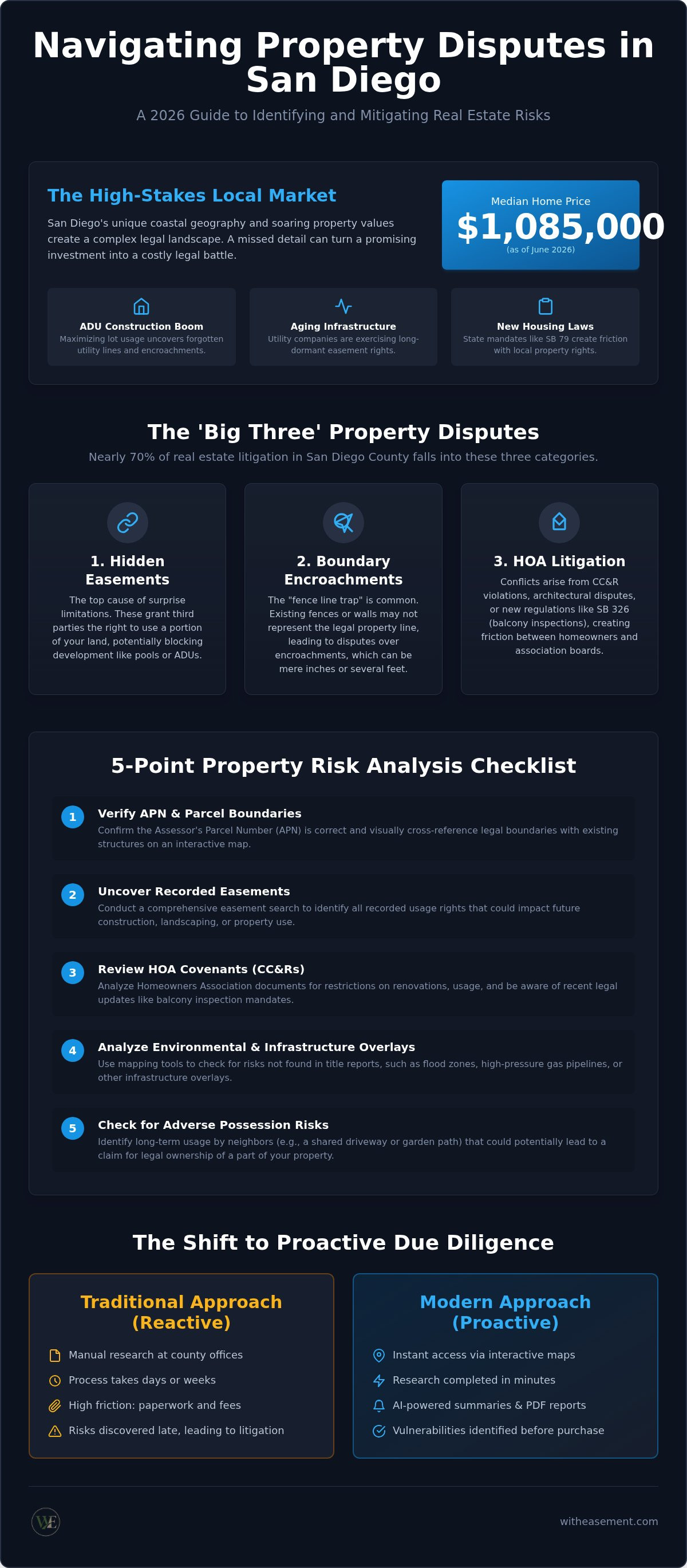
Nearly 70% of real estate litigation in the county involves just three categories: easements, boundaries, and Homeowners Associations (HOAs). These common property disputes San Diego residents face are often preventable with the right data. While the coastal views are clear, the legal entitlements beneath the soil are often murky. Missing a single recorded document can lead to years of legal friction, especially when governed by the broader framework of California Real Estate Law. Successful investors and homeowners prioritize identifying these risks during the due diligence period.
Hidden Easements and Usage Rights
Easements are the top cause of surprise property limitations in San Diego. They grant third parties, such as utility companies or neighbors, the right to use a portion of your land for specific purposes. You might encounter sewer lines under a proposed pool site or a private access path cutting through a backyard. A professional San Diego property easement search is non-negotiable for anyone planning a renovation or new build. It's vital to distinguish between recorded easements, which appear in public records, and implied easements that arise from long-term usage. Uncovering these early prevents development stalls and protects your lot's utility.
Boundary Encroachments in San Diego Neighborhoods
Boundary lines in older neighborhoods like Mission Hills or North Park are notoriously unreliable. Homeowners often fall into the "fence line" trap, assuming an existing fence marks the legal edge of their property. In reality, these structures frequently encroach on neighboring lots by several inches or even feet. In hilly areas like La Jolla, disputes over retaining wall maintenance can cost tens of thousands of dollars. Understanding the easement search vs land survey San Diego distinction is key. While a search identifies legal rights, a survey confirms physical placement. A WithEasement membership helps you start this process by visualizing parcel lines alongside recorded data.
HOA Governance and Compliance
HOA disagreements have intensified in 2026 due to new state mandates. The January 1, 2026, deadline for SB 326 balcony inspections has forced many associations to issue heavy special assessments. Buyers must know what to look for in HOA documents San Diego, including the most recent inspection reports required by SB 410. Undisclosed architectural violations or pending litigation against an association can block financing and lower property values. Reviewing the Covenants, Conditions, and Restrictions (CC&Rs) ensures your planned usage aligns with community rules. Clear data is your best defense against unexpected fines and assessment liens.
Analyzing Environmental and Infrastructure Risks
Environmental factors and underground infrastructure are often the catalysts for common property disputes San Diego neighbors face. While a lot may look perfect on the surface, what lies beneath or around it can trigger massive legal and financial liabilities. Soil movement, flood path changes, and utility corridors don't respect property lines. When these issues arise, they often lead to complex disagreements over repair costs and usage limitations. Proactive risk analysis means looking beyond the dirt to understand the hidden forces impacting your land.
Flood Risk and Coastal Vulnerability
San Diego’s topography creates two distinct flood challenges: coastal surges and canyon drainage. Coastal plains in areas like Imperial Beach face rising sea levels, while inland canyons in Mission Valley deal with flash drainage during heavy rains. You must assess property flood risk San Diego using current FEMA overlays before closing any deal. A high-risk designation can significantly spike your insurance premiums or even disqualify a property from certain mortgage programs. Visualizing these zones helps you understand exactly where water will flow, protecting your foundation and your investment.
Gas and Water Pipeline Overlays
Underground infrastructure is a silent deal-killer for many San Diego projects. High-pressure gas lines and major water mains often traverse residential lots without any visible markers. Relying on a "Call Before You Dig" ticket is a mistake; that happens far too late in the due diligence process. You need to identify SDGE infrastructure and major municipal lines during the feasibility period. These pipelines typically come with restrictive easements that prohibit permanent structures like ADUs or pools. Visualizing pipeline proximity ensures your development plans don't hit a literal and legal dead end.
Geological Hazards and Buildability
San Diego County is home to active fault lines and landslide-prone slopes that directly impact property stability. Areas like Mount Soledad have a well-documented history of soil instability that can lead to multi-neighbor litigation. When land shifts, shared structures like retaining walls or fences are often destroyed. This often brings California's Good Neighbor Fence Law into play as owners struggle to agree on shared repair costs. Understanding these geological risks is essential for determining long-term buildability and securing affordable insurance in a tightening market. Data-driven due diligence allows you to spot these hazards before they become your problem.
The 5-Point Property Risk Analysis Checklist
Mitigating common property disputes San Diego investors face requires a systematic approach. You can't rely on luck or a standard title report to catch every nuance. Instead, use this 5-point checklist to perform professional-grade due diligence in minutes. This process replaces hours of manual research and reduces the risk of expensive legal surprises after closing.
- Step 1: Verify APN and Parcel Boundary Accuracy. Ensure you're looking at the correct land rights by starting with the unique identifier.
- Step 2: Run a Comprehensive Recorded Easement Search. Identify who else has legal rights to use your land for utilities, access, or maintenance.
- Step 3: Analyze Infrastructure and Environmental Overlays. Visualize underground pipelines and flood zones that could restrict your building plans.
- Step 4: Audit HOA Status and Governing Documents. Review current assessments and CC&Rs to avoid unexpected fines or liens.
- Step 5: Generate an AI-Powered Property Summary for Review. Use modern tools to translate dense legal jargon into a clear, actionable report.
Executing the Search by Address or APN
Accuracy begins with the data source. While many start with a street address, searching by the Assessor’s Parcel Number (APN) is far more reliable. Addresses can be ambiguous, especially for multi-unit lots or new developments. To locate an APN in San Diego County, you can search by address on the County Assessor's public portal or find it on the property’s most recent tax bill. Once you have the APN, cross-reference plat maps with current satellite imagery. This reveals physical encroachments, like a neighbor’s shed or a misplaced fence, that don't appear on traditional paper records. It's a simple step that prevents massive boundary headaches later.
Interpreting AI Summaries and PDF Reports
Land records are notoriously difficult to read. They often contain archaic legal descriptions that confuse even seasoned investors. AI Summaries solve this by clarifying complex language and highlighting the most critical encumbrances instantly. This intelligence allows you to move faster than the competition. When you generate professional PDF reports, you gain a powerful tool for client presentations or price negotiations. If a report reveals a hidden utility easement that blocks a planned ADU, you can use that data to request repairs or a price reduction. In a market where manual searches at the County Recorder cost $14.00 for the first page alone, digital reports offer superior value and speed. You can start your risk analysis today to secure these insights before your next offer.
Using WithEasement to Mitigate Real Estate Legal Risks
Identifying common property disputes San Diego buyers face requires more than just a standard title policy. While title insurance is a reactive safety net that pays out after a problem starts, WithEasement provides a proactive intelligence platform to prevent the problem entirely. Manual due diligence in San Diego County is often slow and expensive. The current fee schedule for manual record searches starts at $14.00 for the first page of most titles, rising to $17.00 for fraud-related documents like Deeds of Trust. When you add the $75.00 SB 2 fee per instrument, the cost of manual research quickly compounds. WithEasement centralizes this data, offering a faster, digital alternative that fits the pace of the 2026 market.
Empowering Realtors with Professional Tools
Top-performing realtors use WithEasement to win more listings and protect their buyers from unforeseen liabilities. Instead of waiting days for a title officer to return a preliminary report, you can generate comprehensive PDF Property Reports in seconds. This allows you to provide "Property Intelligence" as a premium value-add service during initial consultations. By identifying hidden easements or pipeline overlays early, you significantly reduce your Errors and Omissions (E&O) insurance risk. Detailed reports also empower your clients to negotiate from a position of strength, using hard data to justify price adjustments or repair requests. It's about replacing guesswork with professional clarity.
Getting Started with WithEasement in San Diego
The platform is designed for effortless efficiency, acting as a bridge between dense public records and your daily workflow. You can search any local parcel by its street address or APN to unlock immediate insights. The interactive map allows you to toggle between critical data layers, including flood zones, pipeline overlays, and recorded easements. This visualization is essential for spotting risks that a text-only report might miss. Whether you're verifying a boundary for a new fence or auditing HOA documents for pending litigation, the information you need is now within reach. Start your risk analysis with a WithEasement Membership today.
By centralizing San Diego County easement searches, HOA data, and environmental overlays, WithEasement removes the friction from complex property research. You no longer need specialized training to interpret land records or spend hours at the County Clerk's office. The platform performs the heavy lifting of organizing information, presenting you with AI-powered summaries that highlight the most critical encumbrances. This modern approach ensures that common property disputes San Diego residents fear don't become part of your next transaction. Take control of your due diligence and protect your real estate investments with speed and accuracy.
Secure Your San Diego Real Estate Future
The 2026 market leaves no room for guesswork. Navigating common property disputes San Diego investors face requires a shift from reactive litigation to proactive intelligence. By applying the 5-point risk analysis checklist, you can identify hidden easements, verify boundary lines, and audit HOA compliance before signing a contract. Understanding underground infrastructure and environmental hazards isn't just about safety; it's about protecting your financial margin in a high-stakes environment.
WithEasement streamlines this process by centralizing exclusive San Diego County data. You can visualize flood zones and pipeline overlays on an interactive map while using AI-powered summaries to decode complex land records instantly. This level of professional clarity was once reserved for specialized intermediaries, but it's now available at your fingertips. Stop searching through fragmented public records and start making data-driven decisions today. Unlock Professional Property Intelligence with WithEasement and move forward with total confidence in your next property acquisition.
Frequently Asked Questions
What are the most common property disputes in San Diego County?
Disputes over easements, boundary lines, and HOA governance are the most common property disputes San Diego owners face in 2026. High property values and the surge in ADU construction have increased conflicts over shared driveways and utility access. You'll also see rising litigation regarding coastal flood risk and new state-mandated HOA balcony inspections. Identifying these issues early prevents costly legal battles that can stall developments for years.
How do I find recorded easements on my San Diego property?
You can find recorded easements by searching the San Diego County Recorder’s official records or using a centralized data platform. Traditional manual searches involve navigating complex indexes and paying per-page fees at the County Clerk's office. A digital Property Easement Search provides a faster alternative; it aggregates recorded documents into a single view. This allows you to identify utility corridors or private access rights without leaving your desk.
Can I build over a utility easement in San Diego?
Generally, you cannot build permanent structures like ADUs, pools, or garages over a utility easement. These areas must remain accessible for maintenance by entities like SDGE or municipal water departments. If you build without permission, the utility holder can legally remove the structure at your expense. Always check for recorded easements and verify clearance requirements with the specific utility holder before finalizing your architectural plans.
How do I check if a property is in a flood zone in San Diego?
Check a property's flood risk by using FEMA’s National Flood Hazard Layer or a localized interactive map. In San Diego, risk varies significantly between low-lying coastal plains and inland canyon drainage paths. Using a platform with flood zone overlays allows you to visualize exactly how these designations impact a specific parcel. This data is critical for securing mortgage approvals and determining if expensive flood insurance is required.
What should I do if my neighbor’s fence is on my property?
If a neighbor's fence encroaches on your land, start by reviewing your parcel map and hiring a licensed surveyor to confirm the legal boundary. California’s Good Neighbor Fence Law governs shared responsibilities for boundary structures; however, it doesn't grant neighbors the right to build on your land. Most owners resolve these issues through a lot line agreement or by moving the fence. Addressing encroachments early prevents future claims of adverse possession.
How can I find out who manages a specific HOA in San Diego?
Locating HOA management information typically requires searching the property’s CC&Rs or using a dedicated HOA search tool. In San Diego County, this data isn't always centralized in a single government database; it's often buried in the recorded documents from the original subdivision. Digital platforms can quickly identify the association name and current management contact. This is essential for verifying pending litigation or upcoming special assessments before you close escrow.
Is a property report from WithEasement the same as a title search?
A WithEasement report is a proactive intelligence tool, while a title search is a reactive legal record used for insurance. Title searches confirm ownership history and liens to facilitate a sale. In contrast, a property report focuses on visualizing usage risks like easements, flood zones, and pipeline overlays. It helps you identify deal-breakers during the feasibility period, long before a title officer issues a preliminary report.
What is an APN and why do I need it for a property search?
An Assessor’s Parcel Number (APN) is a unique identifier assigned to every piece of land in San Diego County. You need it because it's more accurate than a street address, which can change or be shared by multiple units. Using the APN ensures your property search pulls data for the exact legal boundaries of the lot. It's the most reliable way to unlock recorded easements and infrastructure overlays without errors.


